

Void Realm – 200µg LSD Blotter for Deep Psychedelic Immersion
Price range: $230.00 through $1,300.00
Explore the unknown with Void Realm – a 200µg LSD tab designed for deep psychedelic immersion, ego dissolution, and metaphysical exploration.
Void Realm LSD: History, Blotter Art, Dosage Claims, and Harm Reduction
Void Realm LSD refers to a well-known psychedelic blotter design historically associated with GammaGoblin. Historical listings commonly advertised tabs as containing 105 μg of LSD-25 made with “Aztec” crystal. Those specifications cannot authenticate modern blotters: artwork is reproducible, reagent tests are presumptive, and only quantitative laboratory analysis can establish dose or purity.
Void Realm LSD is a historically recognizable blotter design associated with the underground GammaGoblin label. Archived marketplace and community accounts commonly described Void Realm tabs as containing 105 μg of lysergic acid diethylamide (LSD-25) and using highly purified material marketed as “Aztec crystal.” These figures should be treated as historical claims unless supported by independent laboratory results. Void Realm’s distinctive psychedelic and reportedly double-sided artwork can help establish art provenance but cannot authenticate chemical contents. Ehrlich and Hofmann reagents provide presumptive screening information, not dose or purity measurements. Modern samples require chemical testing because recognizable blotter designs can be reproduced or counterfeited.
Introduction
Void Realm LSD occupies a specific place in discussions of underground psychedelic markets, blotter art collecting, and harm reduction education. The name refers to a blotter design and product identity historically connected to a vendor known as GammaGoblin, whose listings circulated on encrypted darknet markets during the 2010s and into the early 2020s.
Understanding Void Realm as a historical product requires separating three distinct categories of information: the artwork and visual identity of the blotter, the claimed chemical specifications associated with historical listings, and the methods available to evaluate any contemporary sample. These categories are frequently conflated in community discussions, which can create genuine safety risks.
This article examines what historical sources say about Void Realm LSD, how blotter art provenance relates to chemical authentication, and what testing methods are available to anyone who wants to evaluate an unknown substance before use. It does not endorse the acquisition, sale, or use of controlled substances.
Editorial Methodology
Historical marketplace specifications for Void Realm LSD are reported here as claims, not established facts. Pharmacological statements use scientific literature and government references. Chemical identification recommendations follow current drug-checking guidance from recognized harm reduction organizations. No visual feature of any blotter is treated as chemical authentication. Where primary documentation for a specific historical claim cannot be identified, the article retains qualified language rather than presenting the claim as verified.
What Is Void Realm LSD?
Void Realm LSD is the name of a psychedelic blotter design and historical underground product associated in online records with GammaGoblin. Historical sources commonly report an advertised 105 μg dose and “Aztec crystal” material, but those specifications are not transferable to modern look-alike blotters and require analytical evidence to verify.
Lysergic acid diethylamide, commonly known as LSD or LSD-25, is a semisynthetic hallucinogen derived from ergotamine, an alkaloid produced by the ergot fungus. It is classified as a Schedule I controlled substance under the Controlled Substances Act in the United States, meaning it has no currently accepted medical use under federal law and carries significant legal penalties. LSD acts primarily as an agonist at serotonin 5-HT2A receptors, producing perceptual, cognitive, and emotional effects that vary considerably by dose, individual physiology, set, and setting.
LSD has historically been distributed on absorbent blotter paper divided into individual unit-dose squares called tabs. The artwork printed on blotter paper serves both aesthetic and, historically, brand-identification purposes within underground markets.
Void Realm represents one documented example of a named, branded blotter release within this informal distribution system.
Void Realm LSD History: GammaGoblin and the Void Realm Brand
GammaGoblin was a vendor identity that built a reputation within darknet market communities over several years, primarily for selling LSD and related psychedelic products. The vendor became one of the more recognized names in those spaces, in part because of consistent branding, distinctive blotter artwork, and sustained community discussion of product quality.
Void Realm was one of several named releases associated with GammaGoblin. Another name linked to the same vendor is Goblin’s Den, which community sources describe as a separate design and, in some cases, a separate product specification. Archived marketplace discussions commonly attributed particular dose claims and crystal-type descriptions to specific named releases. Those attributions reflect seller representations and community reporting rather than independently verified analytical data.
GammaGoblin is generally reported to have ceased operations around 2023, though an exact verified date is difficult to establish without a preserved primary source. As with any discontinued underground product, the absence of an active vendor makes provenance verification of contemporary samples impossible through informal channels.
Void Realm LSD: Verified Facts vs. Historical Claims
For the purposes of this article, available information about Void Realm LSD falls into four distinct categories, each carrying a different level of evidential weight.
Documented historical record: Void Realm is a named blotter identity discussed in connection with GammaGoblin across archived darknet market forums and community platforms. The name, the associated artwork designs, and the vendor relationship are consistently reported across multiple independent community sources and constitute the strongest available historical record.
Historical seller claims: The commonly cited 105 μg dose and “Aztec crystal” purity designation originate in vendor listings and community reporting. They represent advertised product specifications, not independently verified analytical results. No publicly available batch-specific laboratory data has been identified to confirm these figures.
Community claims: Subjective experience reports, visual authentication attempts, and user comparisons between named releases appear widely in online forums. These reflect individual accounts and cannot establish chemical identity, dose, or purity.
Unknowns: The actual chemical contents, dose uniformity, and purity of any contemporary blotter presented as Void Realm are unknown without independent analytical testing.
Void Realm LSD can be verified historically as a named blotter identity discussed in connection with GammaGoblin, but its commonly cited 105 μg dose and “Aztec crystal” purity should be treated as historical product claims unless supported by batch-specific analytical records. Artwork can support print provenance; only chemical analysis can establish a sample’s contents.
Void Realm LSD Dosage: Historical Claims and Their Limits
Historical Void Realm LSD dosage claims most commonly cite 105 μg per tab. This figure appeared consistently enough across archived community sources to be considered the standard historical advertisement for this release. It represents an advertised historical specification, not a guaranteed property of the artwork.
Several important caveats apply.
Underground market dose claims are self-reported by vendors and are not subject to independent verification at the point of sale. A listing that states 105 μg reflects the seller’s representation, not a documented analytical result. Even if a batch was accurately dosed at production, consistency across an entire sheet cannot be assumed, as LSD distribution across blotter paper is not always uniform and individual tabs may vary in actual content.
Reagent tests cannot measure microgram dosage. Quantitative laboratory analysis is the only reliable method to determine the LSD content of an individual sample.
The commonly cited Voidrealm 105ug specification should therefore be understood as a historical marketing claim that may or may not reflect the contents of any particular blotter presented under that name today.
SAMHSA and established harm reduction organizations consistently advise against relying on seller claims to estimate the dose of any unverified substance.
Void Realm Aztec Crystal: What the Term Means
Aztec crystal is an underground-market term historically used for LSD material associated with GammaGoblin products. In underground market terminology, it referred to LSD in crystalline form described as very high purity. Some historical listings associated this material with purity claims approaching 99%.
These claims require careful evaluation. “Aztec crystal” is not a recognized pharmaceutical grade, an analytical chemistry standard, or a designation used by any regulatory or scientific body. It is an informal marketing term originating in an unregulated market. Claims of approximately 99% purity are meaningful only if supported by batch-specific laboratory data obtained through a validated analytical method such as high-performance liquid chromatography (HPLC) or liquid chromatography–mass spectrometry (LC-MS).
The United States Pharmacopeia defines purity standards for pharmaceutical substances through rigorous, validated testing protocols. No equivalent standard governs informal underground market claims, and no credible basis exists for accepting such claims without independent analytical confirmation.
Valid purity percentages require batch-specific quantitative laboratory analysis. The term “Aztec crystal,” like “needlepoint” and similar informal designations used in psychedelic communities, functions as a quality descriptor within a specific marketing context rather than as a verifiable specification.
Void Realm Blotter Art: Design, Back Art, and Provenance
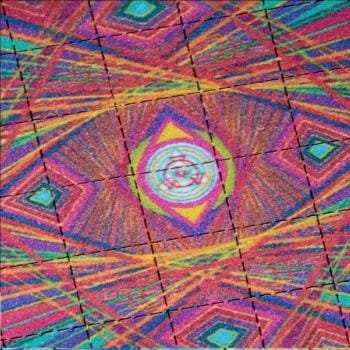
Void Realm blotter art is described in community sources as featuring psychedelic imagery consistent with the broader visual tradition of countercultural blotter design. Historical accounts describe the design as double-sided, meaning artwork was printed on both the front and back of the blotter sheet. The Void Realm back art design is one of the characteristics most frequently cited in community discussions as a potential authenticity marker.
The history of psychedelic blotter art is substantial and well documented. Collector and archivist Mark McCloud assembled one of the largest known collections of blotter art over several decades, and his work has been recognized as part of the broader history of psychedelic counterculture. The visual tradition draws on psychedelic, surrealist, and countercultural imagery dating to the 1960s and continues both as an underground market practice and a recognized art form.
Blotter art provenance concerns the ability to trace a print’s visual characteristics to a known historical design. This is relevant to collectors and researchers interested in documenting that history. However, art provenance has no reliable relationship to chemical content. A blotter that visually matches every documented characteristic of a historical Void Realm print may contain LSD at the stated dose, a different dose, no LSD at all, or a substituted compound.
Artwork, printing quality, the Void Realm back art design, tab dimensions, perforation pattern, paper weight, and color are useful as art-identification tools and nothing more in the context of chemical authentication.
Can Void Realm Tab Size or Back Art Prove Authenticity?
No. Tab size and back art design are among the physical characteristics most commonly cited by community members attempting to authenticate Void Realm blotters, but neither can establish chemical contents.
Standard blotter tabs are typically cut to approximately 6.35 mm (one-quarter inch) square perforations, though dimensions vary by producer and era. A tab that conforms to expected dimensions demonstrates only that it was cut to a familiar size, not that it contains any particular substance. Similarly, a blotter printed with the Void Realm back art design demonstrates only that someone reproduced that artwork. Printing equipment capable of producing double-sided psychedelic blotter art is not exclusive to any single producer.
Physical characteristics such as tab size, back art, paper weight, perforation spacing, and ink color address print provenance. They are entirely separate from the question of what chemical compound, if any, is present on the paper. Treating physical features as authentication evidence creates a meaningful safety risk, particularly when counterfeit or substitute blotters circulate under recognizable design names.
Can You Trust a Void Realm LSD Review?
Subjective experience reports, commonly called “trip reports” in online communities, cannot establish the identity, purity, or dose of a substance. This applies to Void Realm LSD reviews as much as to any other unverified blotter product.
A person consuming a blotter presented as Void Realm experiences the effects of whatever compound or compounds are actually present. Those effects reflect individual pharmacology, dose, set, setting, and the specific substance consumed. They cannot distinguish between, for example, 105 μg of LSD-25 and 80 μg of LSD-25 with a trace adulterant, or between LSD and a closely related ergoline compound at a comparable dose.
The pharmacological literature on LSD establishes that dose-response relationships vary substantially across individuals due to differences in receptor sensitivity, metabolism, and prior exposure. This means that even an accurately described subjective experience is not a reliable proxy for actual dose.
Community reviews of Void Realm LSD are useful as cultural documents and anecdotal accounts. They are not reliable as chemical identification or dose verification. A review praising a blotter’s effects is not evidence that the blotter contained what its label claimed.
Testing Void Realm LSD: Reagent Tests and Their Limitations
Reagent testing is the most accessible form of drug checking available outside of formal laboratory settings. It involves applying a small amount of a substance to a chemical reagent and observing the resulting color change against a reference chart.
Ehrlich Reagent
The Ehrlich reagent, based on p-dimethylaminobenzaldehyde in an acidic solution, reacts with indole-containing compounds to produce a characteristic color change. LSD-25 contains an indole ring structure and commonly produces a violet to purple reaction with Ehrlich reagent. A positive Ehrlich result indicates the presence of an indole-containing compound but cannot identify which compound is present, confirm LSD specifically, determine dose, or establish purity.
Ehrlich testing is recommended by harm reduction organizations as a first-line screening tool because a negative result — no color change where LSD is expected — is a meaningful warning sign. A tab that produces no Ehrlich reaction is unlikely to contain LSD or any other indole-containing psychedelic.
Hofmann Reagent
The Hofmann reagent is more selective than Ehrlich and can help distinguish LSD from certain other indole compounds. LSD is commonly associated with a blue color change in Hofmann reagent reference charts. Using Ehrlich and Hofmann together provides more information than either test alone, though the combination remains presumptive.
Marquis and Mecke Reagents
Marquis and Mecke reagents are more commonly associated with screening amphetamines, MDMA, and opioids. Their utility for LSD specifically is more limited than Ehrlich and Hofmann, but they can contribute information in a multi-reagent screening protocol, particularly when the possible presence of adulterants is a concern.
What Reagent Tests Cannot Determine
Ehrlich and Hofmann are presumptive drug-checking reagents. These reactions can support identification of compound class but cannot determine dosage, purity, Void Realm brand provenance, or guarantee that no additional compounds are present. Specifically, consumer color tests cannot:
- Confirm that LSD-25 is present to the exclusion of all analogues
- Determine the quantity or dose of any compound
- Measure chemical purity
- Establish provenance or brand authenticity
- Rule out all potential adulterants or co-occurring substances
DanceSafe provides accurate descriptions of what reagent tests can and cannot establish, along with purchasing information for testing kits and guidance on interpreting results.
Laboratory Testing: The Standard for Dose and Purity
Quantitative laboratory analysis is the only reliable method to determine how much LSD is present in a specific sample and whether other compounds are also present. This applies equally to Void Realm and any other unverified blotter.
Validated analytical methods include the following.
High-performance liquid chromatography (HPLC): Separates compounds in a mixture and quantifies them based on retention time and detector response. Widely used in pharmaceutical quality control and forensic drug analysis, HPLC is capable of both identifying LSD and measuring its quantity in a sample.
Liquid chromatography–mass spectrometry (LC-MS): Combines chromatographic separation with mass spectrometric identification, providing compound identification and quantification with high sensitivity and specificity. LC-MS is generally preferred over GC-MS for LSD analysis because it avoids the thermal conditions that can degrade the compound.
Gas chromatography–mass spectrometry (GC-MS): A combined separation and identification method widely used in forensic drug analysis. The DEA’s Special Testing and Research Laboratory uses GC-MS and related techniques in controlled substance identification.
Fourier-transform infrared spectroscopy (FTIR): Identifies compounds based on molecular absorption of infrared light. Used in some point-of-care drug-checking services for rapid screening.
Drug-checking services using these methods are available in some jurisdictions. DanceSafe provides harm reduction services and information on accessing drug-checking resources in the United States. The CDC’s drug overdose prevention resources and SAMHSA provide broader context on why accurate substance identification matters within the current drug supply environment.
Fake and Counterfeit Void Realm Blotters
Because Void Realm art is a reproducible design, counterfeit or imitation blotters represent a genuine practical concern. A blotter can be printed to resemble a historical Void Realm design without containing any authentic material, any LSD at all, or the dose historically associated with the original product. This risk is not unique to Void Realm: any recognized blotter design can be replicated by anyone with access to printing equipment and blotter paper.
Substances found on blotter paper in place of or alongside LSD include the following.
NBOMe compounds: 25I-NBOMe and 25B-NBOMe are potent 5-HT2A agonists active in microgram quantities. The DEA has documented NBOMe compounds as a significant public health concern, noting associations with serious adverse events and fatalities, particularly at higher doses. NBOMe compounds do not reliably produce a positive Ehrlich reaction, which is one reason a positive Ehrlich result on a blotter is interpreted as a reassuring though non-definitive screening outcome.
DOx compounds: DOC and related substituted phenethylamines have appeared on blotter paper. They have substantially longer durations and different risk profiles than LSD.
Other adulterants: The broader unregulated drug supply includes a wide range of compounds that may appear on blotter paper in varying quantities and combinations.
Fentanyl test strips, while designed primarily to detect fentanyl in other drug supplies, represent an additional harm reduction tool recommended by the CDC in the context of the broader opioid crisis.
Void Realm vs. Goblin’s Den
Void Realm and Goblin’s Den are separate blotter identities historically associated with GammaGoblin. Online reports attribute different dose specifications and, in some cases, different crystal-type designations to releases under those names. Community sources most commonly describe Goblin’s Den as a distinct design series rather than a variant of Void Realm.
Artwork and reputation cannot establish a chemical difference between these products. Reliable comparison requires documented historical records or analytical testing of authenticated samples from each release. Reputation-based comparisons circulating in online communities reflect subjective and unverifiable accounts. Neither name, design, nor claimed specification is sufficient to draw meaningful chemical or pharmacological conclusions in the absence of laboratory evidence.
Void Realm LSD: What Can Actually Be Verified?
Void Realm LSD can be verified historically as a named blotter identity discussed in connection with GammaGoblin across multiple archived community sources. Its commonly cited 105 μg dose and “Aztec crystal” purity designation are historical product claims that should not be treated as established facts without batch-specific analytical records.
The following summary reflects the current state of available evidence.
Verifiable: The Void Realm name, its association with GammaGoblin, and the general description of its artwork design are consistently documented across multiple independent community sources.
Claimed but unverified by independent analysis: The 105 μg dose, the “Aztec crystal” material description, and purity figures approaching 99%.
Not determinable from artwork: Chemical identity, dose, purity, and the presence or absence of adulterants in any contemporary sample.
Determinable only by laboratory analysis: The actual LSD content, purity percentage, and presence of any co-occurring compounds in a specific sample.
Artwork may document cultural provenance. Reagent or laboratory testing addresses chemical identity. Only suitable quantitative analysis can establish dose or purity.
Psychedelic Harm Reduction: Core Principles
Harm reduction is a public health approach that seeks to reduce the negative consequences associated with drug use without requiring abstinence as a precondition for assistance. Applied to psychedelics, it encompasses substance verification, dose awareness, environmental preparation, and access to support resources.
Key principles relevant to any unverified blotter substance include the following.
Test before use. Reagent testing provides limited but useful presumptive information. Laboratory analysis provides the most reliable information available. DanceSafe offers testing kits and guidance on their appropriate use.
Start with a lower dose than expected. If the actual dose of an unverified substance is unknown, beginning with a smaller amount reduces the risk of an unexpectedly intense experience. The pharmacological literature on LSD dose-response relationships supports conservative initial dosing with unverified material.
Set and setting matter. Research consistently supports the importance of psychological mindset and physical environment in shaping psychedelic experiences.
Have support available. Trusted companions and access to harm reduction resources reduce risk during any psychedelic experience.
Know crisis resources. SAMHSA’s National Helpline at 1-800-662-4357 provides free, confidential referrals and information for individuals and families facing substance-related concerns, available 24 hours a day, seven days a week. The Crisis Text Line is also available by texting HOME to 741741.
Organizations including DanceSafe, the Zendo Project, and MAPS publish harm reduction guidance relevant to psychedelic substances.
Legal Status of LSD
LSD-25 is a Schedule I controlled substance under the federal Controlled Substances Act in the United States. Possession, manufacture, and distribution are subject to significant criminal penalties under both federal law and the laws of all 50 states. No currently accepted medical use under federal law has been established for LSD, though clinical research through regulated protocols continues under DEA and FDA oversight.
The DEA’s LSD fact sheet provides current scheduling information and legal context. Individuals seeking information about legal psychedelic-assisted therapy research can consult MAPS or ClinicalTrials.gov for information on ongoing and completed studies.
This article is provided for educational and harm reduction purposes only. It does not constitute legal advice, medical advice, or encouragement to engage in any activity involving controlled substances.
Frequently Asked Questions
What is Void Realm LSD?
Void Realm LSD is the name of a psychedelic blotter design and historical underground product associated in online records with GammaGoblin. Historical sources commonly report an advertised 105 μg dose and “Aztec crystal” material, but those specifications are not transferable to modern look-alike blotters and require analytical evidence to verify.
How many micrograms are in a Void Realm LSD tab?
Historical listings commonly advertised Void Realm tabs at approximately 105 μg of LSD. This is an advertised historical specification, not a guaranteed property of the artwork. Reagent tests cannot measure microgram dosage; quantitative laboratory analysis is required to determine the LSD content of an individual sample.
What is Void Realm Aztec crystal?
Aztec crystal is an underground-market term historically used for LSD material associated with GammaGoblin products. It is not a recognized pharmaceutical grade or analytical chemistry standard. Claims of approximately 99% purity require batch-specific quantitative laboratory evidence.
Can you identify authentic Void Realm LSD from its blotter art?
No. Artwork can potentially establish that a print resembles a historical Void Realm design, but it cannot determine its chemical contents. Front-and-back printing, tab dimensions, perforations, paper weight, and color are art-provenance clues rather than evidence that LSD is present.
What does LSD do on an Ehrlich reagent test?
LSD commonly produces a violet to purple reaction with Ehrlich reagent because it contains an indole structure. The result is presumptive rather than definitive and cannot determine LSD dose, purity, Void Realm provenance, or the absence of all other compounds.
What does LSD do on a Hofmann reagent test?
LSD is commonly associated with a blue reaction in Hofmann reagent reference charts. Hofmann can complement Ehrlich testing, but no single consumer color test establishes purity, potency, or universal exclusion of LSD analogues and adulterants.
What is the difference between Void Realm and Goblin’s Den?
Void Realm and Goblin’s Den are different blotter identities historically associated with GammaGoblin. Online sources attribute particular doses and crystal-type descriptions to different releases, but reliable comparisons require contemporaneous records or independent analytical testing rather than artwork or reputation.
Are original Void Realm blotters still produced?
Void Realm is best treated as a historical product identity. Reports commonly indicate that GammaGoblin ceased operations around 2023, though an exact verified date requires a preserved primary source. Contemporary Void Realm artwork cannot establish that a sample is original stock.
Conclusion: What Void Realm LSD Can and Cannot Tell You
Void Realm LSD remains notable as a piece of psychedelic blotter history associated with GammaGoblin, a reported 105 μg specification, and the informal marketing term “Aztec crystal.” Its lasting harm reduction lesson is that branding is not analytical evidence. Artwork may document cultural provenance, while reagent or laboratory testing addresses chemical identity. Only suitable quantitative analysis can establish dose or purity.
Anyone encountering a blotter presented as Void Realm LSD today should treat the name and artwork as historical identifiers only, apply appropriate presumptive testing with Ehrlich and Hofmann reagents, and consider laboratory drug-checking services where available. The chemical contents of any unverified blotter are unknown until tested, regardless of how familiar the design appears.
62 reviews for Void Realm – 200µg LSD Blotter for Deep Psychedelic Immersion
Add a review
Related products


Judah Ellington (verified owner) –
Perfect for deep thought and creative expansion.
Kaitlyn Reed (verified owner) –
I didn’t think something so small could have such a big emotional impact. I’m still in awe.
Grant George (verified owner) –
This helped unlock something in me, and the trust I felt toward the provider only deepened the experience.
Isabella Bell (verified owner) –
I was amazed at how fast it arrived, and the experience itself was like pressing the reset button on my inner life.
Lily Cooper (verified owner) –
This allowed me to observe my thoughts without judgment. It changed how I speak to myself now.
Cameron James (verified owner) –
There’s something powerful about knowing your experience matters to the people providing it. That’s exactly how I felt here.
Willa Horton (verified owner) –
Like seeing your life in ultra-HD.
Joelle Whitmore (verified owner) –
My sense of self dissolved—in the best way.
Ledger Phelps (verified owner) –
I understood connection—not just intellectually, but physically.
Russell Vaughn (verified owner) –
I couldn’t believe how smooth the whole process was. No anxiety, just anticipation and deep transformation.
Amaya Bridges (verified owner) –
This was handled like a wellness experience, not just a transaction. I appreciate that more than I can say.
Jordan Rogers (verified owner) –
One of the most meaningful experiences I’ve had — and it started with a website that treated it all with respect.
Andrew White (verified owner) –
Helped me find a deep inner stillness. Like I met a calmer version of myself.
Joel Graham (verified owner) –
The experience wasn’t just visual — it was deeply emotional and grounding.
Gemma Ramsey (verified owner) –
This was life-shifting, and I’m beyond grateful for how carefully the product was handled.
Serenity Baldwin (verified owner) –
You can tell this is run by professionals. Every part of the order felt thoughtful, respectful, and reliable.
Raymond Joseph (verified owner) –
Everything about this felt intentional and deeply respectful. Shipping was silent and fast.
Talia Kearns (verified owner) –
I faced myself and felt peace.
Marley French (verified owner) –
A deeply emotional journey that was only possible because I knew I was in good hands.
Grant George (verified owner) –
The professionalism here is unmatched — respectful tone, fast replies, and packaging that made me feel at ease.
Meghan Landers (verified owner) –
The most beautiful introspection I’ve ever experienced.
Jayleen O’Connell (verified owner) –
So grateful to have found this experience.
Travis Brooks (verified owner) –
Fast, private delivery and emotional peace I didn’t know I needed.
Korbyn Whitfield (verified owner) –
Enhanced my connection with nature and life itself.
Troy Johnston (verified owner) –
The journey itself was transformative, and it helped so much knowing the source was trustworthy and experienced.
Alyssa Morris (verified owner) –
The come-up was smooth and warm, like slipping into a deep meditation.
Leif Carlisle (verified owner) –
I met my higher self—and we laughed.
Sarai Browning (verified owner) –
Felt like stepping outside the boundaries of language.
Reed Wilkins (verified owner) –
I finally understand what people mean when they say “life-changing.” This was that, and more.
Logan Flores (verified owner) –
Incredible introspective depth. I could finally hear my intuition clearly.
Cairo Templeton (verified owner) –
My thoughts were sharper, clearer, and beautifully layered.
Miley Brewer (verified owner) –
It made me appreciate silence in a way I never had before.
Isabella Bell (verified owner) –
There’s something beautiful about knowing you’re in safe hands — this experience gave me deep peace, and the process made me feel completely supported.
Kaiser Sloan (verified owner) –
Made me want to make art, write, sing, and cry.
Kaiser Sloan (verified owner) –
No chaos, no confusion—just expansive peace.
Peyton Ford (verified owner) –
Each moment felt sacred. I was fully immersed in a gentle sense of awe.
Estelle Baldwin (verified owner) –
Incredible visuals and zero paranoia—amazing quality.
Noa Beltran (verified owner) –
Everything I questioned became clear.
Demi Paul (verified owner) –
This felt like a mirror — one that only works when you’re truly ready. I’m thankful for the respectful way it was delivered.
Valerie Barrett (verified owner) –
I’ve tried different sources in the past, but none gave me this level of emotional depth and trust.
Boone Wylie (verified owner) –
Dreamlike, crystalline, and full of heart.
Joseph Martin (verified owner) –
These are people you can trust with a powerful tool. That matters more than anything.
Brooklyn Alexander (verified owner) –
I’m usually super anxious about buying anything online, especially this kind of thing. But this team made it feel secure and smooth.
Esme Brewster (verified owner) –
Everything was energy—and it was all good.
Robert Rodriguez (verified owner) –
There’s a real gentleness to how everything is handled. That energy transferred into the trip.
Jonathan Collins (verified owner) –
Hands down the best source I’ve come across. Quality, care, and customer support were all on point.
Jade Lambert (verified owner) –
Everything about this felt intentional and deeply respectful. Shipping was silent and fast.
Raymond Joseph (verified owner) –
The emotional clarity I got from this experience has stayed with me.
Kenneth Hale (verified owner) –
Wasn’t sure what to expect from an online order, but everything arrived quickly, safely, and without a single issue. The quality was beyond anything I’ve tried before.
Willa Houston (verified owner) –
I used this in a quiet space with my journal, and by the end, I felt like I had released months of tension.
Boone Wylie (verified owner) –
It made me a better listener, even to myself.
Dylan Flores (verified owner) –
This was the most human shopping experience I’ve ever had — the silence, the care, the power of the trip.
Avianna Navarro (verified owner) –
No body load, no weird crash. Just a clean, crisp ride.
Frida Benitez (verified owner) –
It was like remembering something ancient inside me.
Joyce Carson (verified owner) –
No stress, no confusion — just a beautifully smooth and thoughtful experience from start to finish.
Mira Leary (verified owner) –
Heightened creativity like nothing else.
Kaiser Sloan (verified owner) –
The clarity was unreal—I journaled for hours.
Zachary Baker (verified owner) –
These are people you can trust with a powerful tool. That matters more than anything.
James Jones (verified owner) –
This felt like more than a psychedelic journey. It felt like support from people who understand what real healing means.
Elle Valdez (verified owner) –
Beautifully handled from start to finish. Felt guided, not just sold to.
Serenity Baldwin (verified owner) –
There’s something powerful about knowing your experience matters to the people providing it. That’s exactly how I felt here.
Alexis King (verified owner) –
Fast, private delivery and emotional peace I didn’t know I needed.