


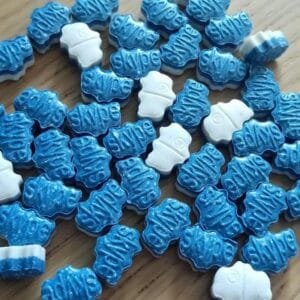
Blue & White Skype MDMA – 200mg High-Impact Tablets (100 Count)
$230.00
100 premium MDMA tablets dosed at 200mg each. Blue & White Skype delivers an ultra-potent, lab-tested empathogenic experience for advanced users.
MDMA Pill Testing and Harm Reduction: Adulteration, Testing, and Safety
MDMA Pill Testing and Harm Reduction: Quick Answer
MDMA pill testing and harm reduction can reduce uncertainty about illicit ecstasy, but no test can prove a pill is safe. Reagent tests provide presumptive information about compounds such as MDMA, fentanyl test strips screen for fentanyl-related targets, and laboratory methods such as GC/MS provide more specific identification.
Pill color, logo, shape, and seller claims cannot establish chemical composition, purity, or dose. Severe overheating, seizures, confusion, unconsciousness, chest pain, or abnormal breathing require emergency medical care.
Illicit ecstasy tablets and powder sold as MDMA (3,4-methylenedioxymethamphetamine) vary widely in actual composition, potency, and purity. A pill’s color, logo, shape, or a seller’s verbal assurance cannot reliably indicate what it actually contains.
Drug checking programs in the United States and internationally have documented that samples sold as MDMA or ecstasy frequently contain other substances, unexpected doses, or no MDMA at all. The exact prevalence varies by location, time period, sample source, and the analytical method used.
Harm reduction for MDMA involves multiple overlapping strategies: chemical field testing, laboratory drug checking services where available, recognizing warning signs of toxicity, and knowing when to seek emergency care. No single approach certifies that an illicit substance is safe to consume.
Even a sample correctly identified as MDMA can cause serious or fatal adverse effects depending on dose, individual health status, other substances present, and environmental conditions.
Why Pill Appearance Cannot Identify Contents
Attempting to identify a tablet by its color, logo, shape, or markings has no reliable scientific basis for illicit pressed pills. This approach is sometimes called press identification or pill ID, and public health agencies consistently advise against relying on it.
Illicit manufacturers can replicate the appearance of any tablet design. The same logo can be applied by entirely different producers using different ingredients, and copying a well-known press design is technically straightforward.
Drug checking programs have documented that visually identical pills from the same logo series can contain substantially different substances and doses across batches.
Surveillance data published by organizations such as DanceSafe and drug checking programs in the United States, Canada, and Europe consistently show that appearance-based identification fails to predict chemical composition. The Centers for Disease Control and Prevention has issued advisories noting that counterfeit and adulterated pills cannot be distinguished from other products based on appearance alone.
Ecstasy press identification risks are present regardless of how familiar or trusted a particular logo appears.
MDMA Purity vs. Potency: What Testing Can and Cannot Tell You
MDMA purity and potency are related but distinct concepts. Purity describes the proportion of a sample composed of the stated substance, such as what percentage of a tablet’s mass is actually MDMA. Potency refers to how much active MDMA a tablet contains in absolute terms, typically expressed in milligrams.
A tablet can contain MDMA without obvious adulterants and still pose significant danger because its MDMA dose is unexpectedly high. Conversely, a low-purity sample may contain a low dose of MDMA alongside other pharmacologically active substances that introduce their own risks.
Standard color reagent tests are qualitative rather than quantitative. They can indicate reactions consistent with certain chemical structures but cannot determine milligrams of MDMA, percentage purity, or whether every adulterant has been excluded. MDMA purity testing kits available for home use share this limitation.
Quantitative analysis requires laboratory instrumentation such as high-performance liquid chromatography (HPLC) or gas chromatography-mass spectrometry (GC/MS), which are not available as consumer field tools.
Understanding this distinction is central to harm reduction: a positive Marquis reagent result does not mean a pill contains a predictable or safe dose.
Common Adulterants and Contaminants in Ecstasy
Understanding what illicit ecstasy may actually contain is central to assessing risk. Drug checking programs have documented a range of substances in samples sold as MDMA or ecstasy, and the composition of the illicit drug supply changes over time and across regions.
High-Dose MDMA
Some tablets contain substantially more MDMA than a user expects based on prior experience. Doses significantly above what a person considers their normal range increase the risk of hyperthermia, cardiovascular toxicity, and serotonin toxicity in a dose-dependent manner.
A user accustomed to lower-potency pills who unknowingly consumes a high-dose tablet faces meaningfully elevated danger, particularly if they take more because the expected effect is delayed or absent.
PMA and PMMA
Paramethoxyamphetamine (PMA) and paramethoxymethamphetamine (PMMA) are stimulant adulterants that have been found in tablets sold as ecstasy. Both compounds have a slower onset of effect than MDMA, which can lead users to take additional doses while waiting for a response.
PMA and PMMA have a narrower margin between an active dose and a toxic dose compared with MDMA, and both are associated with hyperthermia and fatalities. The European Monitoring Centre for Drugs and Drug Addiction has documented multiple fatality clusters involving PMA and PMMA in ecstasy tablets across Europe.
Methamphetamine
Methamphetamine has been found in samples sold as ecstasy across multiple drug checking datasets. It produces pronounced cardiovascular effects and a distinct toxicity profile, and its presence is not detectable by visual inspection of the tablet.
Synthetic Cathinones
Synthetic cathinones are a class of novel psychoactive substances (NPS) that includes compounds such as mephedrone, methylone, and alpha-PVP. They have been documented in ecstasy samples in multiple countries.
Their pharmacology, potency, and adverse effect profiles differ from MDMA, and their presence substantially complicates risk assessment. The EMCDDA’s reporting on novel psychoactive substances provides updated surveillance on synthetic cathinone prevalence in the European drug supply, and similar contamination has been documented in North American datasets.
Fentanyl
Fentanyl contamination in the illicit drug supply has been documented across multiple substance categories, including pressed pills. Because fentanyl is pharmacologically active at microgram quantities, even small amounts of contamination present risk, particularly for people without opioid tolerance.
The CDC’s drug overdose surveillance data documents fentanyl’s expanding presence across illicit drug categories in the United States.
Sampling uncertainty is a real limitation when testing pressed pills. If a substance is not uniformly distributed throughout a tablet, testing one portion may not represent the composition of the whole. Drug checking researchers have noted this sampling challenge in published literature.
A negative fentanyl test result on part of a pill does not certify the remainder is free of fentanyl.
Other Substances
Drug checking programs have documented a range of additional adulterants in ecstasy samples, including caffeine, piperazines such as BZP, ketamine, and various research chemicals. The illicit drug supply is not standardized, and its composition varies by region and over time.
MDMA Potency and Adulteration: What Current Drug-Checking Data Show
Drug checking datasets from multiple programs provide useful context, though prevalence figures should be interpreted with attention to geography, collection period, sample size, and the analytical methods used.
DanceSafe’s drug checking results, drawn from samples submitted at events across the United States, have consistently shown variation in MDMA content ranging from no MDMA detected to high-dose tablets significantly exceeding typical recreational ranges. Their published results are available at DanceSafe’s drug checking page.
The Drug Enforcement Administration’s National Forensic Laboratory Information System (NFLIS) tracks substances identified in law enforcement drug seizures across the United States and provides annual reports on drug identification trends, including adulterants found alongside or instead of MDMA.
The Global Drug Survey publishes annual data on self-reported drug use patterns and perceived drug experiences across dozens of countries, providing population-level context on ecstasy potency perceptions and adverse event rates.
Internationally, drug checking programs such as The Loop in the United Kingdom and services operating in the Netherlands have published detailed compositional analyses of ecstasy samples. While these datasets reflect different supply chains than the United States, they illustrate the range of substances and doses documented in samples sold as MDMA globally.
What these datasets collectively show is that the illicit ecstasy supply is heterogeneous. Any individual pill’s composition and dose cannot be predicted from its appearance, source, or price, reinforcing the role of chemical testing as one component of evidence-based MDMA pill testing and harm reduction.
Reagent Testing for MDMA
Reagent testing for MDMA is a presumptive identification method, not a purity or dose test. Marquis, Simon’s, and Froehde reagents provide additional information when used together, but they cannot reliably rule out every adulterant or measure milligrams of MDMA.
Marquis Reagent
The Marquis reagent is an acidic solution that produces characteristic color reactions with certain chemical structures. MDMA generally produces a dark purple to black color reaction. This is presumptive evidence only: other amphetamine-class compounds can produce overlapping reactions, and the presence of multiple substances in a mixture can complicate interpretation.
To use the Marquis reagent, a small sample is placed on a white ceramic surface or testing plate. One to two drops of reagent are applied, and the color change is observed over approximately 30 to 60 seconds and compared against the manufacturer’s current reference chart.
The reagent solution is corrosive and should not contact skin. Reagents degrade over time and should be stored and replaced according to manufacturer instructions.
Simon’s Reagent
Simon’s reagent can help distinguish between MDMA and MDA (3,4-methylenedioxyamphetamine). MDMA generally produces a blue color reaction with Simon’s reagent, while MDA does not produce the same response.
This distinction matters because MDA has a different pharmacological profile and duration of action. Simon’s reagent is most informative when used alongside Marquis reagent rather than as a standalone test.
Froehde Reagent
The Froehde reagent reacts with a broader range of substances and can help identify some compounds not well-differentiated by Marquis alone. It has utility for detecting certain opioids and other substance classes.
When used as part of a multi-reagent protocol that also includes Marquis and Simon’s reagents, Froehde testing adds additional presumptive information about sample composition.
General Limitations of Reagent Testing
All color reagent tests share fundamental limitations. They are qualitative, not quantitative. Mixtures of multiple substances can produce overlapping or masked color reactions.
A result consistent with MDMA does not exclude the presence of other substances, including dangerous adulterants at concentrations below the test’s detection threshold. Reagents also degrade over time and must be stored properly and replaced before expiration.
Reagent Tests vs. Fentanyl Strips vs. FTIR vs. GC/MS: A Comparison
The following comparison summarizes what each testing approach can and cannot establish.
| Method | What It Can Detect | Quantitative? | Key Limitations | Availability |
|---|---|---|---|---|
| Marquis/Simon’s/Froehde reagents | Presumptive presence of substance classes such as MDMA, MDA, some opioids | No | Cannot rule out all adulterants; mixtures complicate results; no dose information | Consumer kits widely available |
| Fentanyl test strips | Fentanyl-related targets covered by the specific immunoassay | No | Does not detect most non-opioid adulterants; does not quantify fentanyl; some analogs may not be detected | Widely available through harm reduction programs |
| FTIR spectroscopy | Rapid identification of many major components | Semi-quantitative in some applications | Requires specialized equipment; mixtures can complicate spectra; not available as a consumer tool | Drug checking services and some harm reduction programs |
| GC/MS | Separation and identification of multiple compounds; high chemical specificity | Yes, with appropriate methodology | Requires laboratory equipment and trained personnel; not a field tool | Laboratory drug checking services |
No method available for consumer or field use can certify that a sample is safe to consume. Laboratory methods provide the strongest chemical characterization but remain subject to the detection limits and scope of the specific analytical protocol used.
Fentanyl Test Strips for Ecstasy
Standard MDMA reagent tests should not be relied on to detect trace fentanyl. Fentanyl test strips are a separate immunoassay and must be used according to the manufacturer’s validated instructions. A negative result reduces uncertainty for the tested sample but does not establish that a pill is free of every opioid or adulterant.
Fentanyl test strips are immunoassay-based lateral flow devices originally developed for urine drug screening. When used according to current harm reduction protocols, they can screen a prepared sample for fentanyl-related targets covered by the specific assay.
The dilution ratio and sample preparation method specified by the manufacturer matter for accurate results. Users should follow current preparation instructions rather than improvised protocols.
A negative result means fentanyl was not detected at the strip’s threshold in the tested portion of the sample. A positive result indicates presumptive fentanyl detection. Fentanyl test strips do not detect most non-opioid adulterants and do not determine how much fentanyl is present. Some fentanyl analogs may not be reliably detected by all strip formulations.
SAMHSA has published guidance recognizing fentanyl test strips as a harm reduction tool. Several state health departments have updated their policies to support access to fentanyl test strips, and current legal status varies by state. State-specific information is available through state health department websites and SAMHSA resources.
Laboratory Drug Checking Services
Laboratory-based drug checking provides more chemical specificity than home reagent testing. Techniques such as GC/MS separate and identify compounds in a sample, while FTIR can rapidly identify many major components. Capabilities and detection limits vary by method, and results should be interpreted according to what the specific analytical technique can establish.
GC/MS combines chromatographic separation with mass spectrometric identification, allowing simultaneous detection of multiple compounds with high specificity. HPLC can provide quantitative information about the concentration of identified substances. FTIR identifies substances based on their infrared absorption patterns and is used in some rapid drug checking programs because of its speed and versatility.
Drug checking services in the United States vary by location and availability. DanceSafe has historically offered drug checking at events and provides information on reagent testing resources at dancesafe.org. Some harm reduction organizations, syringe services programs, and public health programs offer drug checking or referral pathways. The National Harm Reduction Coalition provides a directory of harm reduction services at harmreduction.org.
Where to Find Drug Checking Services in the USA
Access to laboratory-based drug checking in the United States is not uniform and depends on local availability, funding, and program scope. The following resources represent verified starting points, though specific program availability changes over time and should be confirmed directly.
DanceSafe operates a national network and provides drug checking information at events. Their website lists current programs and resources.
The North American Syringe Exchange Network (NASEN) maintains a directory of syringe services programs across the United States, many of which offer harm reduction services including drug checking or referrals.
State and local health departments may operate or fund drug checking programs, particularly in areas with active drug surveillance initiatives. Contacting a local health department directly is an appropriate first step for identifying whether services exist in a specific area.
SAMHSA’s treatment locator at findtreatment.gov provides location-based information on substance use services, including harm reduction programs that may offer drug checking.
The availability and scope of drug checking services in the USA is an active area of public health development, and program offerings change as funding and policy evolve. Checking directly with local harm reduction organizations provides the most current information.
Toxicological Risks of MDMA
Understanding the medical risks associated with MDMA is essential context for any harm reduction framework. These risks exist even when a sample contains only MDMA without other adulterants and are substantially elevated by adulterants, high doses, drug interactions, and adverse environmental conditions.
Hyperthermia
MDMA impairs thermoregulation through multiple pharmacological mechanisms, including increased heat production from physical activity and altered autonomic responses. Physical exertion, warm or crowded environments, and high doses each increase the risk of dangerous overheating.
MDMA-related hyperthermia involves a rise in core body temperature to levels that can damage multiple organ systems. Sustained significant hyperthermia can cause rhabdomyolysis, acute kidney injury, and disseminated intravascular coagulation, and it is a leading cause of MDMA-related fatalities documented in clinical and forensic literature.
Emergency warning signs requiring immediate medical attention include marked agitation or confusion, extremely rapid heart rate, muscle rigidity, seizures, and loss of consciousness. Recognizing and responding to these signs promptly is a core component of emergency response to drug toxicity in MDMA-related settings.
Harm reduction approaches to hyperthermia risk include periodic rest in cool environments, avoiding sustained strenuous physical activity in hot settings, and monitoring companions for early signs of overheating.
Hyperthermia vs. Hyponatremia: How the Risks Differ
Hyperthermia is dangerously elevated body temperature. Hyponatremia is dangerously low blood sodium. Both can occur in association with MDMA and may produce overlapping symptoms including headache, nausea, confusion, seizures, or loss of consciousness.
Because the clinical presentations can overlap and both conditions can deteriorate rapidly, significant neurological symptoms or extreme overheating require emergency medical evaluation rather than self-management.
MDMA promotes antidiuretic hormone release, causing water retention. When this effect is combined with excessive fluid intake, blood sodium can be diluted to dangerous levels. Severe hyponatremia causes cerebral edema and can produce headache progressing to confusion, seizures, and death.
Current harm reduction guidance from organizations such as DanceSafe recommends moderate fluid intake for people who have used MDMA in physically active settings. Specific recommendations vary depending on body size, activity level, ambient temperature, and individual physiology. Users should consult current guidance from established harm reduction organizations rather than applying a fixed universal intake target, as both dehydration and overhydration carry risk in this context.
Serotonin Syndrome
MDMA causes substantial release of serotonin, dopamine, and norepinephrine. Serotonin toxicity occurs when serotonergic activity reaches dangerous levels in the central and peripheral nervous systems. It can occur with MDMA alone at high doses and is significantly more likely when MDMA is combined with other drugs that affect serotonergic systems.
Symptoms exist on a spectrum. Milder presentations include agitation, tremor, diaphoresis, and elevated heart rate. Severe serotonin toxicity involves hyperthermia, clonus, muscle rigidity, seizures, and altered consciousness, and it constitutes a medical emergency.
The Hunter Serotonin Toxicity Criteria, published in the Quarterly Journal of Medicine in 2003 and validated in subsequent research, provide a clinically applied framework for identifying serotonin toxicity that emergency providers use.
MDMA Drug Interactions
Combining MDMA with other substances substantially increases risk in ways that field testing cannot address.
Monoamine oxidase inhibitors (MAOIs) combined with MDMA carry a high risk of severe, potentially fatal serotonin toxicity. This includes both prescription MAOIs and certain substances with MAOI activity. This combination represents one of the most dangerous interactions documented in clinical toxicology literature and should be avoided categorically.
Serotonergic antidepressants, including SSRIs and SNRIs, interact with MDMA through multiple mechanisms. The clinical significance varies across individual agents, doses, and patient factors. Some interactions may reduce MDMA’s subjective effects while still presenting pharmacological risk. Anyone taking prescription medications that affect serotonin systems should consult a healthcare provider about drug interaction risks.
Lithium combined with MDMA has been associated with seizures in published case reports and warrants specific caution.
Stimulant combinations, including cocaine, amphetamine, or methamphetamine with MDMA, amplify cardiovascular strain and hyperthermia risk. Alcohol combined with MDMA can worsen dehydration and may impair recognition of early warning signs of toxicity.
Cardiovascular Effects
MDMA produces dose-dependent increases in heart rate and blood pressure through its stimulant actions. These effects are more pronounced when adulterants such as methamphetamine or PMA are present. Pre-existing cardiovascular conditions substantially increase the risks associated with MDMA use.
Neurotoxicity and Hepatotoxicity
Research in animal models and human neuroimaging studies suggests that heavy or repeated MDMA exposure may cause serotonergic neurotoxicity, with findings including reduced serotonin transporter density in some brain regions. The relationship between recreational dose patterns and human neurotoxicity remains an active area of research. NIDA’s summary of MDMA research provides an overview of current evidence.
Hepatotoxicity is a recognized potential adverse effect of MDMA, documented in case reports and case series, though the mechanisms and individual risk factors are not fully established.
Recognizing and Responding to MDMA Toxicity
Warning Signs of MDMA Overdose or Severe Toxicity
The following signs indicate a potential medical emergency and require calling 911 immediately: severe agitation or confusion, markedly elevated body temperature, muscle rigidity or uncontrolled rhythmic twitching (clonus), seizures, chest pain or markedly irregular heartbeat, loss of consciousness, and slow, labored, or stopped breathing.
Cardiovascular instability and altered mental status are among the most reliable indicators that a person requires immediate professional medical intervention.
If opioid overdose is also suspected because the person is unresponsive and breathing is abnormal or absent, naloxone should be administered if available while emergency services are contacted simultaneously.
Emergency Response to Drug Toxicity
For severe or rapidly worsening symptoms, call 911 immediately. Inform emergency responders about suspected MDMA use and any other substances or medications involved.
Many states have medical amnesty or Good Samaritan laws that provide some legal protection for people who call for help during a drug-related emergency. The scope of these protections varies by state and can be verified through local legal aid resources or state health department information.
If a person is overheating, move them to a cooler environment, remove excess clothing, and apply cool water or wet cloths to the skin while awaiting emergency services. If breathing has stopped and the person is unresponsive, begin CPR if trained to do so.
Poison Control
The Poison Control national helpline at 1-800-222-1222 is available 24 hours a day and can provide real-time guidance for suspected poisoning or drug toxicity in the United States.
Evidence-Based MDMA Pill Testing and Harm Reduction Strategies
Evidence-based MDMA pill testing and harm reduction integrates multiple strategies rather than relying on any single approach.
Chemical field testing with Marquis, Simon’s, and Froehde reagents provides more information than appearance alone, though it does not rule out all adulterants or determine dose. Fentanyl test strips address fentanyl specifically when used according to current validated preparation protocols. Laboratory drug checking, where accessible, provides stronger chemical characterization.
Avoiding combinations with MAOIs is a high-priority safety measure given the documented severity of that interaction. Interactions with serotonergic antidepressants and other prescription medications require individual consideration, ideally with a healthcare provider.
Starting with a small test amount and waiting to observe effects before considering any additional dose reduces the risk of unintentional high-dose exposure. This is particularly important given documented variability in tablet potency.
Periodic rest in cool environments, avoiding sustained physically intense activity in hot conditions, and monitoring companions for warning signs of overheating addresses hyperthermia risk. Following current harm reduction organization guidance on fluid intake addresses both dehydration and hyponatremia risk.
Knowing the warning signs of severe toxicity and being prepared to call emergency services immediately is fundamental. Informing a trusted person about substance use so they can monitor and respond is a practical harm reduction measure in real-world settings.
Frequently Asked Questions
How can you tell if an ecstasy pill is adulterated?
You cannot reliably identify adulteration from a pill’s color, logo, shape, taste, or a seller’s claims. Reagent tests provide presumptive chemical information, fentanyl test strips screen for fentanyl specifically, and laboratory drug checking offers substantially stronger evidence about a sample’s composition. No method available outside a laboratory can rule out all possible adulterants.
Can a reagent test tell you how many milligrams of MDMA are in a pill?
No. Standard color reagent tests are qualitative rather than quantitative. They can indicate reactions consistent with certain substances but cannot determine an exact MDMA dose, percentage purity, or whether every contaminant has been excluded. Quantitative analysis requires laboratory instrumentation such as HPLC or GC/MS.
How does a Marquis reagent test identify MDMA?
Marquis reagent produces characteristic color reactions with certain chemical structures. MDMA generally produces a dark purple to black reaction. This is presumptive evidence only, because other chemicals can produce overlapping reactions and mixtures can complicate interpretation. Marquis reagent is most informative when used as part of a multi-reagent protocol.
What are the warning signs of MDMA toxicity or overdose?
Warning signs that require emergency medical care include severe agitation or confusion, markedly elevated body temperature, muscle rigidity, clonus, seizures, chest pain, loss of consciousness, and abnormal or stopped breathing. Cardiovascular instability and altered mental status are particularly important emergency signals.
What are the symptoms of MDMA-induced hyperthermia?
MDMA-related hyperthermia can cause extreme overheating, heavy sweating, agitation, confusion, weakness, rapid heart rate, and eventually collapse or altered consciousness. Severe hyperthermia is a medical emergency because sustained high body temperature can damage multiple organs, including the kidneys, liver, and brain.
What should you do if someone shows signs of serotonin syndrome after MDMA?
Severe or rapidly progressing symptoms such as high temperature, confusion, muscle rigidity or clonus, seizures, or loss of consciousness require an immediate call to 911. Tell emergency responders about suspected MDMA use and any other drugs or medications involved. Do not leave the person alone while waiting for help.
Do fentanyl test strips detect fentanyl in ecstasy pills?
Fentanyl test strips can screen an appropriately prepared sample for fentanyl-related targets supported by the specific assay. They do not identify most non-opioid adulterants and do not determine how much fentanyl is present. Users should follow the manufacturer’s current validated preparation instructions. A negative result reduces uncertainty for the tested portion but does not certify the entire sample is fentanyl-free.
Can drug checking prove an MDMA pill is safe?
No. Drug checking reduces uncertainty but cannot certify an illicit pill as safe. Field tests have detection limitations, and even a sample correctly identified as MDMA can cause dose-dependent toxicity, drug interactions, hyperthermia, hyponatremia, and other serious adverse effects depending on the individual and circumstances.
Public Health Drug Advisories and Resources
Public health agencies and harm reduction organizations issue drug alerts when dangerous adulterants or high-potency batches are identified in local drug supplies. These alerts are among the most timely ways to receive updated information about specific risks in a geographic area.
The CDC’s drug overdose resources include public health surveillance data and health advisories related to drug supply threats. SAMHSA’s national helpline is available at 1-800-662-4357 for information on harm reduction, treatment, and recovery services. findtreatment.gov provides location-based access to substance use services across the United States.
DanceSafe publishes drug checking results, educational resources, and current drug alerts at dancesafe.org. State and local health departments are primary sources for geographically specific drug alerts and information on local harm reduction services, naloxone distribution, and drug checking availability.
Evidence and Sources
The following primary and authoritative sources inform this article. Readers and clinicians are encouraged to consult these resources directly for complete documentation.
- Centers for Disease Control and Prevention. Drug overdose surveillance and data. cdc.gov/drugoverdose
- National Institute on Drug Abuse. MDMA (Ecstasy/Molly) research summary. nida.nih.gov/research-topics/mdma-ecstasy-molly
- Substance Abuse and Mental Health Services Administration. Fentanyl test strips and opioid overdose prevention. samhsa.gov
- European Monitoring Centre for Drugs and Drug Addiction. PMA drug profile. emcdda.europa.eu/publications/drug-profiles/pma
- European Monitoring Centre for Drugs and Drug Addiction. Novel psychoactive substances. emcdda.europa.eu/topics/new-psychoactive-substances
- Dunkley EJC, Isbister GK, Sibbritt D, Dawson AH, Whyte IM. The Hunter Serotonin Toxicity Criteria: simple and accurate diagnostic decision rules for serotonin toxicity. QJM. 2003;96(9):635-642. pubmed.ncbi.nlm.nih.gov/12937585
- Drug Enforcement Administration. National Forensic Laboratory Information System (NFLIS). nflis.deadiversion.usdoj.gov
- DanceSafe. Drug checking results and harm reduction resources. dancesafe.org
- Poison Control. National Capital Poison Center. poisoncontrol.org
- National Harm Reduction Coalition. Harm reduction services directory. harmreduction.org
- North American Syringe Exchange Network. Syringe services program directory. nasen.org
- Global Drug Survey. Annual drug use research. globaldrugsurvey.com
Conclusion: MDMA Pill Testing and Harm Reduction
MDMA pill testing and harm reduction can reduce uncertainty about illicit ecstasy, but no available test can certify an illicit tablet as safe.
Pill appearance cannot establish composition or dose. Reagent tests are presumptive tools that provide directional information without quantifying potency or excluding every adulterant. Fentanyl test strips answer a separate and specific screening question and must be used according to validated protocols. Laboratory drug checking provides the strongest chemical characterization available but remains subject to the scope and detection limits of the specific methods used.
The most important safety priorities are understanding what each testing method can and cannot establish, avoiding unsupported assumptions about pill identity or potency, and treating severe overheating, seizures, altered consciousness, chest pain, or abnormal breathing as medical emergencies requiring immediate 911 contact.
10 reviews for Blue & White Skype MDMA – 200mg High-Impact Tablets (100 Count)
Add a review
Related products


Jamison Covington (verified owner) –
An emotional breakthrough like no other.
Jarvis Guy (verified owner) –
Trusted source, amazing journey.
Raya Dillard (verified owner) –
One of the most important nights of my life.
April Whaley (verified owner) –
Highly recommend for personal growth.
Rogelio Vincent (verified owner) –
Best MDMA I’ve had in a long time.
Harold Cho (verified owner) –
I felt truly seen—by myself and others.
Janae Morrow (verified owner) –
The connection was spiritual.
Cassidy Granger (verified owner) –
This experience changed how I view love and connection.
Cannon Lacy (verified owner) –
Pure connection with no fear.
Cassian Noel (verified owner) –
An emotional breakthrough like no other.