


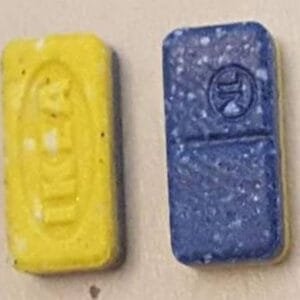
Blue & Yellow IKEA MDMA – 220mg Premium Release (50 Tablets)
$225.00
50-count pack of IKEA-stamped MDMA tablets dosed at 220mg for a bold, euphoric experience—crafted for experienced users and lab-tested for quality.
IKEA Ecstasy Pill Risks and Harm Reduction: What You Need to Know
IKEA Ecstasy Pill Risks and Harm Reduction
An IKEA-stamped ecstasy pill cannot be identified by its logo, color, or shape. Illicit press designs can be copied, so visually identical tablets may contain different substances or MDMA doses. Reagent tests provide presumptive chemical information but cannot measure dose. Laboratory drug checking provides stronger identification. Severe overheating, seizures, unconsciousness, chest pain, or abnormal breathing require emergency medical care.
Pressed ecstasy tablets bearing an IKEA logo or dual-color design circulate in the illicit drug market alongside many other branded pill types. Their appearance offers no reliable information about chemical composition, MDMA dose, or the presence of adulterants.
Illicit pill presses are widely available, and any manufacturer can reproduce a recognizable logo or color scheme. Tablets that look identical to a previously tested sample may have been produced by a different source at a different time with entirely different contents.
IKEA ecstasy pill risks and harm reduction center on this fundamental unpredictability. High-dose MDMA, dangerous substitutes such as PMA and PMMA, and other adulterants have all been documented in tablets sold as ecstasy. No visual feature of a pressed pill establishes what it actually contains.
What Are IKEA Ecstasy Pills?
IKEA ecstasy pills are illicitly pressed tablets stamped with a logo resembling the IKEA brand name or design. They often appear in yellow and blue, mimicking the retailer’s color scheme.
The name refers to the pill’s appearance only. It carries no information about chemical composition, manufacturing source, MDMA content, or safety. An IKEA stamp or yellow-and-blue design is not a chemical identifier. Press designs can be reused by unrelated manufacturers, and a laboratory result for one IKEA-stamped sample applies only to that analyzed sample, not to every visually similar pill.
This distinction is the core public health concern with IKEA ecstasy pill risks: a named or recognized press design creates a false impression of product consistency that does not exist in illicit manufacturing.
Why Pill Appearance Cannot Identify Contents
A pill’s logo, color, shape, or photograph is not a reliable indicator of its chemical contents. This applies to IKEA-stamped tablets and to every other branded ecstasy press.
Illicit manufacturers copy press designs freely. The same logo can appear on tablets from multiple producers using different formulations, doses, and materials. Drug checking programs have documented that visually identical pills from the same apparent logo series contain substantially different substances across batches, locations, and time periods.
Online pill identification databases sometimes list results for specific presses, but those entries reflect only the samples that were actually tested. A pill that resembles a previously catalogued sample may share no chemical similarity with it.
Ecstasy press physical identification is not a substitute for chemical testing. Appearance alone cannot establish safety, potency, or composition.
Historical Pill Alerts vs. Current Pill Identification
A public health drug alert issued for a specific IKEA-stamped pill applies only to the sample or batch that was tested. It cannot identify other pills with the same appearance.
When a drug checking laboratory analyzes an IKEA-branded tablet and publishes the result, that result describes one sample collected at a specific location and time. A different tablet with the same logo, color, and shape, obtained from a different source or at a later date, may have been pressed by an entirely different manufacturer using different ingredients.
This means historical ecstasy pill warning alerts, while useful for documenting what has existed in the supply, cannot serve as a current identification tool. The appropriate response to any named pill press is chemical testing of the specific sample in hand, not comparison with past alerts.
Dual-Color Ecstasy Tablets and Dose Variability
Some pressed ecstasy tablets are manufactured with two distinct colors, either as separate layers or as a bicolored design. This feature is sometimes interpreted as indicating a specific composition or dose, but that interpretation has no scientific basis.
Dual-color construction in illicit tablets is a manufacturing choice, not a quality indicator. It does not establish that the tablet contains a known quantity of MDMA or that the pill meets any content uniformity standard.
Variable dosing in pressed tablets is a documented concern in drug checking literature. Pharmaceutical-grade content uniformity cannot be assumed for illicit tablets. Cutting a tablet in half reduces its physical mass but does not establish the exact amount of MDMA or any other active substance in either piece.
High-Dose Pressed Ecstasy Pills: Risks and Context
High-dose pressed ecstasy pills are tablets containing substantially more MDMA than a user expects. Drug checking programs have documented wide variation in MDMA content across samples sold as ecstasy.
The European Union Drugs Agency publishes annual drug reports documenting trends in ecstasy tablet composition across Europe, including rising average MDMA content over successive monitoring periods. Their reporting provides country-level and aggregate data based on law enforcement seizure analysis and drug checking programs. Readers seeking specific sample-level data should consult the EUDA’s annual European Drug Report directly for current figures.
DrugsData, operated by the Erowid Center, publishes laboratory results for substances submitted by the public in the United States and Canada. Their database provides sample-level compositional data for pressed MDMA tablets, including cases where tested samples differed substantially from what sellers or users expected. Individual entries include the substance detected, quantitative results where available, analytical method used, and submission date.
High MDMA exposure increases the risk of hyperthermia, serotonin toxicity, cardiovascular complications, and seizures in a dose-dependent manner. A user accustomed to lower-potency pills who unknowingly consumes a high-dose tablet faces substantially elevated danger, particularly if they take additional doses because the expected effect seems delayed.
Ecstasy Pill Adulterants: PMA, PMMA, Fentanyl, and Stimulants
Drug checking data consistently show that the illicit ecstasy supply contains a range of substances beyond MDMA. The specific adulterants present vary by region, time period, and supply chain.
PMA and PMMA
Paramethoxyamphetamine and paramethoxymethamphetamine are stimulant compounds documented in ecstasy tablets. Both have a slower onset than MDMA, which can lead users to take additional doses before the initial dose takes full effect. PMA and PMMA have a narrower margin between an active dose and a toxic dose than MDMA, and both are associated with severe hyperthermia and fatalities.
The European Union Drugs Agency has documented multiple fatality clusters linked to PMA and PMMA contamination in ecstasy tablets. Their risk assessment profiles for these compounds describe the toxicological basis for their elevated danger relative to MDMA at comparable doses.
Methamphetamine
Methamphetamine has been identified in samples sold as ecstasy across multiple drug checking datasets. It produces pronounced cardiovascular stimulation and carries a distinct toxicity profile from MDMA. Its presence is not detectable by visual inspection of the tablet.
Synthetic Cathinones
Synthetic cathinones, including compounds such as mephedrone and methylone, have been documented in ecstasy samples in North America and Europe. Their pharmacological effects and toxicity differ from MDMA, and their presence in a tablet is not reliably detectable by standard reagent testing alone.
Fentanyl
Fentanyl contamination has been documented across the illicit drug supply, including in pressed tablets. Because fentanyl is pharmacologically active at microgram quantities, trace contamination presents meaningful risk, particularly for people without opioid tolerance. The CDC’s drug overdose surveillance program tracks fentanyl’s expanding presence across illicit drug categories in the United States.
A negative fentanyl test result applies within the performance and sampling limitations of the specific assay used. It does not certify a tablet as safe or free of fentanyl throughout.
Other Adulterants
Additional adulterants documented in ecstasy samples include caffeine, piperazines, and various research chemicals. The composition of the illicit drug supply is not static and changes over time and across regions.
Reagent Testing for Pressed Ecstasy Pills
Reagent tests provide presumptive chemical identification, fentanyl strips screen for fentanyl-related targets, and laboratory methods such as GC/MS or FTIR provide more specific chemical information. These technologies answer different questions. A favorable result from any single field test should not be interpreted as confirmation that an illicit tablet is safe.
Marquis Reagent
Marquis is a qualitative color reagent that can produce a reaction consistent with MDMA-like compounds. MDMA generally produces a dark purple to black color reaction. It cannot determine milligrams, establish purity, or reliably exclude every secondary substance. Quantitative MDMA measurement requires validated analytical laboratory methods.
To use the Marquis reagent, a small sample is placed on a white ceramic surface. One to two drops of reagent are applied and the color change is observed over approximately 30 to 60 seconds, then compared against the manufacturer’s current reference chart. The solution is corrosive and should not contact skin or eyes.
Simon’s Reagent
Simon’s reagent can help distinguish MDMA from MDA by producing a blue color reaction with MDMA but not MDA. This distinction is pharmacologically relevant because MDA has a different effect profile and duration of action. Simon’s reagent is most informative alongside Marquis reagent rather than as a standalone test.
Froehde Reagent
Froehde reagent reacts with a broader range of compounds and can provide additional presumptive information, including for some opioids. When used as part of a multi-reagent protocol with Marquis and Simon’s reagents, it reduces but does not eliminate uncertainty about sample composition.
Limitations of Reagent Testing
All color reagent tests are qualitative rather than quantitative. They cannot determine how much MDMA is present, establish purity, or reliably detect every adulterant. Mixtures of substances can produce overlapping or masked color responses. Reagents degrade over time and must be stored and replaced according to manufacturer instructions.
Fentanyl Test Strips for Pressed Ecstasy Pills
Standard MDMA reagent tests are not designed to detect fentanyl. Fentanyl test strips are a separate immunoassay tool and must be used according to the manufacturer’s validated preparation instructions.
Fentanyl test strips can screen a prepared sample for fentanyl-related targets covered by the specific assay. The correct dilution ratio matters for reliable results. A negative result means fentanyl was not detected at the assay’s threshold in the tested portion of the sample. A positive result indicates presumptive fentanyl detection.
Fentanyl test strips do not identify most non-opioid adulterants, do not quantify fentanyl, and may not detect all fentanyl analogs. A negative result does not certify a pill is safe or free of other dangerous substances.
SAMHSA has published guidance on fentanyl test strips as a harm reduction tool. Legal access varies by state, and current status can be confirmed through state health department resources.
What Each Drug Test Can and Cannot Answer
Reagent tests indicate presumptive substance class. Fentanyl strips screen for a specific opioid target. Laboratory analysis identifies and, with appropriate methodology, quantifies compounds. No field test answers all three questions simultaneously, and none can certify an illicit tablet as safe.
The following table summarizes what each testing approach can and cannot establish.
| Method | What It Can Detect | Quantitative? | Key Limitations | Availability |
|---|---|---|---|---|
| Marquis, Simon’s, Froehde reagents | Presumptive presence of certain substance classes | No | Cannot measure dose, cannot exclude all adulterants, mixtures complicate results | Consumer kits widely available |
| Fentanyl test strips | Fentanyl-related targets in the specific assay | No | Does not detect most non-opioid adulterants, does not quantify fentanyl, some analogs may not be detected | Available through harm reduction programs |
| FTIR spectroscopy | Rapid identification of many major components | Semi-quantitative in some applications | Requires specialized equipment, not a consumer tool, mixtures can complicate spectra | Some drug checking programs |
| GC/MS | Separation and identification of multiple compounds | Yes, with appropriate methodology | Requires laboratory equipment and trained personnel, not a field tool | Laboratory drug checking services |
Laboratory Drug Checking Services
Laboratory drug checking provides stronger chemical characterization than field reagent tests. Gas chromatography-mass spectrometry separates and identifies multiple compounds in a sample with high specificity. Fourier-transform infrared spectroscopy can rapidly identify many major components. High-performance liquid chromatography can provide quantitative concentration data with appropriate methodology. Each method has specific detection capabilities and limitations, and results should be interpreted according to the analytical technique applied.
DrugsData, operated by the Erowid Center, publishes laboratory results for substances submitted by the public and is one of the most accessible databases of analytical drug checking results for pressed tablets in the United States and Canada.
DanceSafe provides drug checking at events and offers reagent testing resources and harm reduction education. Their published results document compositional variability in samples sold as MDMA.
The North American Syringe Exchange Network maintains a directory of syringe services programs, many of which offer harm reduction services including drug checking or referrals. State and local health departments may also operate or fund drug checking programs. SAMHSA’s treatment locator provides location-based information on substance use and harm reduction services across the United States.
MDMA Purity vs. Potency
Purity and potency are related but distinct concepts. Purity describes the proportion of a sample that consists of the stated substance. Potency refers to the absolute amount of active MDMA a tablet contains, typically expressed in milligrams.
A tablet can contain MDMA without obvious adulterants and still present significant risk because its dose is unexpectedly high. A low-purity tablet may contain a lower MDMA dose alongside other pharmacologically active substances that introduce their own hazards.
Standard reagent tests cannot establish either value. Quantitative measurement requires validated laboratory analysis.
Toxicological Risks of High-Dose MDMA
Hyperthermia
MDMA impairs thermoregulation through multiple pharmacological mechanisms. Physical exertion, warm environments, and high doses each elevate the risk of dangerous overheating.
Sustained hyperthermia can cause rhabdomyolysis, acute kidney injury, and disseminated intravascular coagulation. Hyperthermia is documented as a leading cause of MDMA-related fatalities in clinical toxicology literature, including in the forensic case series and clinical reviews indexed through PubMed.
Emergency warning signs include marked agitation or confusion, extremely rapid heart rate, muscle rigidity, seizures, and loss of consciousness. These require immediate emergency medical attention.
Hyperthermia vs. Hyponatremia: How the Risks Differ
Hyperthermia means dangerously elevated body temperature. Hyponatremia means dangerously low blood sodium. Both can occur in association with MDMA and can cause confusion, seizures, or loss of consciousness. Excessive water intake can worsen hyponatremia, while MDMA, exertion, and environmental heat can increase hyperthermia risk. Severe symptoms require emergency evaluation.
MDMA promotes antidiuretic hormone release, which causes water retention. When this effect combines with excessive fluid intake, blood sodium can be diluted to dangerous levels. Severe hyponatremia causes cerebral edema and can progress from headache to confusion, seizures, and death.
Because the two conditions can present similarly and both can deteriorate rapidly, significant neurological symptoms or extreme overheating require emergency medical evaluation rather than self-management.
Harm reduction guidance from organizations such as DanceSafe recommends moderate fluid intake in physically active settings. The appropriate amount varies by body size, activity level, and ambient temperature. Both overhydration and dehydration carry risk, and users should consult current guidance from established harm reduction organizations rather than applying a fixed universal intake figure.
Serotonin Syndrome
MDMA triggers substantial release of serotonin, dopamine, and norepinephrine. Serotonin toxicity occurs when serotonergic activity reaches dangerous levels and can arise from high-dose MDMA alone or from combinations with other serotonergic drugs.
Milder presentations include agitation, tremor, diaphoresis, and elevated heart rate. Severe serotonin toxicity involves hyperthermia, clonus, muscle rigidity, seizures, and altered consciousness, and constitutes a medical emergency.
The Hunter Serotonin Toxicity Criteria, published in the Quarterly Journal of Medicine in 2003 and validated in subsequent research, provide a widely used clinical framework for identifying serotonin toxicity.
Cardiovascular Effects
MDMA produces dose-dependent increases in heart rate and blood pressure through its stimulant actions. These effects are amplified when adulterants such as methamphetamine or PMA are present. Pre-existing cardiovascular conditions substantially increase the associated risks.
Neurotoxicity and Hepatotoxicity
Animal studies and human neuroimaging research suggest that heavy or repeated MDMA exposure may cause serotonergic neurotoxicity, with findings including reduced serotonin transporter density in some brain regions. The relationship between recreational use patterns and human neurotoxicity remains an active area of research. NIDA’s MDMA research summary provides an overview of current evidence.
Hepatotoxicity has been documented in MDMA case reports and case series, though the mechanisms and individual risk factors are not fully established.
MDMA Drug Interactions
Monoamine oxidase inhibitors combined with MDMA carry a high risk of severe or fatal serotonin toxicity. This applies to both prescription MAOIs and substances with MAOI activity. This combination represents one of the most dangerous interactions documented in clinical toxicology literature and should be avoided categorically.
Serotonergic antidepressants, including SSRIs and SNRIs, interact with MDMA through multiple mechanisms. Clinical significance varies by agent, dose, and individual patient factors. Anyone taking medications that affect serotonin systems should consult a healthcare provider before considering MDMA use.
Lithium combined with MDMA has been associated with seizures in published case reports and warrants specific caution. Stimulant combinations amplify cardiovascular strain and hyperthermia risk. Alcohol may worsen dehydration and impair recognition of early toxicity warning signs.
Recognizing MDMA Overdose Symptoms and Severe Toxicity
Warning Signs Requiring Emergency Care
Serious warning signs of MDMA overdose symptoms and severe toxicity include severe agitation or confusion, marked overheating, muscle rigidity or clonus, seizures, chest pain, collapse, loss of consciousness, and abnormal breathing. Cardiovascular instability and altered mental status are among the most reliable indicators that professional emergency intervention is needed without delay.
Call 911 immediately for any of these signs. If opioid overdose is also suspected and the person is unresponsive with abnormal or absent breathing, administer naloxone if available while contacting emergency services simultaneously.
Emergency Response to Ecstasy Toxicity
Tell emergency responders about suspected MDMA use and any other substances or medications involved.
If a person is overheating, move them to a cooler environment, remove excess clothing, and apply cool water or wet cloths to the skin while waiting for emergency services.
If the person is unresponsive and not breathing, begin CPR if trained to do so.
Many states have Good Samaritan laws providing some legal protection for people who call for help during a drug-related emergency. Scope varies by state and can be confirmed through local health department or legal aid resources.
Poison Control
The Poison Control national helpline at 1-800-222-1222 is available 24 hours a day and provides real-time guidance for suspected drug toxicity in the United States.
IKEA Ecstasy Pill Risks and Harm Reduction Strategies
Harm reduction does not endorse drug use. It provides accurate information to reduce the likelihood of serious injury or death among people who use substances.
Using multiple reagents, including Marquis, Simon’s, and Froehde, provides more information than a single test. Fentanyl test strips address fentanyl specifically when used with the manufacturer’s validated preparation protocol. Laboratory drug checking, where accessible, provides the strongest available characterization.
Starting with a small amount and waiting to observe effects before considering any additional dose reduces the risk of unintentional high-dose exposure. This is especially important given the documented variability in pressed tablet potency and the absence of content uniformity standards in illicit manufacturing.
Resting in cool environments, avoiding sustained physical activity in hot conditions, and monitoring companions for overheating warning signs address hyperthermia risk. Following current harm reduction guidance on fluid intake addresses both dehydration and hyponatremia risk.
Knowing the warning signs of severe toxicity and being prepared to call emergency services without delay is fundamental. Informing a trusted companion about substance use so they can monitor and respond if needed is a practical and well-established harm reduction measure.
Public Health Drug Monitoring and Ecstasy Pill Warning Alerts
Public health agencies and harm reduction organizations issue ecstasy pill warning alerts when dangerous adulterants or high-potency batches are identified in local supplies. These alerts provide some of the most timely available information about specific regional risks, though they reflect tested samples rather than all pills bearing the same appearance.
The CDC’s drug overdose resources include surveillance data and health advisories related to drug supply threats. SAMHSA’s national helpline at 1-800-662-4357 provides information on harm reduction, treatment, and recovery services. findtreatment.gov offers location-based access to substance use services across the United States.
DanceSafe publishes drug checking results and current alerts at dancesafe.org. DrugsData publishes submitted sample results at drugsdata.org. State and local health departments are primary sources for geographically specific alerts and information on local naloxone distribution, drug checking availability, and harm reduction services.
Frequently Asked Questions
Are yellow-and-blue IKEA ecstasy pills high dose?
Appearance cannot establish dose. Some IKEA-stamped tablets may appear in historical laboratory databases, but those results apply only to the specific samples analyzed. A visually similar pill from a different location, seller, batch, or date can have entirely different contents and potency.
Can you tell if an ecstasy pill is safe by its color or logo?
No. A pill’s color, logo, shape, or photograph cannot reliably establish its chemical composition, purity, potency, or safety. Illicit manufacturers can copy press designs, so analytical drug checking provides more meaningful information than visual identification.
Why are high-dose pressed ecstasy pills dangerous?
Higher MDMA exposure can increase the probability and severity of hyperthermia, cardiovascular stress, serotonin toxicity, seizures, and other dose-dependent complications. Because illicit tablets have unknown composition and dose, pill size, logo, or previous experience with a similar-looking tablet cannot establish actual exposure.
What are the warning signs of MDMA toxicity?
Serious warning signs include severe agitation or confusion, marked overheating, muscle rigidity or clonus, seizures, chest pain, collapse, loss of consciousness, or abnormal breathing. Severe or rapidly worsening symptoms require immediate emergency medical care.
What is the difference between MDMA hyperthermia and hyponatremia?
Hyperthermia is dangerously elevated body temperature. Hyponatremia is dangerously low blood sodium. Both can cause serious neurological symptoms including confusion and seizures. Excessive fluid consumption can contribute to hyponatremia, while heat, exertion, and MDMA can each contribute to hyperthermia.
Can a Marquis reagent test determine how much MDMA is in a pill?
No. Marquis reagent provides presumptive qualitative information based on a color reaction. It cannot determine the milligram dose of MDMA, establish purity, or reliably exclude every adulterant. Quantification requires a validated laboratory analytical method.
Does cutting an ecstasy pill in half guarantee half the MDMA dose?
No. Dividing a tablet reduces its physical mass, but pharmaceutical-grade content uniformity cannot be assumed for illicit tablets. Cutting a tablet in half does not establish the exact amount of MDMA or any other active substance in either piece.
Can fentanyl test strips prove an ecstasy pill is safe?
No. Fentanyl test strips screen for fentanyl-related targets covered by the particular assay. They do not measure MDMA dose, identify most non-opioid adulterants, or certify a pill as safe. Test preparation and interpretation should follow the manufacturer’s current validated instructions.
Evidence and Sources
- Centers for Disease Control and Prevention. Drug overdose surveillance and data. cdc.gov/drugoverdose
- National Institute on Drug Abuse. MDMA (Ecstasy/Molly) research summary. nida.nih.gov/research-topics/mdma-ecstasy-molly
- Substance Abuse and Mental Health Services Administration. Fentanyl test strips and opioid overdose prevention. samhsa.gov
- European Union Drugs Agency. PMA and PMMA risk assessment. euda.europa.eu/topics/pods/pma-and-pmma
- European Union Drugs Agency. European Drug Report, annual publication. euda.europa.eu
- Dunkley EJC, Isbister GK, Sibbritt D, Dawson AH, Whyte IM. The Hunter Serotonin Toxicity Criteria: simple and accurate diagnostic decision rules for serotonin toxicity. QJM. 2003;96(9):635-642. pubmed.ncbi.nlm.nih.gov/12937585
- DrugsData, Erowid Center. Laboratory drug checking results database. drugsdata.org
- DanceSafe. Drug checking results and harm reduction resources. dancesafe.org
- Drug Enforcement Administration. National Forensic Laboratory Information System. nflis.deadiversion.usdoj.gov
- Poison Control. National Capital Poison Center. poisoncontrol.org
- North American Syringe Exchange Network. Syringe services program directory. nasen.org
- SAMHSA. Treatment and harm reduction services locator. findtreatment.gov
Conclusion: IKEA Ecstasy Pill Risks and Harm Reduction
IKEA ecstasy pill risks and harm reduction begin with one foundational fact: no pill’s logo, color, shape, or photograph can establish what it contains. Press designs are freely copied, batches vary, and visually identical tablets may differ entirely in composition and dose.
Reagent tests reduce uncertainty but cannot measure dose or exclude every adulterant. Fentanyl test strips answer a separate screening question. Laboratory drug checking provides the strongest available chemical characterization and remains the most informative option where accessible.
The most important priorities are understanding what each testing method can and cannot establish, avoiding assumptions based on appearance or prior experience with a similar-looking pill, and treating severe overheating, seizures, altered consciousness, chest pain, or abnormal breathing as medical emergencies that require immediate 911 contact.
“Casino reviews guide to crazy vegas fast cashouts & e wallet sync october 1, 2026 raelynn thomas 0 comments posted at 9 : 40 am winning big at an online casino is an incredibly thrilling experience.”
— blueradius.ai
30 reviews for Blue & Yellow IKEA MDMA – 220mg Premium Release (50 Tablets)
Add a review
Related products


Clarence Vance (verified owner) –
A gentle nudge toward emotional liberation.
Julissa Riddle (verified owner) –
Tears of joy, and deep understanding.
Chase Holt (verified owner) –
This was handled like a wellness experience, not just a transaction. I appreciate that more than I can say.
Spencer Wells (verified owner) –
I was honestly nervous before trying this, but the experience felt like a gentle opening into something deep and beautiful — like my mind finally exhaled.
Isla Ponder (verified owner) –
The world felt safe and beautiful again.
Tiana Levine (verified owner) –
Everything was discreet and smooth — no anxiety, just anticipation. And the product didn’t disappoint.
Emerson Norris (verified owner) –
I felt held the entire time — from opening the package to the final moments of deep reflection.
Tessa Doyle (verified owner) –
A spiritual tune-up. My body felt lighter, and my mind was free of clutter.
Anthony Green (verified owner) –
There was a warmth and clarity I’ve never felt before. It gave me space to process emotions I had buried for years.
Martin Holloway (verified owner) –
The experience wasn’t just visual — it was deeply emotional and grounding.
Juliana Welch (verified owner) –
There’s something beautiful about knowing you’re in safe hands — this experience gave me deep peace, and the process made me feel completely supported.
Caroline Kelly (verified owner) –
Every step felt respectful, like this wasn’t just about selling something — it was about helping someone reconnect with themselves.
Willow Love (verified owner) –
The best part was knowing I didn’t have to worry about the process. I could just focus on the journey.
Chelsea Adkins (verified owner) –
Safe and loving vibes the whole way through.
Jordan Rogers (verified owner) –
Every part of this felt intentional — the product, the packaging, even the timing of the delivery.
Trace Monroe (verified owner) –
The sensation of connection was deeply healing.
Bruce Moss (verified owner) –
Ordering was simple and smooth, and the support I felt during and after my session was something I didn’t expect from a website.
Quentin Ball (verified owner) –
I used this in a quiet space with my journal, and by the end, I felt like I had released months of tension.
Lawrence Lloyd (verified owner) –
This helped lift a heavy emotional weight I didn’t even know I was carrying.
Dale Carmichael (verified owner) –
Such a deep, safe experience.
John Davis (verified owner) –
Everything arrived looking clean and professional, which helped me relax before the experience even began.
Amanda Martinez (verified owner) –
This journey opened my eyes and softened my heart. I’m so grateful for the professionalism that made it possible.
Mackenzie Brant (verified owner) –
Just what I needed to soften the walls around my heart.
April Whaley (verified owner) –
Safe, supportive, and life-affirming.
Fred Winters (verified owner) –
There’s real wisdom in how this company operates. You can feel it in the care of every step.
Miley Brewer (verified owner) –
It’s incredible how something this subtle and powerful was also delivered so discreetly.
Skylar Franco (verified owner) –
It’s like my heart finally got to speak.
Tiana Levine (verified owner) –
Everything about this felt sacred, from the respectful tone of the site to the stillness of the trip itself.
Audrey Pruitt (verified owner) –
Perfect for a night of connection and emotional clarity.
Katherine Powell (verified owner) –
I’ve waited years for something like this — safe, sacred, and available when I was ready.