


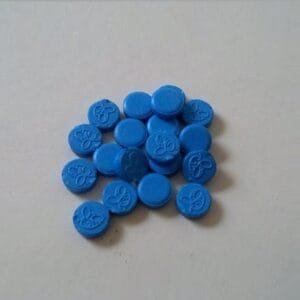
2C-B Nexus Blue Bees – 50 Tablets of Euphoric Psychedelic Experience
$240.00
Enjoy 50 premium-grade Blue Bee 2C-B tablets, expertly dosed for euphoric clarity, sensual enhancement, and vivid psychedelic journeys.
2C-B Nexus Blue Bees: Pill Identification, Reagent Testing, and Pharmacology
What Are 2C-B Nexus Blue Bees?
2C-B Nexus Blue Bees are unofficial blue pressed tablets bearing a bee logo or similar embossed design, circulated in illicit drug markets and represented as containing 2C-B, the compound 4-bromo-2,5-dimethoxyphenethylamine. The design is not a chemical identifier. Visually identical tablets can contain different ingredients or concentrations entirely. Chemical testing, rather than appearance or branding, is required to establish composition.
The name “Nexus” has been associated with 2C-B in street and recreational contexts for decades, though it functions as informal market terminology rather than a standardized product name. No regulatory body, licensed manufacturer, or pharmaceutical authority produces or certifies these tablets. Blue Bee pill designs are not proprietary or protected, and the same visual format can be reproduced by any operator with access to a pill press and appropriate dye.
2C-B Nexus Blue Bees are unofficial pressed tablets represented as containing 2C-B, a psychedelic substituted phenethylamine. Blue color, bee logos, and Nexus branding cannot establish a tablet’s identity, purity, or potency because illicit pill designs can be copied and batches vary. Reagent tests such as Marquis, Mecke, Froehde, Liebermann, and Robadope provide only presumptive chemical information. Instrumental techniques including validated FTIR and GC/MS offer stronger identification, while quantitative analysis is required to determine actual concentration. 2C-B is pharmacologically distinct from MDMA, LSD, and the variable mixtures marketed as tusi or pink cocaine. U.S. federal law has classified 2C-B as a Schedule I controlled substance since 1995.
Blue Bee Pill Identification: Why Appearance Is Unreliable
Visual identification is not a valid method for confirming a tablet’s chemical contents. Pill presses capable of producing embossed, colored tablets are commercially available, and the same die used to press one batch can produce tablets with entirely different contents in a subsequent run.
Blue coloring reflects dye selection during manufacturing, not any chemical property of 2C-B. A Blue Bee tablet could contain 2C-B, a different psychedelic, a stimulant, a synthetic cathinone, an adulterant, an inert filler, or some combination of these. Press-copied tablet designs have been documented repeatedly in harm reduction laboratory databases, including DrugsData, which publishes GC/MS and other analytical results from anonymously submitted samples.
Color, logo, shape, score lines, photographs, and seller descriptions cannot confirm that a tablet contains 2C-B. Relying on visual features for pill identification carries substantial risk of misidentification regardless of how consistent a tablet’s appearance may seem.
2C-B Nexus Blue Bees Dosage Variance and Content Uniformity
Unregulated tablets lack verified pharmaceutical content-uniformity controls. In licensed pharmaceutical manufacturing, regulatory guidance from agencies such as the U.S. Food and Drug Administration specifies acceptable limits for dosage uniformity across a batch. No equivalent standard governs illicitly pressed tablets.
Dosage variance in illicit tablets can arise from several manufacturing factors. Uneven blending of active compound with binders and fillers, differences in particle size, powder segregation during pressing, equipment inconsistency, and batch-to-batch variation can all produce tablets whose actual drug content differs significantly from any stated milligram amount. An advertised figure such as “20 mg 2C-B” is a seller claim, not an analytically verified measurement. Actual concentration can be higher, lower, or the stated substance may not be present at all.
Nexus 2C-B History
2C-B was first synthesized by the American chemist Alexander Shulgin in 1974. Shulgin documented its synthesis, receptor interactions as understood at the time, and reported pharmacological properties in the 1991 book PiHKAL: A Chemical Love Story, co-authored with Ann Shulgin. The work remains a widely cited historical reference for substituted phenethylamine chemistry and is indexed in academic and harm reduction archives.
The name “Nexus” emerged as informal market terminology for 2C-B during the late 1980s and 1990s, particularly in European and North American recreational drug markets, alongside other informal names including “Venus” and “Erox.” None of these terms correspond to a regulated or standardized product, and their historical origins are not formally documented in peer-reviewed literature.
The Drug Enforcement Administration placed 2C-B in Schedule I of the Controlled Substances Act in 1995. The scheduling action is documented in the Federal Register and reflects the statutory criteria of no currently accepted medical use in treatment, lack of accepted safety for use under medical supervision, and high potential for abuse as defined under 21 U.S.C. § 812.
2C-B Pharmacology
2C-B as a Substituted Phenethylamine
2C-B belongs to the 2C family of substituted phenethylamines, characterized by methoxy groups at the 2 and 5 positions of the phenethylamine backbone and a bromine substituent at the 4 position. Phenethylamine is an endogenous trace amine; structural modifications to this scaffold produce compounds with widely varying receptor binding profiles and pharmacological effects.
2C-B and the 5-HT2A Receptor
2C-B interacts with multiple serotonergic receptors, including 5-HT2A and 5-HT2C subtypes, as well as various adrenergic receptors. Although 5-HT2A signaling is strongly implicated in the perceptual and cognitive effects associated with classical psychedelics as a class, 2C-B’s receptor pharmacology and functional signaling are more complex than a simple 5-HT2A agonist model captures. Published receptor binding studies indicate meaningful affinity at multiple targets, and the relative contribution of each to the compound’s reported effects is not fully resolved in the peer-reviewed literature.
Research published in journals including Neuropsychopharmacology and summarized in NIDA’s hallucinogen research resources provides useful context for understanding serotonergic psychedelic pharmacology more broadly. Readers seeking primary literature should consult PubMed-indexed binding affinity studies and functional pharmacology research rather than secondary or informal sources.
2C-B Duration
Based on reported human data, oral 2C-B produces effects with an onset commonly described between thirty and ninety minutes, with total duration generally falling in the range of four to six hours. This is notably shorter than LSD, whose effects are typically described as lasting eight to twelve hours or longer. These ranges reflect reported experiences rather than controlled clinical measurements, and individual variation, gastric contents, and dosage influence timing substantially.
2C-B Side Effects
Reported adverse effects associated with 2C-B include nausea, particularly during onset, elevated heart rate, elevated blood pressure, muscle tension, anxiety, and psychological distress. At higher doses, confusion, disorientation, and acute panic reactions are more frequently reported.
Because illicitly obtained tablets have unverified contents and concentration, the dose-response relationship cannot be predicted reliably from a tablet’s stated milligram value or visual appearance. Long-term safety data for 2C-B in humans is limited, as the compound has not undergone controlled clinical trials required for approved pharmaceutical development. Individuals with personal or family histories of psychotic disorders or cardiovascular conditions face additional risk factors that are not well characterized in the available literature for this specific compound.
When to Seek Emergency Medical Care
Anyone experiencing severe chest pain, difficulty breathing, loss of consciousness, sustained confusion, or signs of cardiovascular distress after ingesting an unknown substance should seek emergency medical care immediately. In the United States, the Poison Control Center can be reached at 1-800-222-1222 for guidance.
2C-B vs MDMA
2C-B and MDMA are both substituted phenethylamines, but their pharmacological mechanisms and associated effect profiles differ substantially.
MDMA is a substituted amphetamine whose primary action involves reversing monoamine transporters, producing release of serotonin, dopamine, and norepinephrine from presynaptic terminals. This mechanism produces the pronounced euphoria, empathogenic qualities, and stimulant effects characteristic of the entactogen class.
2C-B’s pharmacology centers on serotonergic receptor interactions, particularly at 5-HT2A and 5-HT2C receptors, associated with psychedelic perceptual effects rather than the monoamine release pattern of MDMA. While some users report mild empathogenic qualities from 2C-B, the compounds are mechanistically distinct and should not be treated as interchangeable or pharmacologically equivalent.
Combining 2C-B with MDMA introduces compounded and poorly characterized pharmacological interactions. The effect profile of either compound cannot be reliably predicted in combination based on single-drug pharmacology alone.
2C-B vs LSD
LSD and 2C-B both produce psychedelic effects associated with serotonergic signaling, but they differ considerably in potency, duration, and receptor pharmacology.
LSD is active at far lower mass than 2C-B, a difference reflecting substantial potency distinctions between the compounds. LSD also has documented affinity for dopamine receptors and a broad range of serotonin receptor subtypes beyond 5-HT2A, contributing to a more complex overall receptor profile than 2C-B.
Duration is a practical pharmacological distinction: 2C-B effects are generally described as resolving within four to six hours, compared to eight to twelve hours or longer for LSD. The two compounds are pharmacologically distinct despite sharing serotonergic receptor activity as part of their mechanisms.
2C-B vs Tusi and Pink Cocaine
Tusi, also spelled tucibi and commonly called pink cocaine, is a market term for variable drug mixtures sold primarily in powder or compressed form. Despite the phonetic similarity to “2C-B” and some marketing claims suggesting a relationship, tusi is not a defined chemical entity.
Laboratory analyses from services such as DrugsData and reports from harm reduction organizations have documented tusi samples containing combinations of ketamine, MDMA, caffeine, synthetic cathinones, and other substances with no detectable 2C-B. The similarity in name does not establish a chemical relationship. 2C-B is a single, chemically specific compound. Tusi is a variable market mixture whose contents depend entirely on the manufacturer and batch.
Treating these as equivalent or related substances is chemically inaccurate and represents a meaningful harm reduction risk.
Reagent Testing for 2C-B
How Reagent Testing Works
Reagent tests are colorimetric screening tools that produce color reactions between a chemical reagent solution and an unknown substance. They are used in harm reduction practice to obtain preliminary chemical information about a sample.
Reagent testing is presumptive. A color reaction consistent with a given compound indicates that substance may be present but does not confirm identity, purity, or concentration. Color results can be complicated by mixtures, adulterants, reaction conditions, reagent age, and lighting. A reaction inconsistent with expectations may indicate a different substance, but absence of a reaction does not confirm absence of a compound.
Organizations such as DanceSafe provide harm reduction education and reagent testing resources in the United States, along with guidance on interpreting results and the limitations of presumptive testing.
2C-B Blue Bee Marquis Reagent Test
Can Marquis confirm 2C-B? No. Marquis and other spot reagents provide presumptive color reactions, not definitive identification. They cannot establish purity or concentration, and mixtures can complicate interpretation significantly. Instrumental laboratory analysis provides substantially stronger chemical evidence.
For 2C-B, reference charts commonly describe a yellow to yellow-green color reaction with Marquis reagent, potentially progressing toward green. For comparison, MDMA typically produces a purple to black reaction, and LSD generally produces no significant color change. These reference colors should be verified against current charts published by reputable reagent suppliers or established harm reduction organizations, as apparent color can vary with concentration, reagent freshness, and lighting conditions.
Mecke, Froehde, Liebermann, and Robadope Reagent Tests
Using multiple reagents increases the information available from presumptive screening. The following typical reactions for 2C-B are drawn from reference charts in circulation among harm reduction practitioners, but users should verify these against current authoritative sources before drawing conclusions, as reagent formulations and reference standards can differ across suppliers and publications.
Mecke reagent typically produces a blue-green reaction with 2C-B reference samples.
Froehde reagent typically produces a yellow to green reaction.
Liebermann reagent typically produces an orange to brown reaction.
Robadope reagent is associated with primary amines including the phenethylamine class. A positive result, typically described as orange, in combination with other consistent reactions can support a presumptive identification of a phenethylamine-class compound.
No combination of color reactions constitutes a definitive chemical identification. Consistent results across multiple reagents increase confidence in a presumptive finding but cannot establish what every ingredient in a tablet is or what concentrations are present.
What Lab Testing Can and Cannot Tell You
Understanding what each level of analytical evidence can and cannot establish is important for interpreting drug checking results accurately.
Visual appearance provides no chemical confirmation. Tablet color, logo, shape, and score lines reflect manufacturing choices, not composition.
Seller or label claims are unverified assertions. An advertised milligram amount is a commercial claim, not an analytical measurement.
Colorimetric reagent tests provide presumptive screening. A consistent color reaction suggests a compound may be present but cannot identify every ingredient, confirm purity, or measure concentration. Results can be confounded by mixtures.
FTIR (Fourier transform infrared spectroscopy) identifies compounds by their characteristic infrared absorption spectra when compared against validated reference libraries. It provides stronger compound identification than colorimetric tests but has limitations with complex mixtures, low-concentration components, and samples without matching reference spectra. FTIR does not provide concentration data without additional quantitative methodology.
GC/MS (gas chromatography-mass spectrometry) separates mixture components and identifies each by its characteristic mass spectrum compared against validated reference databases. Under properly validated methods, GC/MS provides high-specificity compound identification and is widely used in forensic toxicology and analytical chemistry. Quantitative concentration requires a validated quantitative method applied to the specific analytical context.
Validated quantitative analysis using GC/MS, LC/MS, or HPLC with appropriate standards is required to determine actual drug concentration. Identification alone does not establish dose.
Each level of evidence answers different analytical questions and has distinct limitations. No single test answers all of them.
What Is Actually Known About Blue Bee Pill Contents
Drug-checking databases document what analytical testing found in submitted samples. They do not measure prevalence across the entire illicit drug supply. Voluntary submission datasets reflect selection bias, geographic concentration, the populations that access drug checking services, and the time periods during which samples were collected. Results from DrugsData and similar services describe what was found in those specific submitted samples, which is useful information, but cannot be extrapolated to characterize all Blue Bee tablets in circulation or the broader U.S. market.
Published laboratory records from drug checking services have documented Blue Bee-style tablets containing 2C-B as represented, tablets containing other psychedelics, tablets containing no identifiable controlled substance, and tablets containing adulterants or substituted compounds. The range of findings reflects the fundamental unreliability of illicit tablet composition generally.
2C-B Evidence Limitations
Human clinical evidence for 2C-B is limited. The compound has not undergone controlled clinical trials under regulatory standards, and most available pharmacological data derives from in vitro receptor binding studies, animal research, and anecdotal human reports. Published case reports and small observational studies provide some clinical information, but controlled human pharmacology data comparable to research on approved pharmaceuticals does not currently exist for 2C-B.
Anecdotal reports from users, harm reduction forums, and informal publications should not be treated as equivalent to controlled pharmacological evidence. Published receptor binding affinity data and analytical chemistry records represent a stronger evidentiary basis than experiential accounts, though even binding data does not fully predict functional effects in humans.
2C-B Legal Status in the United States
2C-B is classified as a Schedule I controlled substance under the Controlled Substances Act. Its scheduling became effective in 1995 and is documented in the Federal Register. Schedule I classification under 21 U.S.C. § 812 reflects a federal determination of no currently accepted medical use in treatment in the United States, lack of accepted safety for use under medical supervision, and high potential for abuse under the statutory criteria applied by the DEA.
Unauthorized manufacture, distribution, and possession of Schedule I substances are federal criminal offenses subject to penalties under applicable federal statutes. State laws may impose additional or different penalties. Legal status varies internationally, and individuals seeking jurisdiction-specific legal information should consult applicable national law, official regulatory sources, or qualified legal counsel.
2C-B Nexus Blue Bees: Key Takeaways
2C-B Nexus Blue Bees are unofficial pressed tablets represented as containing 2C-B, a psychedelic substituted phenethylamine classified as a Schedule I controlled substance in the United States since 1995. No aspect of a tablet’s appearance, including its blue color, bee logo, or Nexus branding, establishes its chemical contents, purity, or concentration. Pill designs can be copied, batches vary without pharmaceutical uniformity controls, and stated milligram amounts are unverified claims rather than analytical measurements.
Reagent tests provide presumptive screening information. Instrumental laboratory methods including validated FTIR and GC/MS provide stronger chemical identification. Quantitative concentration requires validated quantitative analysis. Drug-checking database results reflect submitted samples rather than the broader drug supply. 2C-B is pharmacologically distinct from MDMA, LSD, and the variable mixtures marketed as tusi or pink cocaine, despite superficial name similarities in the latter case.
For anyone who has ingested an unknown substance and is experiencing a medical emergency, contact emergency services or call U.S. Poison Control at 1-800-222-1222.
Frequently Asked Questions
What is a 2C-B Nexus Blue Bee pill?
A Nexus Blue Bee is an unofficial blue pressed tablet bearing a bee logo, represented as containing 2C-B. Its color, bee design, or Nexus branding cannot verify its chemical contents, purity, or potency. Chemical analysis is required to establish composition.
Can you identify a Blue Bee 2C-B pill by appearance?
No. Color, logos, tablet shape, score lines, photographs, and seller claims cannot confirm chemical identity. Pill dies can be copied, and chemically different tablets can share the same appearance across batches.
What color does 2C-B turn with Marquis reagent?
Reference charts commonly describe yellow or yellow-green progressing toward green for 2C-B with Marquis reagent. Apparent color can vary with concentration, reagent age, and lighting. Marquis testing is presumptive and cannot establish purity, concentration, or the absence of other substances.
Can a reagent test prove that a Blue Bee contains 2C-B?
No. Multiple reagents together provide stronger presumptive evidence than a single test, but color reactions cannot definitively identify all ingredients or measure concentration. Instrumental laboratory analysis provides substantially stronger chemical identification.
Why do Nexus Blue Bees vary in strength?
Illicit tablets lack verified pharmaceutical content-uniformity controls. Powder segregation, uneven blending, particle-size differences, binder variation, and batch inconsistency can cause composition to differ substantially. An advertised milligram amount is a seller claim, not an analytically verified measurement.
Is 2C-B the same as tusi or pink cocaine?
No. 2C-B is the specific compound 4-bromo-2,5-dimethoxyphenethylamine. Tusi, tucibi, or pink cocaine is a market term for variable drug mixtures that frequently contain no 2C-B. The phonetic similarity does not indicate a chemical relationship.
How does 2C-B differ from MDMA?
2C-B interacts with serotonergic receptors including 5-HT2A and 5-HT2C, associated with psychedelic perceptual effects. MDMA is a substituted amphetamine whose primary mechanism involves monoamine transporter reversal and the release of serotonin, dopamine, and norepinephrine. The compounds are pharmacologically distinct.
Is 2C-B legal in the United States?
2C-B has been federally classified as a Schedule I controlled substance since 1995. Unauthorized possession, manufacture, and distribution are prohibited under federal law subject to penalties under applicable statutes. State laws may differ, and legal status varies internationally.
30 reviews for 2C-B Nexus Blue Bees – 50 Tablets of Euphoric Psychedelic Experience
Add a review
Related products


Jasper Hines (verified owner) –
My best friend and I had the deepest talk of our lives.
Kirklin Gillespie (verified owner) –
Amazing product. Emotional healing at its finest.
Gabriella Barnes (verified owner) –
This wasn’t just about visuals — it was an emotional deep dive.
April Whaley (verified owner) –
A tool for emotional freedom.
Brandi Schmitt (verified owner) –
This helped me reframe my inner narrative.
Sierra Brewer (verified owner) –
This was handled like a wellness experience, not just a transaction. I appreciate that more than I can say.
Nina Elliott (verified owner) –
This helped lift a heavy emotional weight I didn’t even know I was carrying.
Charles Richardson (verified owner) –
I didn’t just receive a product. I received permission to go deeper, safely and professionally.
Miles Stephens (verified owner) –
Everything slowed down, and for once, I didn’t feel rushed or reactive.
June Hampton (verified owner) –
Every thought felt intentional. Like my mind was guiding me through healing.
Oscar Stone (verified owner) –
You can tell this is run by professionals. Every part of the order felt thoughtful, respectful, and reliable.
Maurice Ferrell (verified owner) –
So clean—no weird sensations or confusion.
Nyla Thatcher (verified owner) –
This experience changed how I view love and connection.
Cody Gibson (verified owner) –
Such a smooth process — no awkward moments, just support and results.
Brooklyn Alexander (verified owner) –
A spiritual tune-up. My body felt lighter, and my mind was free of clutter.
Cameron James (verified owner) –
This was the most human shopping experience I’ve ever had — the silence, the care, the power of the trip.
Nina Elliott (verified owner) –
It felt like my thoughts were being held by something kind and wise.
Harvey Horton (verified owner) –
This helped lift a heavy emotional weight I didn’t even know I was carrying.
Adam Murphy (verified owner) –
They don’t just sell — they serve. And that’s why this experience felt so safe.
Victoria Walker (verified owner) –
It made me appreciate silence in a way I never had before.
Joy Molina (verified owner) –
It brought out the best in me.
Brady Bishop (verified owner) –
I felt held — not just by the product, but by the whole process. From order to unpacking, everything was seamless and professional.
Rosa LeBlanc (verified owner) –
Everything made sense—without needing words.
Miles Stephens (verified owner) –
The emotional clarity I gained from this session is hard to put into words. It felt safe, guided, and surprisingly gentle.
Megan Jackson (verified owner) –
I was honestly nervous before trying this, but the experience felt like a gentle opening into something deep and beautiful — like my mind finally exhaled.
Adam Murphy (verified owner) –
I felt emotionally safe using this, and that matters deeply with a product like this.
Joyce Singleton (verified owner) –
Felt connected to everyone in the room.
Alina Burris (verified owner) –
Felt the fear melt off me like rain.
Benjamin Campbell (verified owner) –
A peaceful and profound journey. Every thought felt more meaningful, and I could finally hear myself think without the usual noise.
Bryce Harper (verified owner) –
The journey was deep and personal, but the professionalism around it made me feel completely supported.