


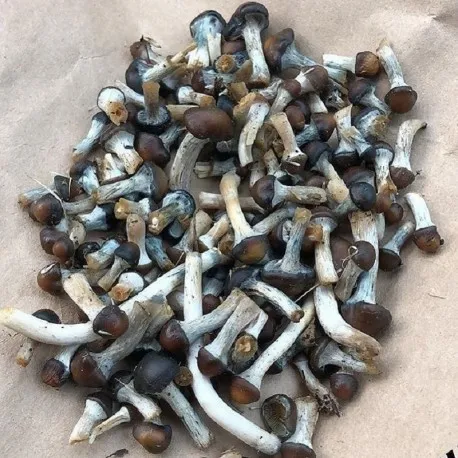
Psilocybe Baeocystis – Rare Psilocybin Mushroom for Gentle Depth
Price range: $170.00 through $830.00
Psilocybe Baeocystis, sometimes called “Bottle Cap,” is a rare and balanced psychedelic mushroom offering moderate potency, ideal for emotional healing, gentle visuals, and introspective calm.
Psilocybe Baeocystis: Identification, Baeocystin, Habitat & Lookalikes
Psilocybe baeocystis, commonly called knobby tops, is a species in the genus Psilocybe with a well-established historical association with the Pacific Northwest. Taxonomic descriptions characterize a variable, hygrophanous mushroom that may develop a pronounced central umbo. The species is also historically important to research on baeocystin, a phosphorylated tryptamine closely related structurally to psilocybin.
Safety note: Mushroom morphology, habitat, blue staining, and spore-deposit color can support a taxonomic identification, but they are not ingestion-safety tests. Wood-associated environments can also contain toxic small brown fungi, including amatoxin-containing Galerina. This guide is for scientific identification, ecology, chemistry, and harm reduction. It does not provide consumption or cultivation instructions.
| Attribute | Scientific context |
|---|---|
| Scientific name | Psilocybe baeocystis Singer & A.H. Sm. |
| Common name | Knobby tops |
| Kingdom | Fungi |
| Phylum | Basidiomycota |
| Class | Agaricomycetes |
| Order | Agaricales |
| Family | Hymenogastraceae |
| Genus | Psilocybe |
| Historical description | Singer & Smith, 1958—verify complete citation against primary record before publication |
| Geographic association | Pacific Northwest; exact range requires record-level evidence |
| Ecology | Saprobic; reported from organic-rich and woody substrates |
| Spore deposit | Dark purplish-brown in published descriptions—verify against primary source |
| Chemistry | Historically associated with research on psilocybin-related tryptamines and baeocystin; species-specific compound claims are documented below from primary analytical sources |
| Important safety issue | Potential confusion with other small brown fungi, including amatoxin-containing species |
| U.S. legal context | Psilocybin and psilocin remain federally controlled; state and local rules vary |
Key takeaways:
- P. baeocystis is an established Psilocybe taxon with a variable appearance that changes with hydration, maturity, and individual specimens
- The “knobby” cap is useful descriptive information, not a diagnostic test
- Baeocystin has a genuine historical connection with this species, but claims about a distinctive “baeocystin effect” need to be separated from controlled pharmacological evidence
- Strong identification combines macroscopic, microscopic, ecological, and—when necessary—molecular evidence
- No photograph, bruise color, or spore print makes an unknown wild mushroom safe to consume
Contents
- What Is Psilocybe baeocystis?
- Who Described Psilocybe baeocystis and How Was It Named?
- What Does Psilocybe baeocystis Look Like?
- How Can Psilocybe baeocystis Be Identified Scientifically?
- Where Does Psilocybe baeocystis Grow?
- What Is Baeocystin and Why Is It Associated With Psilocybe baeocystis?
- What Is the Psilocybe baeocystis Alkaloid Profile?
- How Does Psilocybe baeocystis Compare With Other Psilocybe Species?
- Which Psilocybe baeocystis Lookalikes Are a Safety Concern?
- What Does Microscopy Reveal About Psilocybe baeocystis?
- What Is the U.S. Legal Status of Psilocybe baeocystis?
- How Can P. baeocystis Be Documented Responsibly?
- What Are the Most Common Psilocybe baeocystis Research and Identification Mistakes?
- Frequently Asked Questions
- How Was This Guide Researched and Reviewed?
- Which Scientific Sources Support This Guide?
- Summary
What Is Psilocybe baeocystis?
Psilocybe baeocystis is a species of Psilocybe historically associated with the Pacific Northwest and commonly called knobby tops. Its cap is often described as hygrophanous and prominently umbonate, though considerable variation occurs across specimens and developmental stages. The species also occupies a distinct position in the scientific history of baeocystin—it is the fungus most closely associated with early analytical work on that compound.
Scientific Classification and Taxonomy
The accepted taxonomic hierarchy places P. baeocystis within:
Fungi → Basidiomycota → Agaricomycetes → Agaricales → Hymenogastraceae → Psilocybe → Psilocybe baeocystis
Formal scientific nomenclature matters here because common names are ambiguous. “Knobby tops” describes an observable appearance, not a unique taxonomic property—and more than one mushroom can develop a prominent umbo. Current nomenclature, author citation, and synonymy should be verified against the original taxonomic publication and authoritative resources including MycoBank (mycobank.org/page/Name/Details/413831) and Index Fungorum (indexfungorum.org) before any scientific publication or consequential claim.
Why Is It Called the Knobby Tops Mushroom?
The common name refers to the central umbo—the raised or projecting area at the center of the pileus—that can be conspicuous in some P. baeocystis specimens. The nickname is memorable, which is precisely the problem: it is easy to remember and easy to overvalue.
Umbo prominence varies with developmental stage and among individual fruit bodies of the same species. A mushroom with an impressive central knob is not necessarily P. baeocystis, and a specimen without one is not necessarily something else.
Who Described Psilocybe baeocystis and How Was It Named?
Psilocybe baeocystis is taxonomically attributed to Rolf Singer and Alexander H. Smith, with 1958 conventionally associated with its formal description. A production version of this page should cite the original publication and nomenclatural record directly, including the type material and locality where those details can be verified from primary sources.
Rolf Singer, Alexander H. Smith, and the 1958 Description
Singer and Smith were defining figures in twentieth-century agaric taxonomy. Singer’s comparative work on Psilocybe and Smith’s expertise in North American agarics gave their species concepts lasting influence, making the original description the appropriate historical baseline for interpreting P. baeocystis and evaluating subsequent accounts.
Primary verification matters particularly for microscopic measurements. A value copied from one field guide to the next can acquire apparent authority over time, even when its relationship to the original type material has never been confirmed. For publication, the taxonomic citation must be inserted from the verified primary record—not inherited from secondary websites.
What Does “baeocystis” Mean?
Various secondary sources suggest the name involves Greek or Latin roots meaning “small pouch” or “small cyst.” That interpretation should remain qualified until it can be traced to the original authors or a reliable linguistic and nomenclatural reference. The species epithet has also become closely associated with baeocystin—a connection that is historically interesting but represents a separate question from any naming intention.
How Is the Species Connected to Baeocystin?
Historical chemical literature links P. baeocystis with the early isolation and characterization of baeocystin. Accounts commonly associate researchers A. Y. Leung and A. G. Paul with that work, generally placing it in the 1960s.
That history is worth establishing precisely. The exact first-isolation claim, publication date, fungal source material, and analytical terminology should come from the original paper rather than from secondary reproductions of the same attribution that has been copied between reference sites for decades. The distinction between a compound’s discovery history and its typical concentration across specimens of a species is also worth preserving—they are different scientific questions that popular accounts frequently conflate.
What Does Psilocybe baeocystis Look Like?
Psilocybe baeocystis is a morphologically variable mushroom with a hygrophanous pileus that may develop a conspicuous central umbo, gills that darken as spores mature, a slender stipe with blue discoloration possible in injured tissue, and a dark purplish-brown spore deposit. A complete scientific identification also requires microscopic structures that field photographs cannot show.
Appearance shifts meaningfully with age, hydration, and handling. A specimen photographed wet can look strikingly different from the same collection photographed an hour later—which is precisely why any single idealized photograph provides an incomplete identification record.
Cap Shape, Acute Umbo, and Hygrophanous Color Variation
The cap is responsible for the memorable knobby tops name. Authenticated descriptions depict a pileus that can shift substantially in apparent shape and color as specimens mature and lose moisture.
Hygrophanous means that apparent color changes as tissue water content changes. A wet cap may appear dark olive-brown or chestnut; the same cap partially dried can fade to pale tan or ochre. This means photographs of authenticated P. baeocystis collections can show markedly different colors—they may simply reflect different hydration states rather than different identifications.
A series of images showing the same authenticated collection across different hydration states is considerably more useful for scientific identification than any single portrait. Multi-state documentation reveals how apparent color responds to conditions, which is information a single photograph cannot provide.
Gills and Gill Attachment
The lamellae provide taxonomic information that cap-only photographs cannot reveal. Their maturation, spacing, coloration, and attachment pattern to the stipe should all be compared with authenticated descriptions from primary taxonomic sources—specifically the original Singer and Smith material where that text has been verified.
An underside photograph showing the relationship between gills and stipe should accompany any morphological documentation. This view is diagnostically useful precisely because it is so commonly omitted.
Stipe, Veil Characteristics, and Bluing
The stipe and any veil remnants contribute additional evidence. Published descriptions report blue discoloration in P. baeocystis tissue following damage. This reaction should be documented as one character among several rather than treated as a diagnostic test, because blue staining is not unique to this species.
Modern biochemical research has clarified mechanisms underlying blue discoloration in psilocybin-containing Psilocybe (see the bluing chemistry reference in the sources section). Any claim extending a specific mechanism to multiple species should be accompanied by a primary biochemical source rather than stated as general fact. A field record should note the presence, location, and approximate extent of any discoloration observed—not whether the specimen “passed” a bruising test.
Spore Deposit and Microscopic Characters
The Psilocybe baeocystis spore print is generally described as dark purplish-brown in published taxonomic sources. Spore-deposit color can help distinguish broad taxonomic possibilities—particularly separating species with dark purple-brown prints from those with rusty or cinnamon-brown deposits—but color alone does not confirm species identity. Lighting, deposit thickness, and the collection surface all influence perceived color.
Microscopy contributes the characters that matter most when macroscopic identification is uncertain: basidiospore dimensions and morphology, wall thickness, germ-pore features, basidia, cheilocystidia, and pleurocystidia. These should be reproduced from authenticated primary taxonomic literature rather than secondary sources, and the exact verified values should replace any placeholder before publication.
How Can Psilocybe baeocystis Be Identified Scientifically?
Scientific Psilocybe baeocystis identification relies on converging evidence. Macroscopic morphology establishes a candidate identification; microscopy tests characters invisible in photographs; ecological context establishes plausibility; authenticated vouchers allow reproducible comparison; and molecular analysis can resolve specimens that remain ambiguous after morphological examination.
Why Does No Single Field Character Confirm the Species?
Can blue bruising identify Psilocybe baeocystis? No. The same answer applies to a pronounced umbo, an olive-brown cap color, a Pacific Northwest location, or a dark purplish spore deposit.
Each observation can support an identification hypothesis. None is species-specific proof. Identification confidence should increase because several independent lines of evidence agree—not because one striking feature appears particularly convincing.
The Knobby-Top Evidence Framework
A practical scientific framework evaluates three evidence domains in sequence.
Macromorphology covers the intact pileus, gills, stipe, and veil alongside maturity and hydration state. Microscopy tests spore and cystidial characters against authenticated descriptions from primary sources. Context and verification consider substrate, geographic plausibility, voucher material, and molecular data where necessary.
Documenting these systematically produces records that are far more useful to expert review than a single photograph. The framework’s limitation deserves equal emphasis: it is a taxonomic evidence framework, not an edibility certificate.
Morphology vs. Microscopy vs. DNA
| Evidence type | Best use | Evidentiary value | Main limitation |
|---|---|---|---|
| Macromorphology | Establish candidate identification | Moderate | Changes with age, hydration, and environment |
| Ecological context | Test plausibility | Supporting | Multiple species share substrates |
| Spore deposit | Broad taxonomic filtering | Low to moderate | Color perception and deposit quality vary |
| Microscopy | Test additional diagnostic characters | Moderate to high | Character overlap among related taxa |
| Authenticated voucher | Reproducible comparison | High | Requires curated reference material |
| ITS sequencing | Molecular comparison | High when references are reliable | Dependent on database quality and reference accuracy |
| Expert synthesis | Integrate all evidence | Evidence-dependent | Cannot compensate for inadequate source material |
The nuclear ribosomal internal transcribed spacer (ITS) region is widely used as a fungal DNA barcode. An ITS match is not, however, automatically a species verdict. Reference databases can contain incomplete records and sequences from incorrectly identified specimens—limitations that matter particularly in groups where reference coverage is still developing.
What Does Each Level of Evidence Actually Prove?
Macromorphology can show that a specimen is consistent with P. baeocystis; it rarely settles a difficult identification on its own. Microscopy tests additional taxonomic characters that photographs cannot capture. A voucher preserves physical material so another researcher can repeat the assessment. ITS sequencing provides molecular evidence, but its value depends on the accuracy of the reference sequences in the comparison database.
The strongest conclusion therefore does not come from asking which evidence type “wins.” It comes from recognizing that independent evidence streams become progressively more persuasive when they converge on the same taxonomic result—and progressively more concerning when they conflict.
Where Does Psilocybe baeocystis Grow?
Psilocybe baeocystis has a strong historical association with the Pacific Northwest and has been reported from organic-rich, woody, and human-modified substrates. Precise distribution statements should distinguish authenticated occurrence from assumptions about native range—those are different biogeographic claims.
What Is Its Verified Pacific Northwest Distribution?
Washington is central to the species’ historical taxonomic record. Claims involving Oregon, British Columbia, California, and other regions should be separated into authenticated voucher records, peer-reviewed reports, and unvouchered observations rather than treated as equally reliable.
Occurrence does not automatically establish nativity. “Documented in,” “established in,” and “native to” represent progressively more demanding biogeographic conclusions and should not be used interchangeably.
What Does the Voucher Record Actually Show?
| Region | Authenticated voucher or record | Institution | Evidence class | What it establishes |
|---|---|---|---|---|
| Washington | To be populated from institutional herbarium query | To be verified | Voucher | To be confirmed before publication |
| Oregon | To be populated from institutional herbarium query | To be verified | Voucher or literature | To be confirmed before publication |
| British Columbia | To be populated from institutional herbarium query | To be verified | To be assessed | To be confirmed before publication |
| California | To be populated from institutional herbarium query | To be verified | To be assessed | To be confirmed before publication |
This table should be populated from authenticated herbarium records before publication. Rows for regions where suitable authenticated evidence is not found should be omitted rather than filled with placeholder text.
What Substrates Are Associated With P. baeocystis?
Literature and occurrence reports associate P. baeocystis with decomposing organic material and various woody or landscaped substrates—peat-rich soil, woody debris, bark mulch, and organic-rich ground appear across secondary ecological accounts. Those associations need source-level treatment before they can be treated as authoritative.
Finding a mushroom on woodchips or bark mulch does not identify it as P. baeocystis. Substrate information supports plausibility; it does not confirm identity.
Why Is P. baeocystis Associated With Human-Modified Landscapes?
Saprobic fungi derive nutrition from decomposing organic matter. Human landscaping practices—particularly the widespread use and transport of bark mulch, wood chips, and compost—can concentrate suitable substrate in new locations, which plausibly changes where saprobic fungi appear. This is a reasonable ecological explanation for observations from parks, lawns, and landscaped environments, not a demonstrated habitat preference.
A rigorous dataset would compare authenticated records from natural, suburban, and intensively landscaped sites across multiple seasons rather than inferring preference from accumulated anecdotal sightings.
When Has P. baeocystis Been Recorded Fruiting?
Pacific Northwest sources commonly associate P. baeocystis observations with the cooler, wetter portions of the year—broadly autumn through early winter. More precise phenological timing should come from authenticated collection records with documented dates rather than from a fixed temperature rule that may not generalize across the full reported range.
How Reliable Are Online Distribution Records?
Biodiversity platforms are valuable discovery tools, but their records do not all carry equal taxonomic weight. An authenticated herbarium voucher can be physically re-examined; an unvouchered photograph cannot.
For GBIF-mediated and iNaturalist records, inspect the available photographs, source collection, available identification and provenance metadata, and any voucher information before using the occurrence to support a range claim. A scientifically useful map should distinguish evidence classes—making the difference between a voucher-backed herbarium record and an unvouchered community observation visible—rather than plotting every point with equal confidence.
What Is Baeocystin and Why Is It Associated With Psilocybe baeocystis?
Baeocystin is a phosphorylated tryptamine structurally related to psilocybin and historically associated with research involving Psilocybe baeocystis. Its chemical identity is established. Popular claims about a unique “baeocystin effect,” however, should not be confused with controlled evidence of compound-specific human pharmacology—those are different scientific questions with different evidentiary standards.
What Is Baeocystin Chemically?
Baeocystin is a phosphorylated tryptamine closely related structurally to psilocybin and commonly described as its N-demethyl analog. Where psilocybin carries two methyl groups on its terminal amine nitrogen, baeocystin carries one. In chemical database terms, baeocystin is catalogued in PubChem under CID 12433515 and carries the molecular formula C11H15N2O4P—details that should be verified against the current PubChem record (pubchem.ncbi.nlm.nih.gov) before publication.
That structural relationship can motivate pharmacological hypotheses, but it does not establish equivalent receptor activity, metabolic fate, or subjective human effects. Chemical structure, biological activity, and human experience are three separate levels of evidence.
When and From What Material Was Baeocystin First Isolated?
Historical accounts connect A. Y. Leung and A. G. Paul with the early isolation and characterization of baeocystin, with P. baeocystis commonly identified as the relevant fungal source and the 1960s as the relevant period.
That history should be stated precisely only after the original publication has been consulted directly. The exact first-isolation claim, journal name, year, experimental method, and naming language should come from primary literature rather than from secondary attributions that have circulated without verification. This distinction matters because the history of a compound’s discovery and its typical concentration across specimens of a fungal species are different scientific questions that popular accounts frequently collapse into one.
How Does Baeocystin Differ Structurally From Psilocybin?
The structural difference is a single N-methyl group. Psilocybin is 4-phosphoryloxy-N,N-dimethyltryptamine; baeocystin is the corresponding N-monomethyl compound. By the standards of organic chemistry, that is a small change—but apparently small molecular differences can translate into meaningful differences in receptor binding, metabolic processing, and biological effect. They also may not. Structure and pharmacology run in parallel, not in lockstep.
What Is Known About Baeocystin Pharmacology?
Baeocystin has been studied far less extensively than psilocybin. Far fewer pharmacological studies have examined baeocystin than psilocybin, and interpreting the available evidence by study type prevents weaker evidence from substituting for stronger.
| Evidence level | What it can establish | What it cannot establish |
|---|---|---|
| Chemical identification | Molecular identity and structure | Human subjective effects |
| In-vitro receptor research | Activity at tested targets in a cellular model | Whole-human pharmacology |
| Preclinical animal research | Effects in a specified model organism | Direct equivalence to human experience |
| Controlled human research | Effects under defined experimental conditions | Effects beyond those specific conditions |
| Anecdotal mushroom reports | Hypotheses worth investigating | Baeocystin-specific causation separate from other constituents |
The anecdote problem deserves emphasis. A subjective report involving whole mushroom material cannot isolate baeocystin’s contribution from the simultaneous presence of psilocybin, psilocin, other minor tryptamines, individual biological variability, and expectation effects. Words like “gentler” or “deeper” describe a user’s experience of a complex chemical mixture under uncontrolled conditions—they cannot be attributed to a single compound without evidence that no whole-mushroom report can provide.
What Do Human Studies Actually Tell Us About Baeocystin?
A production version of this section should report the results of a documented literature search specifying the databases searched, the search terms used, and the inclusion criteria applied. If no controlled human trials of isolated baeocystin are identified under that search, that finding should be stated explicitly with those search parameters—”no qualifying studies identified” means something reproducible when the search methodology is recorded. It does not mean the absence of evidence extends indefinitely into the future, and this section should not claim otherwise.
If qualifying human studies exist at time of publication, summarize the study design, participant number, intervention, endpoints, and main limitations in plain language here.
What Is the Psilocybe baeocystis Alkaloid Profile?
The chemical profile of Psilocybe baeocystis should be described from analyses of authenticated species material rather than from genus-level inference or potency aggregators. For each reported compound, the relevant questions are whether it was detected in verified P. baeocystis, which analytical method was used, how many samples were tested, and whether concentrations were reported on a fresh- or dry-weight basis.
Which Compounds Have Actually Been Detected in P. baeocystis?
How Strong Is the Evidence for Each Chemical Claim?
Four evidence labels apply consistently throughout this section:
- Established: independently supported by suitable species-specific analytical evidence
- Supported: demonstrated species-specifically but with limited sampling or methodological constraints
- Preliminary: reported in evidence requiring replication or stronger specimen authentication
- Unverified: no adequate species-specific source identified during the documented review
| Chemical claim | Evidence status | Best source | Main limitation |
|---|---|---|---|
| Psilocybin in P. baeocystis | To be assessed from primary literature | Source required before publication | Specimen provenance and method must be documented |
| Psilocin in P. baeocystis | To be assessed from primary literature | Source required before publication | Specimen provenance and method must be documented |
| Baeocystin in P. baeocystis | To be assessed from primary literature | Source required before publication | Provenance, method, and concentration evidence required |
| Norbaeocystin in P. baeocystis | To be assessed from primary literature | Source required before publication | Evidence may be limited |
Only analytical evidence from identified P. baeocystis material belongs in this table. Detecting a compound in another Psilocybe species does not demonstrate its presence here, and a cell should remain at “Unverified” status rather than be filled with genus-level inference.
What Do Published Concentration Studies Actually Show?
| Study | Material and n | Weight basis | Psilocybin | Psilocin | Baeocystin | Norbaeocystin | Method | Key limitation |
|---|---|---|---|---|---|---|---|---|
| To be populated from primary analytical literature | Verify | State basis | Value required | Value required | Value required | Value required | HPLC or LC-MS required | State limitations |
This table should be completed from original chemistry papers before publication. No value should be sourced from potency-aggregator websites that reproduce figures without documenting the analytical experiments behind them.
Why Do Alkaloid Measurements Vary?
Fungal chemistry varies naturally across specimens, developmental stages, and growing conditions. Laboratory methodology compounds that natural variation further: specimen age, the specific tissue sampled, storage conditions, degradation before analysis, extraction procedures, and analytical technique can all influence a reported result.
The fresh-weight versus dry-weight distinction is particularly easy to miss when reading across studies. A value reported on a dry-weight basis and another on a fresh-weight basis cannot be directly compared, and presenting them in the same column of a table creates false precision rather than meaningful comparison.
Five questions apply to any alkaloid claim before it is cited: What material was analyzed, and what was its provenance? How many specimens or samples were tested? Was the result on a fresh- or dry-weight basis? Which analytical method was used? Is the reported figure a mean, a range, a maximum, or a single observation? Without those details, a precise-looking percentage can be less informative than a carefully qualified range from a smaller but better-documented study.
Is There Evidence for a Unique “Baeocystin Effect”?
Anecdotal descriptions from whole-mushroom use cannot establish a baeocystin-specific human effect. The scientifically answerable question is whether isolated baeocystin has produced a reproducible, distinct effect in appropriately controlled human research.
The answer to that question should be tied to the documented literature review described above rather than inferred from experience reports. Until controlled human evidence is available and documented, community descriptions of a distinctive baeocystin experience should be treated as hypotheses worth investigating—not as established pharmacology.
How Does Psilocybe baeocystis Compare With Other Psilocybe Species?
Psilocybe baeocystis differs from P. cubensis, P. cyanescens, and P. stuntzii in taxonomy, ecology, and morphology. Chemical comparisons are meaningful only when the underlying analyses are sufficiently comparable in method, specimen basis, and weight reporting. Isolated percentages from methodologically different studies do not establish a fixed species-to-species potency ratio.
Psilocybe baeocystis vs. P. cubensis
Psilocybe baeocystis and P. cubensis are distinct species with different ecological associations, morphological characters, and geographic profiles. Both appear in the literature on psilocybin-containing fungi. A defensible chemical comparison identifies the specimens, sample basis, and analytical method behind each measurement—it does not label one species “stronger” based on figures drawn from methodologically incompatible datasets.
Psilocybe baeocystis vs. P. cyanescens
P. baeocystis and P. cyanescens both appear in Pacific Northwest discussions of wood-associated Psilocybe, making them relevant comparative taxa for field researchers in that region. They represent distinct species concepts, and ambiguous specimens deserve complete morphological and microscopic assessment. Cap coloration and blue staining alone are insufficient to separate them—both characters vary with conditions and are shared across multiple Psilocybe species.
Psilocybe stuntzii vs. baeocystis
P. stuntzii is another important regional comparison given its Pacific Northwest distribution and superficial similarities to other small brown Psilocybe species. Published taxonomic descriptions distinguish it through combinations of macroscopic and microscopic characters. Simplified claims about veil structures or ring presence should be checked against authenticated material before being used as binary rules—those structures change and disappear with maturity in ways that can undermine a single-character shortcut.
Why Should Potency Rankings Be Treated Cautiously?
“Which species is strongest?” combines at least three different scientific questions: which specimen produced the highest recorded measurement, which species has the highest population mean, and which species would rank highest under standardized representative testing. These are not equivalent, and the datasets currently available for Pacific Northwest Psilocybe answer none of them definitively.
| Species | Broad ecology | Taxonomic relationship | Chemistry evidence status | Main limitation |
|---|---|---|---|---|
| P. baeocystis | Organic and woody substrates | Distinct species | To be populated from primary literature | Comparative sampling limited |
| P. cyanescens | Wood-associated | Distinct species | To be populated from primary literature | Cross-study methodology varies |
| P. stuntzii | Regional ecological associations | Distinct species | To be populated from primary literature | Dataset availability limited |
| P. cubensis | Different ecological profile | Distinct species | To be populated from primary literature | Specimen and study variation substantial |
No dose-equivalence should be inferred from this table, and no cell should be populated from secondary potency aggregators.
Which Psilocybe baeocystis Lookalikes Are a Safety Concern?
Psilocybe baeocystis lookalikes deserve particular attention because wood- and organic-substrate habitats contain numerous small brown fungi, including species that produce amatoxins. Galerina marginata is the most critical concern: it can occur in overlapping habitats and is associated with amatoxins capable of causing severe and potentially fatal liver injury.
Why Does Galerina marginata Deserve Special Attention?
Galerina marginata is a wood-decaying fungus associated with amatoxins. It is relevant to P. baeocystis identification because dangerous fungi can occur on or near the same organic and woody substrates—not because every G. marginata specimen closely resembles every P. baeocystis collection. The consequences of a mistaken identification warrant stronger evidence than cap color, blue staining, or habitat alone can provide.
Amatoxin poisoning can involve delayed serious liver injury following an earlier gastrointestinal phase. Because the clinical pattern and timing require medical interpretation, suspected ingestion warrants prompt poison-center or medical consultation rather than waiting to assess whether symptoms resolve on their own.
For current clinical guidance on amatoxin poisoning, consult America’s Poison Centers at poisoncenters.org and peer-reviewed clinical toxicology literature. The Enjalbert et al. (2002) retrospective review in the Sources section provides useful historical context on treatment approaches; current medical management should be verified against contemporary clinical resources and poison-center guidance.
Galerina marginata vs. Psilocybe baeocystis
The following comparison is educational reference material, not an ingestion-safety key. No table, photograph, identification app, or online guide can establish that an unknown mushroom is safe to consume.
| Character | P. baeocystis | G. marginata | Limitation |
|---|---|---|---|
| Spore deposit | Described as dark purplish-brown | Typically brown to rusty-brown | Color perception and deposit quality vary |
| Blue staining | Reported in damaged tissue | Not characteristic | Bluing is not species-specific |
| Cap | Hygrophanous; often umbonate | Brown; can be hygrophanous | Moisture substantially alters appearance |
| Stipe and veil | Assess using complete species description | Veil or ring structures often present; can be lost with maturity | Individual structures alone are insufficient |
| Microscopy | Psilocybe spore and cystidial characters | Different taxonomic character set | Requires expertise and reference material |
| Toxicology | Tryptamines historically reported | Amatoxins associated | Chemistry cannot be inferred from visual assessment |
Qualified mycologists working from adequate physical material can make strong taxonomic determinations. That is a different proposition from using a web table or photograph to declare an unknown wild mushroom safe to consume—those are different claims requiring different evidence.
P. baeocystis vs. Pholiotina and Conocybe Taxa
Other small brown fungi may also enter the differential depending on location and substrate. Nomenclature within Pholiotina and Conocybe has shifted as fungal taxonomy has developed, and historical literature uses these names differently from current accepted usage. Current accepted names should be cross-checked against MycoBank and Index Fungorum before publication, and field-guide names that predate recent taxonomic revisions should be treated accordingly.
What Should You Do After Suspected Poisonous-Mushroom Ingestion?
Do not wait for symptoms before seeking expert guidance. Contact Poison Control promptly rather than attempting online identification.
In the United States, contact Poison Control at 1-800-222-1222 or poison.org. Call 911 for collapse, difficulty breathing, loss of consciousness, or any immediate medical emergency. America’s Poison Centers at poisoncenters.org can help locate regional services. Outside the United States, contact the appropriate national or regional poison-information service immediately.
If readily available without delaying care, preserve mushroom remnants, photographs, or food material for medical professionals. Do not delay seeking advice while attempting to identify what was consumed.
What Does Microscopy Reveal About Psilocybe baeocystis?
Psilocybe baeocystis microscopy provides characters that are simply invisible in field photographs. Basidiospore morphology, germ-pore features, basidia, cheilocystidia, and pleurocystidia can each be compared with authenticated taxonomic descriptions and voucher material—and that comparison substantially strengthens or challenges a macroscopic identification hypothesis.
Which Microscopic Characters Matter Most?
Spore dimensions are useful only as part of a complete microscopic description. Shape, wall characteristics, and germ-pore features each contribute independently. Cheilocystidia on the gill edge and pleurocystidia on the gill face provide additional characters that help distinguish Psilocybe from superficially similar genera.
Verified spore dimensions and cystidial measurements from Singer and Smith’s original description should be inserted here from primary text before publication. The same applies to any subsequent taxonomic treatments that have established or revised those measurements. Where reputable studies disagree, preserve the disagreement explicitly—it is more scientifically useful than artificial concordance.
Every microscopy image should carry a scale bar. Display magnification alone is unreliable because digital images change size between creation and display, rendering a stated magnification meaningless without a physical reference in the frame.
How Should Published Measurements Be Compared?
| Reference | Voucher or material | Spore data | Cystidia | Preparation method | Notes |
|---|---|---|---|---|---|
| Original Singer and Smith description | Verify before publication | Primary-source range | Primary-source description | Verify | Foundational species concept |
| Later taxonomic treatment | Voucher details | Compare range | Compare description | State method | Note differences from original |
| Molecular or voucher study | Voucher details | Morphological range | Structural description | State method | Links morphology with sequence |
Where reputable studies disagree, the disagreement should remain visible. Disagreements in the technical literature are often more scientifically useful than artificial agreement produced by averaging incompatible measurements.
What Are the Limits of Microscopic Identification?
Microscopy is powerful evidence, not an omniscient arbiter. Measurements overlap among related fungi. Specimen preparation and observer interpretation introduce additional variation. The significance of a given structure depends on taxonomic context and familiarity with the group being studied.
For genuinely difficult specimens, morphology, microscopy, molecular data, and an authenticated voucher work as complementary forms of evidence—each addressing aspects the others cannot fully resolve. A high ITS similarity score is only as trustworthy as the accuracy of the reference sequences against which it is compared, which means database quality is a constraint on how much confidence any molecular result can support.
What Is the U.S. Legal Status of Psilocybe baeocystis?
Psilocybin and psilocin are listed in Schedule I under current U.S. federal controlled-substance regulations. State laws, regulated-access programs, and municipal policies differ, so there is no single nationwide answer covering every type of fungal material or activity involving P. baeocystis.
How Does Federal Law Treat Psilocybin and Psilocin?
Psilocybin and psilocin are listed as Schedule I controlled substances under 21 CFR § 1308.11, maintained in the Electronic Code of Federal Regulations. The current operative text is available at ecfr.gov/current/title-21/chapter-II/part-1308/section-1308.11 and should be verified against the current version before any legal reliance. The Drug Enforcement Administration’s controlled-substance resources at dea.gov/drug-information/csa provide supplementary agency context.
A state reform or municipal enforcement decision does not independently alter federal Schedule I status.
What Is the Legal Status of Spores and Microscopy Materials?
There is no reliable evergreen rule stating that Psilocybe spores are simply “legal in 47 states.” That shorthand has circulated online for years and has become less accurate as policy has evolved and as its imprecision has become more consequential.
Federal scheduling, state statutes, the specific material involved, intended use, and subsequent conduct each raise distinct legal questions that can produce different answers in different jurisdictions. Psilocybe baeocystis microscopy materials should be discussed only by reference to current operative law in the relevant jurisdiction, verified against current statutory language. This article does not provide procurement, germination, or cultivation instructions.
How Do Oregon, Washington, and Other Local Policies Differ?
Oregon operates a regulated psilocybin-services framework administered by the Oregon Health Authority at oregon.gov/oha/ph/preventionwellness/pages/psilocybin-services.aspx. That system authorizes specified activity within its regulatory structure; it does not eliminate federal scheduling or make psilocybin generally available.
Washington state law and individual municipal policies must be evaluated separately. A local enforcement or decriminalization measure should not be described as statewide legalization unless the operative legal text supports that characterization. For broader national comparisons across additional states, the site’s maintained U.S. psilocybin legal-status guide provides more appropriate coverage than expanding this species page.
Three concepts should not be collapsed into one: decriminalization changes penalties or enforcement priorities but does not make commercial activity legal; regulated access authorizes defined activity through a formal system with specified participants and conditions; and legalization permits specified conduct within defined parameters while still leaving federal scheduling unchanged.
For any location-specific question, consult the current statute, operative regulation, and responsible government agency rather than relying on news coverage that may reflect an earlier regulatory state.
How Can P. baeocystis Be Documented Responsibly?
A useful scientific observation records what can actually be seen without converting assumptions into facts. Photograph the specimen from multiple perspectives, include a scale reference, record the date and broad habitat conditions, describe the substrate literally, and follow the property and collection rules wherever specimens are encountered.
Ethical Observation in Urban and Pacific Northwest Habitats
Urban habitat does not mean unrestricted access. Parks, landscaping beds, and lawns typically have management rules concerning entry and biological collection, whether private or publicly administered. The assumption that landscaped or semi-urban sites are open for unrestricted observation and collection deserves examination before acting on it.
Where sensitive or productive locations are involved, consider whether exposing precise coordinates on public platforms could concentrate visitor activity in ways that damage the habitat. That pattern has been documented at ecologically sensitive sites worldwide once they receive public attention, and responsible documentation practice means anticipating it.
What Makes a Scientific Observation Useful?
Photograph the cap from above, the underside showing gill structure and attachment, and the complete visible stipe including its base and any veil remnants. Include a ruler or scale reference in at least one frame. Record the apparent maturity and hydration state at the time of observation.
Habitat metadata should describe what was actually seen rather than what the observer assumes the specimen is. “Growing among woody landscaping debris in a partially shaded urban park, October, wet conditions” is stronger scientific documentation than a premature ecological assignment. Where a lawful, scientifically justified voucher is taken, record its accession details so future researchers can re-examine the physical material rather than relying solely on photographs.
What Are the Most Common Psilocybe baeocystis Research and Identification Mistakes?
The strongest general rule is consistent throughout mycology: match the confidence of a claim to the quality of the evidence supporting it.
Identification and Research Mistakes
| Common mistake | Better practice |
|---|---|
| Treating the cap knob as diagnostic | Compare multiple independent taxonomic characters |
| Treating blue staining as species-level proof | Record it as supporting evidence among others |
| Identifying from substrate alone | Use ecology to test plausibility, not confirm identity |
| Repeating one potency percentage | Report study, specimens, method, and weight basis |
| Assuming baeocystin determines subjective effects | Separate compound chemistry from human pharmacology |
| Treating biodiversity platform records as automatically verified | Evaluate provenance and identification quality individually |
| Using common names as taxonomy | Use scientific nomenclature with supporting evidence |
| Equating decriminalization with legalization | Check the current operative law |
| Using photograph identification for ingestion decisions | Seek appropriate specimen-based expertise |
Common Internet Claims vs. What the Evidence Actually Supports
| Popular claim | What the evidence supports |
|---|---|
| “Baeocystin creates a gentler experience.” | Anecdotes from whole-mushroom use cannot establish compound-specific human effects |
| “P. baeocystis has a fixed baeocystin ratio.” | Ratios require study-specific and specimen-specific measurements |
| “The knob identifies the mushroom.” | Umbo development varies substantially across specimens and developmental stages |
| “Blue staining confirms P. baeocystis.” | Bluing is not species-specific and is shared across multiple Psilocybe taxa |
| “Dark spores prove it is safe.” | Spore-deposit color is taxonomically useful but provides no ingestion-safety information |
| “Microscopy spores are legal except in three states.” | Legal treatment depends on current jurisdiction, material, intended use, and conduct |
Frequently Asked Questions About Psilocybe baeocystis
What is Psilocybe baeocystis?
Psilocybe baeocystis is a species of Psilocybe historically associated with the Pacific Northwest and commonly known as knobby tops. Its morphology can include a prominent umbo and hygrophanous cap. The species has an important historical relationship with scientific research on baeocystin.
Why is P. baeocystis called knobby tops?
The nickname refers to the raised central umbo that can give its cap a knob-like appearance. Umbo development varies among specimens and across developmental stages, so this feature does not independently identify the species.
What is baeocystin?
Baeocystin is a phosphorylated tryptamine structurally related to psilocybin—specifically, its N-monomethyl analog. Its chemical identity is established. Its specific contribution to subjective human effects remains a separate pharmacological question that controlled evidence has not yet resolved.
Was baeocystin first isolated from P. baeocystis?
Historical literature commonly associates early work by Leung and Paul with baeocystin isolated from P. baeocystis. The exact first-isolation date, source material, and naming history should be cited directly from the original chemistry publication rather than from secondary reproductions of the same attribution.
Is baeocystin the same as psilocybin?
No. Baeocystin and psilocybin are closely related phosphorylated tryptamines but differ in N-methyl substitution. Psilocybin carries two N-methyl groups; baeocystin carries one. Structural similarity does not establish identical pharmacological or subjective effects.
Is baeocystin known to have unique effects?
Available controlled evidence does not justify assigning a distinctive human experience to baeocystin based on anecdotal mushroom reports. Controlled evidence capable of separating baeocystin’s contribution from those of other constituents is required for a compound-specific conclusion.
Is Psilocybe baeocystis native to Oregon and Washington?
Documented occurrence and native range are different claims. Washington is central to the species’ historical taxonomic record. Records from Oregon and elsewhere should be evaluated from authenticated collections. Nativity requires biogeographic evidence beyond simply finding specimens in a location.
Where has P. baeocystis been documented?
The species has a strong historical association with the Pacific Northwest, particularly Washington. Distribution claims involving Oregon, British Columbia, California, and other regions should distinguish authenticated voucher records from unverified occurrence reports.
What habitat is associated with P. baeocystis?
Published accounts associate the species with decomposing organic material and woody or landscaped substrates. Reported habitat is supporting ecological context for an identification hypothesis, not independent confirmation of it.
What color is the P. baeocystis spore deposit?
Taxonomic descriptions generally characterize the spore deposit as dark purplish-brown, though the exact primary-source wording should be verified against the original Singer and Smith description. Spore color alone cannot confirm the species or establish that an unknown mushroom is safe.
Can blue staining identify P. baeocystis?
No. Blue discoloration can occur across multiple Psilocybe species through related biochemical reactions. Bluing is supporting evidence worth documenting carefully, but it is not a species-specific test and should not be used to estimate alkaloid concentration.
How does P. baeocystis differ from P. stuntzii?
They are distinct Psilocybe species defined by different combinations of macroscopic and microscopic characters. Identification should use complete authenticated taxonomic descriptions rather than relying on a single cap feature, veil structure, or bruising pattern.
How does P. baeocystis differ from P. cyanescens?
Both enter Pacific Northwest wood-associated Psilocybe comparisons, but they represent distinct taxa. Morphology, microscopy, and—where necessary—molecular comparison provide stronger differentiation than cap coloration or blue staining alone.
How does P. baeocystis compare with P. cubensis?
They differ taxonomically, morphologically, and ecologically. Both are associated with psilocybin chemistry, but available measurements do not support a scientifically reliable fixed potency ratio between them.
Can P. baeocystis be confused with Galerina?
Small brown fungi in wood-associated and organic-substrate environments present genuinely consequential identification problems. Galerina marginata is especially relevant because it is associated with amatoxins capable of severe and potentially fatal liver injury. No photograph comparison or online checklist should be used to determine whether an unknown wild mushroom is safe to consume.
What microscopic characteristics are used to study P. baeocystis?
Taxonomic examination includes basidiospore dimensions, morphology, wall, and germ-pore characteristics; basidia; cheilocystidia; and pleurocystidia. Measurements should be compared directly with authenticated taxonomic literature rather than secondary sources.
Is a Psilocybe baeocystis spore print enough for identification?
No. Spore-deposit color is useful taxonomic evidence but cannot confirm the species alone. A complete identification may require macroscopic morphology, microscopy, ecological context, authenticated reference material, and—for ambiguous specimens—molecular evidence.
Can DNA sequencing confirm Psilocybe baeocystis?
DNA sequencing can substantially strengthen an identification when the specimen sequence is high quality and the comparison references are reliably identified. ITS results are best interpreted alongside morphology, microscopy, and specimen provenance, ideally with a retrievable voucher that can be physically re-examined.
Are P. baeocystis spores legal in the United States?
There is no reliable nationwide answer covering every jurisdiction and activity. Psilocybin and psilocin are federally controlled, while state rules concerning fungal materials and local policies differ and continue to change. Current federal, state, and local primary sources should be checked separately before acting.
How Was This Guide Researched and Reviewed?
This guide uses claim-specific evidence standards: primary taxonomic publications for nomenclature and morphology, species-specific analytical studies for chemistry, peer-reviewed pharmacology and toxicology for biological claims, authenticated specimens for distribution, and current government text for law.
Evidence hierarchy applied throughout:
Primary taxonomy → primary analytical chemistry → peer-reviewed pharmacology and toxicology → authenticated voucher and herbarium data → official legal sources → individually evaluated biodiversity observations → secondary literature
Claims that cannot be traced to suitable primary evidence are marked for verification rather than filled from commercial websites or internet summaries. A production version of this page replaces all such markers with real evidence or removes the associated claim.
Author: Named author with relevant mycological, scientific, or editorial credentials to be added before indexing.
Scientific reviewer: Named reviewer with documented mycological or taxonomic expertise to be added before indexing. If no independent scientific review was conducted, that should be stated explicitly rather than implied.
Legal review: Named reviewer or documented editorial process, or an explicit statement that legal claims have been checked against primary government sources without independent attorney review.
Published: Date to be added before indexing.
Last scientific review: Date to be added and maintained.
Last legal review: Date to be added separately because policy continues to change at state and local levels.
Literature search for baeocystin pharmacology: Databases searched, search terms, and inclusion criteria to be documented before the “no qualifying controlled human evidence” finding is stated.
Image authentication: Specimen or voucher identifier and image-provenance information to be documented for each photograph before publication.
Corrections policy: Factual corrections are assessed against primary sources. Verified corrections are applied to the text and recorded in a changelog accessible to readers.
Which Scientific Sources Support This Guide?
High-consequence claims should carry citations where they appear, with the bibliography serving as a reference index rather than the reader’s only way to determine provenance.
Taxonomy: Verified original Singer and Smith species description with complete bibliographic details, confirmed against MycoBank (mycobank.org/page/Name/Details/413831) and Index Fungorum (indexfungorum.org) before publication. Relevant modern taxonomic revisions treating Psilocybe should be added when identified.
Baeocystin chemistry and history: Original Leung and Paul isolation and characterization paper with complete bibliographic details confirmed from primary text. Species-specific analytical studies of P. baeocystis chemistry, each cited with specimen provenance, analytical method, and DOI. PubMed at pubmed.ncbi.nlm.nih.gov and PubChem at pubchem.ncbi.nlm.nih.gov/compound/12433515 for chemical entity verification.
Pharmacology: In-vitro, preclinical, and controlled human baeocystin research documented separately by evidence level with search methodology recorded.
Bluing chemistry: The primary reference for enzymatic bluing mechanisms in Psilocybe (DOI: 10.1002/anie.201910175—verify complete author list, journal metadata, and pagination from the publisher record at Wiley or Crossref (crossref.org) before publication).
Amatoxin toxicology: Enjalbert F, Rapior S, Nouguier-Soulé J, Guillon S, Amouroux N, Cabot C. Treatment of amatoxin poisoning: 20-year retrospective analysis. Journal of Toxicology: Clinical Toxicology. 2002;40(6):715–757. doi:10.1081/CLT-120014646—verify complete bibliographic record via PubMed or Crossref before publication. Supplement with current Poison Control and clinical toxicology resources for contemporary management guidance.
Federal law: Current 21 CFR § 1308.11 at ecfr.gov/current/title-21/chapter-II/part-1308/section-1308.11. DEA resources at dea.gov/drug-information/csa.
Oregon psilocybin services: Oregon Health Authority at oregon.gov/oha/ph/preventionwellness/pages/psilocybin-services.aspx.
Distribution: Authenticated herbarium vouchers from relevant Pacific Northwest institutions. GBIF-mediated occurrence records with available identification and provenance metadata evaluated at gbif.org. iNaturalist research-grade observations with supporting evidence assessed individually at inaturalist.org.
Taxonomic cross-checking: MycoBank species record at mycobank.org/page/Name/Details/413831 and Index Fungorum at indexfungorum.org.
Poison Control: 1-800-222-1222 or poison.org. America’s Poison Centers at poisoncenters.org.
Community forums, commercial mushroom websites, and user-generated experience reports can reveal questions worth investigating. They should not serve as final authorities for taxonomy, toxicology, quantitative chemistry, or law.
Summary: What Does the Evidence Establish About Psilocybe baeocystis?
Psilocybe baeocystis is a recognized Psilocybe species with a strong historical association with the Pacific Northwest and a notable place in the scientific history of baeocystin. Its hygrophanous, sometimes prominently umbonate cap explains the knobby tops name. Cap shape, blue staining, substrate, and spore-deposit color are supporting characters rather than stand-alone identification tests—and none of them establishes ingestion safety for an unknown specimen.
The chemistry requires the same discipline. Baeocystin is structurally related to psilocybin, but chemical detection, receptor activity, and compound-specific human effects are three different evidentiary questions. Psilocybe baeocystis potency and baeocystin concentration should be reported from individual analytical studies with documented specimen provenance, sample size, weight basis, and analytical method—not as universal species percentages inferred from genus-level data or potency aggregators.
For identification, the strongest evidence comes from convergence among macromorphology, microscopy, authenticated voucher material, and—where appropriate—molecular data. For distribution, voucher-backed records should be clearly distinguished from unverified observations, and occurrence should not be conflated with nativity. For law, current government text takes precedence over inherited internet rules that may no longer reflect operative statutes.
| QUANTITY | OZ, 1/4 POUND, 1/2 POUND, POUND |
|---|
31 reviews for Psilocybe Baeocystis – Rare Psilocybin Mushroom for Gentle Depth
Add a review
Related products

MAGIC MUSHROOMS


MAGIC MUSHROOMS
Blue Meanie Mushrooms – Ultra-Potent Psilocybe Cubensis Strain


MAGIC MUSHROOMS

MAGIC MUSHROOMS

Kori Velez (verified owner) –
The trip felt like an emotional detox.
Jacob Roberts (verified owner) –
I appreciate how low-key and respectful the process was. It made the emotional journey so much easier to approach.
Finnegan Craft (verified owner) –
It felt like the mushrooms knew what I needed.
Liv Whitmore (verified owner) –
No weirdness, just clarity.
Sydney Peterson (verified owner) –
This product helped me unpack so much mentally — and knowing it came from a reliable, discreet source made all the difference.
Talon Robles (verified owner) –
Perfect for beginners. The journey was gentle but deep.
Isla Morrison (verified owner) –
I’ve never felt so grounded and uplifted at the same time. Truly grateful for the people behind this.
Kayla Allen (verified owner) –
My journey was quiet, deep, and incredibly healing. The ordering experience matched that same energy.
Meilani Horner (verified owner) –
I got exactly what I was seeking.
Tanner Paul (verified owner) –
I’ve bought from other sites, but none felt as professional and secure as this one. Real people, real care.
Arianna Newton (verified owner) –
When something this powerful is handled with love and care, it becomes more than a product — it becomes a moment.
Callan Thatcher (verified owner) –
Always fresh, always consistent.
Jason Bailey (verified owner) –
This was handled like a wellness experience, not just a transaction. I appreciate that more than I can say.
Caleb Chavez (verified owner) –
The subtle power of this journey was unlike anything I’ve experienced. And knowing it came from a team that values discretion made it even better.
Leonard Cobb (verified owner) –
I don’t usually leave reviews, but the professionalism here deserves credit. Plus, the trip was everything I needed and more.
Rachel Lewis (verified owner) –
A deeply emotional journey that was only possible because I knew I was in good hands.
Miles Stephens (verified owner) –
It’s rare to find a product that makes you feel something this deep and safe at the same time.
Ivory Cote (verified owner) –
I felt divine love pouring through me.
Adeline Burke (verified owner) –
I wasn’t just buying something — I was giving myself space to grow, and this site made that feel completely natural.
Adam Murphy (verified owner) –
A spiritual tune-up. My body felt lighter, and my mind was free of clutter.
Elliot Saunders (verified owner) –
I’m more myself now than I’ve ever been.
Quinton Gentry (verified owner) –
The packaging was professional, the product was fresh, and the journey was profound.
Reuben Atkins (verified owner) –
Subtle but profound.
Langston Moyer (verified owner) –
It helped me love myself again.
Brooklyn Alexander (verified owner) –
It’s hard to put into words how much this changed me, but I know it wouldn’t have happened without the care behind the scenes.
Daniel Clark (verified owner) –
I’ve waited years for something like this — safe, sacred, and available when I was ready.
Juliana Welch (verified owner) –
More than just a product — it’s a tool for real self-awareness.
Clark Vincent (verified owner) –
Nothing about this felt sketchy. Just professionalism, transparency, and a product that changed how I see myself.
Chloe Nelson (verified owner) –
Ordering felt clean and easy. The emotional release I had during the session was gentle, powerful, and safe.
Emery Horton (verified owner) –
I feel more grounded, more creative, and more alive since using this.
Blake Russell (verified owner) –
It felt more like a sacred exchange than a transaction — the kind of experience you don’t forget.