

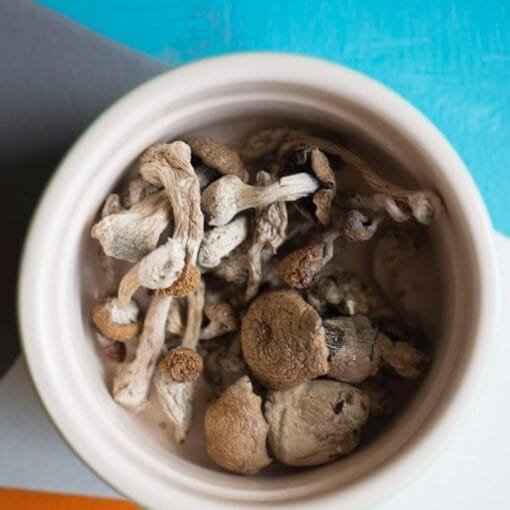
Psilocybe stuntzii – Pacific Northwest Insight Mushroom
Price range: $190.00 through $890.00
Psilocybe stuntzii, native to the Pacific Northwest, offers a gentle psilocybin experience with grounding, emotional balance. Legal and lab-tested by licensed vendors.
Psilocybe stuntzii (Stuntz’s Blue Leg): Identification, Habitat, Potency, and Safety
Psilocybe stuntzii, commonly called Stuntz’s blue leg mushroom or a blue ringer, is a documented Pacific Northwest psilocybin-containing species whose urban ecology and distinctive veil-derived ring have made it both recognizable and consequentially misidentified.
Named for Daniel E. Stuntz, mycologist at the University of Washington, and formally described by Gastón Guzmán and Jonathan Ott, the species is documented from lawns, disturbed ground, bark mulch, and woody debris across the Pacific Northwest—habitats it shares with Galerina marginata, an amatoxin-containing species capable of causing fatal liver failure.
The combination of a veil-derived ring, blue-green bruising, and woody or grassy habitat has generated a persistent identification shortcut in popular literature: ring plus bruising equals P. stuntzii. That shortcut is dangerous.
Galerina marginata can also possess veil-derived ring structures and occupies overlapping woody habitats. Its amatoxins produce a delayed clinical onset—symptoms frequently absent for 6–24 hours after ingestion—meaning a collector who consumes a misidentified Galerina specimen may feel well for hours before the onset of organ-damaging injury.
High-confidence identification of Psilocybe stuntzii requires agreement across macroscopic morphology, veil characters, spore-deposit color, microscopy, habitat, and geographic provenance. No single character is sufficient.
Scientific and Legal Disclaimer: This article serves mycological education, taxonomic documentation, identification safety, and harm-reduction research. It is not a cultivation, harvesting, consumption, or dosing guide. Psilocybin and psilocin remain Schedule I controlled substances under U.S. federal law as of 2026. State and local policies differ; verify current statutes through official government sources before any possession, acquisition, or research activity. Mushroom identification from text, photographs, or online descriptions alone is never sufficient to establish species identity or safety.
Quick Facts: Psilocybe stuntzii at a Glance
| Attribute | Value |
|---|---|
| Common Names | Stuntz’s Blue Leg; Blue Ringer; Blue Ringers |
| Scientific Name | Psilocybe stuntzii Guzmán & Ott |
| Taxonomic Authorities | Gastón Guzmán & Jonathan Ott [VERIFY: year, publication, volume, pages against protologue] |
| Named For | Daniel E. Stuntz (1909–1983), mycologist, University of Washington |
| Family | Hymenogastraceae |
| Order | Agaricales |
| Phylum | Basidiomycota |
| MycoBank/Index Fungorum | [VERIFY identifiers and add direct record links before publication] |
| Active Compounds | Psilocybin, psilocin (reported; see potency section) |
| Spore Print Color | Dark purplish-brown to violet-brown |
| Ecology | Saprotrophic; disturbed grass, bark mulch, woody debris |
| Primary Range | Pacific Northwest (Washington, Oregon, British Columbia); Northern California [VERIFY voucher evidence] |
| Critical Lookalike | Galerina marginata (amatoxin-containing; potentially fatal) |
| Legal Status (USA) | Psilocybin/psilocin: Schedule I federal |
Taxonomic History and Nomenclature
Formal Description and the Stuntz Eponym
Psilocybe stuntzii Guzmán & Ott was formally described by Gastón Guzmán—whose monographic work on the genus remains a foundational taxonomic reference for Psilocybe—and Jonathan Ott, a central figure in mid-twentieth-century ethnomycological literature. [VERIFY: Mycotaxon volume, year, pages, type locality, and holotype repository against protologue before publication]
The species is named for Daniel E. Stuntz (1909–1983), mycologist at the University of Washington and author of influential Pacific Northwest fungal work. Stuntz’s role in training generations of regional mycologists makes the eponym fitting: P. stuntzii is among the most ecologically characteristic Psilocybe of the urban and peri-urban landscapes he studied.
The common name blue ringer references two immediately observable field characters: the blue or blue-green bruising reaction and the veil-derived ring or annular zone on the stipe. The name is functionally descriptive; its precise historical origin and the context in which it emerged should be supported by contemporary documentation before being attributed to a specific period or community.
Resolving this table from the protologue and cross-referencing against MycoBank and Index Fungorum is the highest-priority pre-publication task. It would make this page one of the only online resources for P. stuntzii with a verifiable, complete nomenclatural record—a significant competitive advantage for both traditional search and AI citation.
Current Taxonomic Status and Molecular Context
P. stuntzii is placed in the family Hymenogastraceae, order Agaricales, phylum Basidiomycota, consistent with the molecular-era circumscription of the psilocybin-containing Psilocybe clade.
Molecular phylogenetic placement of P. stuntzii relative to P. cyanescens, P. azurescens, and other Pacific Northwest congeners is not extensively represented in published primary literature as of 2026.
Where a molecular reference record does not yet exist, that absence is informative rather than merely a gap: it means ITS-based identification of putative P. stuntzii specimens carries elevated uncertainty, and any sequence-based identification should explicitly acknowledge the depth and authentication quality of the comparison database.
Relationship to Other Pacific Northwest Psilocybe
P. stuntzii occupies a distinctive ecological position within the Pacific Northwest psilocybin-containing Psilocybe assemblage.
Where P. cyanescens and P. azurescens are most strongly associated with wood-chip substrates in cooler coastal environments, P. stuntzii‘s documented association with disturbed grassy ground and landscaped sites gives it a wider overlap with managed urban space.
This niche distinction has a direct identification implication: a small brown ringed mushroom in a maintained lawn is ecologically more consistent with P. stuntzii than with P. cyanescens, but it is also consistent with Galerina marginata, Agrocybe species, and several other taxa. Ecology narrows the field; it does not identify the specimen.
Psilocybe stuntzii Identification: Morphological and Microscopic Criteria
Direct Answer: Psilocybe stuntzii identification requires multiple converging characters, including cap and gill morphology, veil-derived annular features, dark purplish-brown spores, microscopy, habitat, and provenance. Blue staining and a stem ring are supporting characteristics, not confirmation. Potentially dangerous Galerina must be excluded using the complete specimen rather than any single field test.
Identification Evidence Hierarchy
| Confidence Level | Evidence Required |
|---|---|
| Highest | Authenticated voucher + DNA sequencing + complete macro/microscopic characters |
| Strong | Preserved voucher + microscopy + full macromorphology + compatible ecology |
| Provisional | Full macromorphology + microscopy without independent voucher confirmation |
| Low | Photograph, ring presence, blue staining, habitat, spore color, or AI image match alone |
Macroscopic Traits: Field Identification
Pileus (Cap): Published descriptions characterize the cap as small to medium, broadly convex to nearly plane at maturity, and hygrophanous to subviscid—appearing brown to chestnut or olive-brown when moist, fading to pale buff or yellowish-tan when dry. [VERIFY precise diameter range against protologue]
The hygrophanous color shift is a specific interpretive hazard: a specimen examined after field drying can appear substantially paler than a fresh collection from the same location. Moisture state must be explicitly noted when cap color is used as any part of a diagnostic assessment.
Lamellae (Gills): Gill attachment is described as adnate to adnexed. Gill color progresses from pale at early developmental stages to dark purplish-brown as spore maturity advances, consistent with the psilocybin-containing Psilocybe clade.
Stipe (Stem) and Annular Features: The stem is pale to whitish, fibrous, and relatively slender. A partial veil produces a ring or annular zone on the stipe—the structural feature most central to the common name “blue ringer” and the character most responsible for dangerous misidentification with Galerina marginata.
The partial veil in G. marginata can vary with specimen maturity and weathering: it may be membranous and persistent in younger specimens or deteriorated and ring-zone-like in older material. This variability strengthens rather than weakens the safety argument—veil character alone cannot safely distinguish P. stuntzii from Galerina at any developmental stage.
Blue-Green Bruising: Damage to pileus, lamellae, or stipe can produce blue-to-blue-green discoloration, consistent with the enzymatic oxidation cascade characterized by Lenz et al. (2020) in Angewandte Chemie. Cyanescence supports psilocybin-clade membership but is not species-specific. It may also be weak, delayed, or absent under some field conditions.
Is Blue Staining Proof of Psilocybe stuntzii?
Direct Answer: No. Blue or blue-green staining provides supporting evidence consistent with psilocybin-clade membership but is not sufficiently species-specific to confirm P. stuntzii. Staining intensity varies and the reaction is not exclusive to Psilocybe. The absence of obvious blueing cannot safely be used to classify an unknown mushroom as non-Psilocybe, and its presence cannot confirm species identity.
Does Psilocybe stuntzii Have a Ring on Its Stem?
Direct Answer: Psilocybe stuntzii can have a veil-derived ring or annular zone on the stipe, but a stem ring is not species-specific. Galerina marginata and other unrelated mushrooms display similar veil remnants. Ring morphology should be treated as one component of a complete taxonomic assessment—a reason for careful full-character evaluation, never a positive identification test.
Is Psilocybe stuntzii the Same as a Blue Ringer?
Direct Answer: Blue ringer is a common name associated with Psilocybe stuntzii, referring to its reported blue-green staining and veil-derived ring or annular zone. Common names are not taxonomically precise, and the term should not substitute for species-level identification using the complete morphological, microscopic, and provenance character set.
Microscopic Features
Microscopy provides the most reliable morphological evidence available for differentiating P. stuntzii from dangerous lookalikes and morphologically similar congeners.
Basidiospores: Published descriptions characterize spores as smooth, thick-walled, and bearing a distinct apical germ pore, consistent with the psilocybin-containing Psilocybe clade. [VERIFY precise spore dimensions against the Guzmán & Ott protologue; do not apply measurements from related species without confirmation]
Cystidia: Cheilocystidia and pleurocystidia provide critical diagnostic evidence. Their morphology for P. stuntzii should be verified against the original description and compared against validated species-specific reference keys. [VERIFY and cite specific cystidial dimensions]
Spore surface: The spore surface of Galerina marginata—typically roughened or finely warted—contrasts with the smooth spore surface of P. stuntzii under compound microscopy. Combined with spore-deposit color, this provides one of the most reliable microscopic differentiating characters available between these two species.
On molecular identification: ITS sequencing against authenticated sequences in GenBank or UNITE provides strong molecular evidence where institutional access permits. Reference coverage for P. stuntzii should be explicitly assessed; sparse reference libraries increase false-positive match risk.
Psilocybe stuntzii Spore Print: Color and Interpretation
Direct Answer: Psilocybe stuntzii is described as producing a dark purplish-brown to violet-brown spore deposit, whereas Galerina marginata produces rusty to cinnamon-brown spores. This color difference is among the most important safety characters when evaluating small brown ringed mushrooms in Pacific Northwest woody habitats. Spore deposit color must be assessed on white paper under neutral lighting and interpreted alongside the full morphological and microscopic character set—not as a standalone test.
What Is and Is Not Diagnostic
| Character | Diagnostic Status | Interpretive Caveat |
|---|---|---|
| Veil-derived ring or annular zone | Supportive; important for recognition | Present in Galerina and other dangerous taxa; cannot confirm P. stuntzii |
| Blue-green bruising (cyanescence) | Supportive | Not species-specific; may be weak, delayed, or absent |
| Brown hygrophanous cap | Supportive | Shared with many Pacific Northwest LBMs; color shifts with moisture |
| Dark purplish-brown spore deposit | Strong supportive | Must be assessed under neutral light; discriminates from rusty Galerina spores |
| Smooth spore surface (microscopy) | Strong confirmatory | Contrasts with roughened Galerina spore surface |
| Spore dimensions + germ pore (microscopy) | Strong confirmatory | Requires calibrated measurement against protologue |
| Cheilocystidia morphology (microscopy) | Confirmatory | Requires species-specific validated reference |
| Disturbed grassy/mulch Pacific NW habitat | Contextual | Necessary but not sufficient; shared with dangerous species |
| ITS molecular sequencing | Strong molecular evidence | Quality-dependent; verify reference library depth |
Psilocybe stuntzii Habitat, Distribution, and Ecology
Direct Answer: Psilocybe stuntzii is associated particularly with the Pacific Northwest and has been documented from disturbed grassy and landscaped environments, including sites containing woody debris or bark mulch. Washington State is central to its published distribution. Broader state and provincial range claims should be based on authenticated herbarium records in GBIF and MyCoPortal.
Urban Psilocybe Species: The Landscaping Connection
P. stuntzii is one of the clearest examples of a psilocybin-containing Psilocybe whose documented distribution correlates with human landscape management.
Maintained lawns, ornamental bark mulch, disturbed grassy margins, and wood-chip beds around urban plantings are environments that have expanded substantially across the Pacific Northwest over the past half-century as urban development has replaced native vegetation with managed green space. These substrates create repeated islands of suitable saprotrophic habitat across urban environments.
Whether this association reflects genuine anthropogenic range expansion, collecting bias toward accessible environments, or some combination is an open empirical question. Population-genetic comparison of urban P. stuntzii colonies against regional mulch supply chain records would test whether commercial landscaping constitutes a measurable dispersal mechanism—converting a field observation into an empirically demonstrable ecological finding.
This distinction between a testable ecological hypothesis and an established fact is exactly the kind of epistemic precision that strengthens a resource’s credibility for both human readers and AI retrieval systems.
Voucher-Verified Distribution
| Region | Evidence Status | Source |
|---|---|---|
| Washington State | Primary; type-associated and documented collections | [STATISTICS PLACEHOLDER: voucher count; link to specific GBIF/MyCoPortal records with access date] |
| Oregon | Documented; [VERIFY voucher counts] | [STATISTICS PLACEHOLDER: voucher count; link to specific records] |
| British Columbia | Reported; [VERIFY molecularly confirmed records] | [STATISTICS PLACEHOLDER: record count; link to specific records] |
| Northern California | Reported; requires voucher verification | [VERIFY against primary evidence before publishing] |
| Outside Pacific Northwest | Not documented in verified primary literature | Claims require primary source support |
Link to specific specimen pages with dataset access dates. A link to a verified herbarium record is a traceable primary source; a database homepage is a general reference. That distinction directly affects both AI citation quality and reader trust.
Seasonal Fruiting
P. stuntzii is associated with cool-season fruiting in the Pacific Northwest—autumn and early winter following sustained cool temperatures and adequate precipitation.
Specific temperature thresholds for P. stuntzii fruiting are not established as physiologically validated parameters in the primary literature. Figures in secondary sources should be treated as field-observational guidelines rather than experimentally confirmed thresholds.
Psilocybe stuntzii Potency and Biochemical Profile
Direct Answer: Psilocybe stuntzii contains psilocybin, but no universal potency percentage should be assigned to the species without replicated analyses of authenticated specimens. Alkaloid concentrations can vary with biological material, storage, preparation, and analytical method. Quantitative potency claims should identify the study, sample size, authentication method, and dry-mass normalization before being cited.
Reported Alkaloid Content and Evidence Quality
P. stuntzii is treated as psilocybin-containing in the primary and secondary literature, consistent with its placement within the psilocybin-producing Psilocybe clade.
| Claim | Evidence Category |
|---|---|
| Psilocybin reported | Consistent with clade placement; requires species-specific chemical verification |
| Specific concentration percentages | [STATISTICS PLACEHOLDER: identify original study, n specimens, authentication method, analytical method, psilocybin/psilocin ranges, dry-mass normalization] |
| Potency rank relative to other Psilocybe | No multi-specimen comparative dataset identified for this species specifically |
If no reliable P. stuntzii-specific chemical dataset exists, explicitly documenting that absence is more authoritative than repeating secondary potency percentages. A resource that accurately represents the limits of available evidence earns more citation credibility than one that fills gaps with unverified figures.
Pharmacological Mechanism
Psilocybin is a phosphorylated tryptamine prodrug that undergoes enzymatic dephosphorylation to psilocin following ingestion. Psilocin acts as an agonist at 5-HT2A serotonin receptors, producing the characteristic psychedelic effects associated with the psilocybin-containing Psilocybe clade, as reviewed by Nichols (2016) in Pharmacological Reviews. This mechanism is shared across the clade and is not specific to P. stuntzii.
Galerina marginata vs. Psilocybe stuntzii: The Critical Safety Comparison
Direct Answer: Psilocybe stuntzii and Galerina marginata can occur in overlapping woody and landscaped habitats and may both display veil-derived material on the stipe. P. stuntzii has dark purplish-brown spores; G. marginata has rusty to cinnamon-brown spores and contains potentially lethal amatoxins. High-confidence differentiation requires complete macromorphology, spore-deposit evaluation, and microscopy—never a single field character.
Galerina marginata: The Amatoxin Hazard
Galerina marginata contains amatoxins including α-amanitin, which inhibit RNA polymerase II, blocking cellular transcription and producing progressive, potentially irreversible hepatic and renal injury.
Karlson-Stiber and Persson (2003) [VERIFY this is the correct citation for amatoxin poisoning clinical data; confirm journal, volume, pages, and DOI before publication—do not merge separate bibliographic records] documented the characteristic delayed clinical presentation of amatoxin poisoning. Symptoms may be absent for 6–24 hours after ingestion—a feature that has historically contributed to fatal treatment delays by creating a false initial impression of safety.
The American Association of Poison Control Centers (AAPCC) identifies Galerina marginata among the most toxicologically significant mushroom species in North America.
Comparative Character Matrix
| Diagnostic Character | Psilocybe stuntzii | Galerina marginata |
|---|---|---|
| Spore deposit color | Dark purplish-brown to violet-brown | Rusty to cinnamon-brown |
| Spore surface (microscopy) | Smooth | Roughened; finely warted |
| Blue bruising (cyanescence) | Documented; supports psilocybin-clade | Absent |
| Veil-derived ring or annular zone | Present; can be fragile or deteriorated | Present; variable with maturity and weathering |
| Stipe character | Pale, fibrous; blues when damaged | Brownish; fibrillose; ring character varies |
| Primary toxicological concern | Psychoactive tryptamines (Schedule I) | Potentially fatal amatoxins |
| Habitat | Woody debris, mulch, disturbed ground | Overlapping woody or landscaped habitats |
Why the Ring Creates Dangerous Confusion
The veil-derived ring is the character most responsible for P. stuntzii–Galerina confusion, and understanding exactly why clarifies the identification challenge.
Both species possess a partial veil. Both occur in Pacific Northwest woody and landscaped habitats. Both are small brown mushrooms that an inexperienced observer might initially classify as “a ringed brown mushroom in mulch.”
The critical differentiating characters require steps beyond casual field observation: taking a spore print to discriminate rusty Galerina spores from purplish-brown P. stuntzii spores, assessing fresh tissue for bruising that Galerina lacks, and—most reliably—microscopic examination of spore surface texture and cystidial morphology.
High-confidence identification should integrate complete macromorphology, spore-deposit characteristics, microscopy, substrate, and provenance. Molecular evidence can further strengthen a research-grade determination.
Can Galerina marginata and Psilocybe stuntzii Grow in the Same Patch?
Direct Answer: They can occur in overlapping woody and landscaped habitats, so proximity does not establish that all mushrooms in a patch belong to the same species. Each collection requires independent assessment. Potentially fatal Galerina should never be excluded because neighboring mushrooms were identified as Psilocybe.
Psilocybe stuntzii vs. Psilocybe cyanescens: Adjacent Species Comparison
A frequent identification question in the Pacific Northwest concerns the relationship between P. stuntzii and P. cyanescens—the most widely documented wood-chip-associated psilocybin-containing Psilocybe in the region.
| Character | Psilocybe stuntzii | Psilocybe cyanescens |
|---|---|---|
| Cap margin | Broadly convex to nearly plane | Often strongly undulate (wavy) at maturity |
| Veil character | Produces ring or annular zone | Typically no persistent membranous annulus |
| Primary habitat | Disturbed grass, landscaped areas, mixed mulch | Wood chips, bark mulch, woody debris |
| Stipe | Pale, fibrous, with annular remnants | Whitish, fibrillose, no prominent ring |
| Spore deposit | Dark purplish-brown to violet-brown | Dark purplish-brown |
| Cyanescence | Documented; variable | Characteristically pronounced |
| Geographic center | Washington State; documented urban/peri-urban | Pacific coast; coastal woodland and urban mulch |
The most accessible field discriminator between these two species is the veil: P. stuntzii retains a ring or annular zone; P. cyanescens does not characteristically produce a persistent membranous annulus.
The most important shared safety consideration is that both species occupy Pacific Northwest woody and landscaped environments alongside Galerina marginata, meaning the same multi-character identification standard applies to both.
Psilocybe stuntzii Lookalikes: Additional Species
⚠️ Safety Warning: If an unidentified mushroom has potentially been consumed, do not wait for symptoms before seeking guidance. Contact Poison Control at 1-800-222-1222 or visit Poison.org. Call 911 for any medical emergency. Retain specimens or clear photographs; they assist medical and mycological experts in assessment.
Direct Answer: Beyond Galerina marginata, Pacific Northwest taxa that may superficially resemble P. stuntzii include Leratiomyces ceres, Agrocybe species, and Deconica species. Each requires exclusion through the full character set. Regional lookalike assemblages in urban Pacific Northwest habitats are complex; specialist knowledge and microscopy cannot be substituted by field appearance or photographs.
Leratiomyces ceres (Red Lead Head)
Leratiomyces ceres is a common wood-chip and mulch species whose orange-red to brick-red cap immediately distinguishes it from P. stuntzii in fresh material. Its spores are dark purplish-brown, overlapping at the deposit level, but the distinctive cap color and differing microscopic anatomy provide reliable differentiation in typical specimens. Weathered or faded specimens may present a less distinctive cap color—reinforcing the value of full-character assessment rather than reliance on any single visual feature.
Agrocybe Species
Agrocybe species—particularly A. praecox and related taxa—are brown-capped, ring-bearing, wood-chip-associated mushrooms that may cause initial confusion. They typically produce brown rather than purplish-brown spore deposits, and their microscopic anatomy, including thick-walled cystidia, differs substantially from P. stuntzii. Spore-print color under neutral lighting and cystidial morphology together effectively discriminate Agrocybe from P. stuntzii in most cases.
Deconica Species
Following molecular revision of Psilocybe, several former species were transferred to Deconica—a placement reflecting phylogenetic evidence that these taxa fall outside the psilocybin-containing clade. Deconica species encountered in Pacific Northwest urban habitats do not contain psilocybin, and “formerly placed in Psilocybe” is not a reliable indicator of psilocybin content for species now in Deconica. Genus-level placement requires comparison against current molecular taxonomy, not historical nomenclature.
Pacific Northwest Active Mushrooms: Psilocybe stuntzii in Regional Context
P. stuntzii is notable for its association with human-disturbed Pacific Northwest landscapes. Lawns, woody landscaping materials, and disturbed ground can create suitable saprotrophic habitat. Whether commercial mulch also acts as a regional dispersal network for P. stuntzii remains a testable ecological hypothesis rather than an established fact.
The broader urban Psilocybe ecology of the Pacific Northwest—the relationship between commercial landscaping infrastructure, mulch sourcing, and documented fungal species distribution—represents a scientifically productive and largely unresolved research question.
Urban environments also compress multiple species into small areas. A lawn or landscaped bed in a Pacific Northwest city may simultaneously host P. stuntzii, Galerina marginata, and other dark-spored fungi in the same visible cluster—making the multi-character identification standard not analytical excess but an accurate reflection of the actual identification environment.
Spore Microscopy, Legality, and Regulatory Status
Federal and State Legal Frameworks
Psilocybin and psilocin are Schedule I controlled substances under the Controlled Substances Act, 21 U.S.C. § 812, as enumerated in 21 C.F.R. § 1308.11.
Psilocybe spores generally do not contain psilocybin or psilocin at detectable concentrations, but legal status varies substantially by state statute and intended purpose.
California, Georgia, and Idaho have historically maintained statutory provisions relevant to spores from psilocybin-producing species. Current statutory language should be verified through official legislative sources—California Legislative Information, the Georgia General Assembly, and the Idaho Legislature—rather than vendor claims or secondary summaries.
Local decriminalization measures do not supersede federal scheduling.
Microscopy and the Annular Character
For researchers examining spores from legally obtained, jurisdictionally compliant material, P. stuntzii presents particular research interest because of the combination of characters that also make it difficult to identify: veil-derived annular features, smooth thick-walled spores with apical germ pore, and cystidial morphology that differentiates it from Galerina under compound microscopy.
Documenting spore surface texture, measuring spore dimensions with calibrated microscopy, and characterizing cheilocystidia against the Guzmán & Ott protologue provides the most reliable morphological differentiation available from properly preserved material.
All institutional research should proceed under current biosafety, DEA, and applicable ethics board protocols.
Research Priorities for Psilocybe stuntzii
1. Protologue retrieval and verified nomenclature. Confirming authorship order, publication year, Mycotaxon volume and pages, type locality, holotype repository, and direct MycoBank and Index Fungorum record links is the single highest-priority task. This would make the page one of the only online resources with a verifiable, complete nomenclatural record for P. stuntzii.
2. Voucher-backed distribution dataset. Systematic review of GBIF and MyCoPortal specimen records, separated by state/province and preservation type (herbarium versus observational), would produce the most accurate published distribution summary for this species.
3. Molecular phylogenetic placement. ITS sequencing of voucher-verified P. stuntzii specimens would establish the species’ position relative to P. cyanescens, P. azurescens, and other Pacific Northwest congeners, and determine whether current morphological species boundaries correspond to molecular reality.
4. Validated alkaloid profiling. Multi-specimen LC-MS/MS analysis of genetically verified material—with standardized dry-mass normalization and distributional reporting—would replace historically inferred psilocybin content with primary analytical evidence. If no such dataset exists, that absence is itself informative and should be documented explicitly.
5. Urban dispersal and population genetics. Population-genetic comparison of P. stuntzii colonies from geographically distributed urban Pacific Northwest sites against commercial mulch supply chain records would test directly whether landscaping infrastructure functions as a measurable dispersal network.
Primary Sources and Taxonomic References
- Guzmán, G. & Ott, J. [Psilocybe stuntzii original description]. [VERIFY: Mycotaxon volume, year, pages, stable URL or DOI]
- Guzmán, G. (1983). The Genus Psilocybe. J. Cramer, Vaduz. CAB Abstracts
- Lenz, C., et al. (2020). Injury-triggered blueing reactions of Psilocybe fungi. Angewandte Chemie International Edition, 59(4), 1450–1454. DOI: 10.1002/anie.202000953
- Nichols, D. E. (2016). Psychedelics. Pharmacological Reviews, 68(2), 264–355. DOI: 10.1124/pr.115.011478
- Amatoxin poisoning clinical reference\]. \[VERIFY correct citation for amatoxin clinical data—confirm whether this is Karlson-Stiber & Persson (2003) in *Toxicon* or a different paper; do not merge separate bibliographic records\]
- MycoBank record for Psilocybe stuntzii. [VERIFY identifier and add direct URL]
- Index Fungorum record for Psilocybe stuntzii. [VERIFY identifier and add direct URL]
- Any validated LC-MS/MS alkaloid analysis of *P. stuntzii*\]. \[IDENTIFY and cite if available; document absence if not\]
- GBIF occurrence record(s) for verified *P. stuntzii* specimens\]. \[IDENTIFY and link with specific record URLs and dataset access date\]
Frequently Asked Questions
What is Psilocybe stuntzii?
Psilocybe stuntzii is a psilocybin-containing mushroom documented from the Pacific Northwest and named for Daniel E. Stuntz, mycologist at the University of Washington. Formally described by Gastón Guzmán and Jonathan Ott, it is associated with disturbed grassy and landscaped environments and is characterized by dark purplish-brown spores, veil-derived annular features, and reported blue-green staining. Its veil-derived ring and blue bruising are supporting characteristics, not sufficient for safe identification.
Why is Psilocybe stuntzii called a blue ringer?
The name “blue ringer” references two immediately observable field characters: reported blue-green staining and the veil-derived ring or annular zone on the stipe. It is a functionally descriptive common name rather than a taxonomic designation, and it should not substitute for species-level identification using the complete morphological, microscopic, and provenance character set.
Where does Psilocybe stuntzii grow?
Psilocybe stuntzii is associated particularly with the Pacific Northwest—Washington, Oregon, and British Columbia, with additional reports from Northern California requiring voucher verification. Documented habitats include lawns, disturbed ground, bark mulch, and woody debris in landscaped environments. Geographic range claims should be based on authenticated herbarium records in GBIF and MyCoPortal, not secondary range maps.
Does Psilocybe stuntzii have a ring on its stem?
Psilocybe stuntzii can have a veil-derived ring or annular zone on the stipe, but this feature cannot confirm the species. Galerina marginata and other unrelated mushrooms also display veil-derived structures, and veil character in Galerina varies with maturity and weathering. The ring should be treated as one component of a complete taxonomic assessment—never a positive identification test.
What color is a Psilocybe stuntzii spore print?
Psilocybe stuntzii is described as producing a dark purplish-brown to violet-brown spore deposit, whereas Galerina marginata produces rusty to cinnamon-brown spores. This difference is among the most important safety characters when evaluating small brown ringed mushrooms in Pacific Northwest woody habitats. Spore color must be assessed on white paper under neutral lighting and interpreted alongside the full morphological and microscopic character set.
How can you distinguish Galerina marginata from Psilocybe stuntzii?
Psilocybe stuntzii has dark purplish-brown spores and smooth spores under microscopy, while Galerina marginata has rusty to cinnamon-brown spores and roughened spore surfaces. Both can display veil-derived features and occur in overlapping woody or landscaped habitats. Because G. marginata contains potentially fatal amatoxins, differentiation requires complete macromorphology, spore-deposit evaluation, and microscopy—not a single field observation.
How potent is Psilocybe stuntzii?
Psilocybe stuntzii contains psilocybin and is psychoactive, but no universal potency percentage should be assigned without replicated chemical analyses of authenticated specimens. Quantitative potency claims should identify the study, sample size, authentication method, and dry-mass normalization. If no reliable P. stuntzii-specific chemical dataset is currently available, explicitly documenting that absence is more authoritative than repeating unverified secondary figures.
Is blue staining proof of Psilocybe stuntzii?
No. Blue or blue-green staining supports psilocybin-clade membership but is not species-specific and may be weak, delayed, or absent under some conditions. The absence of obvious bruising cannot be used to exclude P. stuntzii, and its presence cannot confirm it. Reliable identification requires agreement among macroscopic morphology, microscopy, spore characteristics, veil features, habitat, and provenance.
Can Psilocybe stuntzii and Galerina marginata grow in the same patch?
Yes. Both species can occur in overlapping woody and landscaped habitats, meaning proximity does not establish that all mushrooms in a patch belong to the same species. Each collection requires independent assessment. Potentially fatal Galerina should never be excluded because neighboring mushrooms were identified as Psilocybe.
Conclusion: Psilocybe stuntzii and the Evidence Standard Its Lookalike Demands
Psilocybe stuntzii is a Pacific Northwest Psilocybe whose identification challenge is inseparable from its most distinctive field characters. The veil-derived ring that gives it the common name “blue ringer,” combined with blue-green bruising and an urban woody habitat, creates a profile memorable enough to encourage overconfident identification—and dangerous enough to require the opposite.
Galerina marginata possesses a veil-derived ring. It occupies overlapping mulch and woody debris habitats. It contains amatoxins that can cause fatal liver failure with a delayed onset that may create a false sense of safety hours after ingestion. And the variability of its veil character with maturity and weathering means there is no reliable single visual test that separates it from P. stuntzii in field conditions.
That is the biological reality that makes the identification framework this article presents—full character convergence across macromorphology, spore-deposit color, smooth versus roughened spore surface under microscopy, and complete cystidial assessment—not excessive caution but the minimum standard justified by the actual lookalike assemblage.
The most consequential remaining work is evidentiary: retrieving the Guzmán & Ott protologue, confirming the complete nomenclatural record, verifying the toxicology citation, building a voucher-backed distribution dataset, documenting the alkaloid evidence base honestly, and replacing every [VERIFY] marker with a traceable primary source.
| QUANTITY | OZ, 1/4 POUND, 1/2 POUND, POUND |
|---|
31 reviews for Psilocybe stuntzii – Pacific Northwest Insight Mushroom
Add a review
Related products

MAGIC MUSHROOMS
Psilocybe Azurescens – Ultra-Potent Wild Psilocybin Mushroom


MAGIC MUSHROOMS

MAGIC MUSHROOMS
Blue Meanie Mushrooms – Ultra-Potent Psilocybe Cubensis Strain


MAGIC MUSHROOMS


Raegan Valentine (verified owner) –
Shipping was fast, unmarked, and secure. Very professional.
Luca Nash (verified owner) –
Beautiful energy.
Amaya Rosenthal (verified owner) –
This changed the way I see my past, in the best way.
Clark Vincent (verified owner) –
Every color seemed to carry a message. I cried a little — not out of sadness, but because something in me finally felt seen.
Jacob Roberts (verified owner) –
You’re not just buying a product here — you’re entering a process that’s treated with integrity.
Raymond Joseph (verified owner) –
Every step felt respectful, like this wasn’t just about selling something — it was about helping someone reconnect with themselves.
Winston Harrell (verified owner) –
Discreet and efficient shipping.
Blake Russell (verified owner) –
Beautiful experience, smooth journey, and zero stress about shipping. These folks know exactly what they’re doing.
Delilah Holland (verified owner) –
Everything was discreet and smooth — no anxiety, just anticipation. And the product didn’t disappoint.
Louis Doyle (verified owner) –
Every thought felt intentional. Like my mind was guiding me through healing.
Sierra McKenzie (verified owner) –
Helped me reconnect with people in my life.
Joel Graham (verified owner) –
From start to finish, it felt like I was in good hands. Customer service was responsive and respectful, and the product was top-tier.
Julia Parker (verified owner) –
It helped me break through emotional blocks I didn’t even know were there.
Kendra Robbins (verified owner) –
A beautiful, sacred experience.
Ronin Chadwick (verified owner) –
I felt so much love during my trip. Thank you for making this safe.
Gerald Tate (verified owner) –
The emotional clarity I gained from this session is hard to put into words. It felt safe, guided, and surprisingly gentle.
Sierra Brewer (verified owner) –
I could finally see things clearly — emotionally, mentally, spiritually. The team behind this product made that clarity possible.
Tessa Carver (verified owner) –
The emotional insight I gained is invaluable.
Naomi Warren (verified owner) –
The journey itself was transformative, and it helped so much knowing the source was trustworthy and experienced.
Skye Zimmerman (verified owner) –
This isn’t just product delivery — it’s care, trust, and a commitment to a better experience.
Bryan Patterson (verified owner) –
Fast, private delivery and emotional peace I didn’t know I needed.
Briar Neely (verified owner) –
Everything about this experience was intentional and healing.
Paola Henson (verified owner) –
Great potency without being overwhelming.
Xavier Craig (verified owner) –
From the moment I received the package, I knew I was in for something different. I wasn’t wrong.
Cason Lockett (verified owner) –
I was able to forgive myself.
Annalise Owen (verified owner) –
Even before the trip, I felt calm — because everything about the ordering experience was solid and trustworthy.
Christian Evans (verified owner) –
My experience with this product was sacred, and the way it was delivered only enhanced that trust.
Jocelyn Spencer (verified owner) –
This gave me space to explore parts of myself without fear or confusion. Everything was clear, even the packaging.
Maurice Lowe (verified owner) –
This isn’t just about the trip — it’s about feeling safe, informed, and respected along the way. That’s exactly what I got here.
Katherine Powell (verified owner) –
Everything about this was thoughtful. It made me want to take the experience seriously — and I’m so glad I did.
Gabriella Barnes (verified owner) –
I used this in a quiet space with my journal, and by the end, I felt like I had released months of tension.