


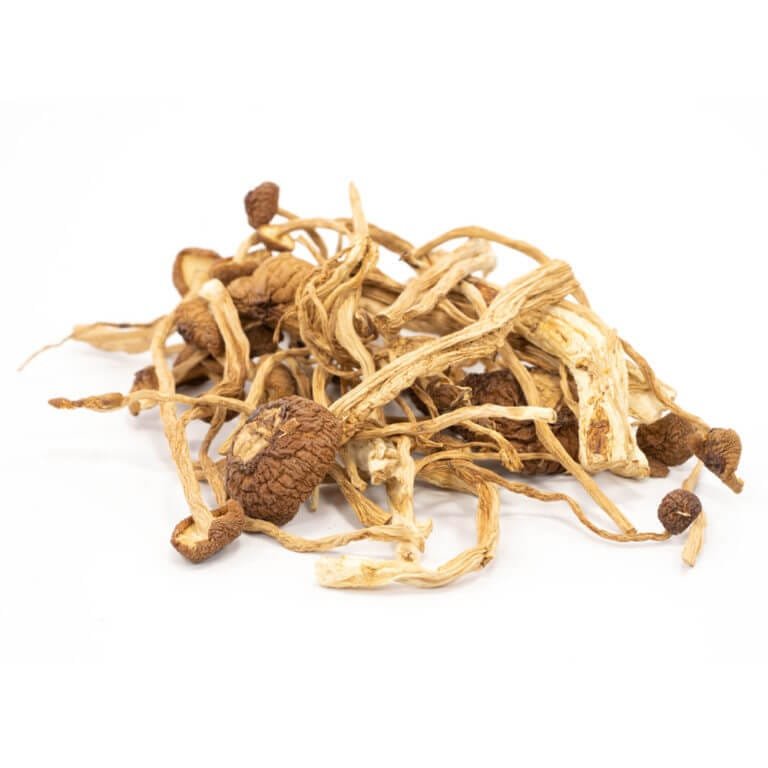
Mexican Cubensis Mushrooms – Traditional Psilocybe for Visionary Experiences
Price range: $180.00 through $910.00
Experience a time-honored psychedelic journey with Mexican Cubensis Mushrooms, a legendary strain rooted in indigenous ritual use and revered for its visionary clarity.
Mexican Cubensis Mushrooms: History, Potency, Effects & Identification
Mexican Cubensis mushrooms are commercially named lineages of Psilocybe cubensis reported to have Mexican provenance. They are not the same organism as Psilocybe mexicana, a separate species with its own taxonomic and ethnomycological history. That distinction matters because online strain guides frequently treat the biology, history, potency, and cultural associations of these mushrooms as though they were interchangeable—a conflation this guide deliberately avoids.
What follows separates three categories that strain pages routinely mix together: established facts about P. cubensis and psilocybin; observations specifically documented for Mexican-labeled specimens; and community or vendor claims that remain anecdotal or unverified. In particular, there is no good evidence for a universal Mexican Cubensis potency percentage or a uniquely predictable “visionary,” calm, or low-body-load experience.
Quick answer: Mexican Cubensis is a commercial name for Psilocybe cubensis material reportedly associated with Mexico. It is taxonomically distinct from Psilocybe mexicana. Claims that Mexican Cubensis has standardized potency, uniquely spiritual effects, or direct ancestry from mushrooms used in historic Mazatec ceremonies require evidence that commercial strain descriptions generally do not provide.
| Key fact | Evidence-based assessment |
|---|---|
| Species | Psilocybe cubensis |
| “Mexican” | Commercial lineage/strain designation |
| Reported provenance | Mexico; quality of documentation varies |
| Same as P. mexicana? | No |
| Active compounds | P. cubensis can contain psilocybin, psilocin and related tryptamines |
| Standardized potency | No established universal concentration |
| “Visionary” reputation | Primarily anecdotal/commercial characterization |
| Historical Mazatec connection | Mexican sacred-mushroom history is real; direct linkage to this commercial lineage should not be assumed |
| Microscopy | Spores can provide useful morphological observations |
| U.S. legality | Depends on material, conduct, state/local law and current legal context |
What Are Mexican Cubensis Mushrooms?
Quick answer: Mexican Cubensis mushrooms are P. cubensis specimens carrying a commercial lineage name associated with Mexico. “Mexican” is not a separate species and should not be treated as a formally recognized taxonomic variety. Commercial provenance, potency, phenotype, and subjective-effect claims each require their own evidence.
Where Mexican Cubensis Fits Within Psilocybe cubensis
Psilocybe cubensis is an accepted fungal species classified within Fungi, Basidiomycota, Agaricomycetes, Agaricales, and Hymenogastraceae. Its accepted name and taxonomic history can be checked through authoritative fungal databases such as MycoBank and Index Fungorum.
“Mexican,” Golden Teacher, B+, Mazatapec, and Penis Envy are names used commercially for P. cubensis material—not formally recognized species names. Their use can communicate marketplace or lineage history, but the label by itself does not establish genetic uniformity, potency, or provenance.
Where Did the Mexican Cubensis Strain Originate?
Quick answer: Mexican Cubensis is commercially reported to originate in Mexico, but widely repeated geographic attribution is not the same as authenticated provenance. A strong origin claim requires original collection records, location and date information, voucher material, or other evidence connecting modern specimens to a documented Mexican collection.
Ten retailers repeating the same origin story do not constitute ten independent pieces of evidence if all ultimately derive from an undocumented commercial description. For that reason, this guide uses “reported Mexican provenance” unless a specific specimen or lineage has traceable documentation.
Is “Mexican” a Strain, Variety, Cultivar, or Commercial Lineage?
“Mexican strain” is common search and marketplace terminology. “Commercial lineage” is often the safer scientific formulation, because “variety” implies a recognized taxonomic rank and “strain” can suggest more genetic uniformity than the underlying fungal material necessarily possesses. Unless an authoritative taxonomic source establishes a formal infraspecific rank, the notation “Psilocybe cubensis var. Mexican” should not be used as though it were an accepted scientific name.
Are Mexican Cubensis and Psilocybe mexicana the Same Mushroom?
Quick answer: No. Mexican Cubensis refers to commercially named material within Psilocybe cubensis. Psilocybe mexicana is a separate recognized species. Their shared geographic modifier creates substantial online confusion, but “Mexican Cubensis” cannot be shortened to “P. mexicana” without changing the organism under discussion.
| Feature | Mexican Cubensis | Psilocybe mexicana |
|---|---|---|
| Accepted species | Psilocybe cubensis | Psilocybe mexicana |
| Meaning of “Mexican” | Modern commercial/lineage designation | Geographic species epithet |
| Taxonomic relationship | Material identified as P. cubensis | A separate Psilocybe species |
| General morphology | P. cubensis morphology; phenotype varies | Distinct species morphology [CITE TAXONOMIC DESCRIPTION] |
| Sclerotia | Not a defining Mexican Cubensis lineage feature | Sclerotial formation documented |
| Historical significance | Do not infer ceremonial ancestry from the commercial name | Discuss only where species-specific history supports it |
| Authentication | Provenance/molecular evidence needed for lineage claims | Species-level taxonomic evidence |
Strain or Lineage Versus Species
Species and commercial strain names operate at different levels of biological classification. P. cubensis and P. mexicana are distinct taxonomic entities. “Mexican” modifies a commercial P. cubensis lineage; it does not transform cubensis into mexicana. Mixing them produces incorrect claims about morphology, ecology, sclerotia, history, and chemistry—errors that recur frequently across strain-guide content.
How Does Their Morphology Differ?
P. cubensis generally produces fruit bodies with morphology characteristic of that species, although cap coloration, stem proportions, and overall dimensions can vary considerably. P. mexicana is described in taxonomic literature as a more delicate mushroom with a comparatively small cap and slender stipe. Both descriptions should be sourced from peer-reviewed taxonomic literature rather than commercial strain photographs.
What Are Sclerotia?
Sclerotia are compact masses of hardened fungal tissue that function as resistant nutrient-storage structures. P. mexicana is among the Psilocybe species documented as capable of producing them. This is the source of a specific and consequential confusion: products colloquially called “magic truffles” are sclerotia rather than botanical truffles. Their association with P. mexicana does not make a Mexican-labeled P. cubensis lineage the same species.
Why Do Websites Confuse the Two?
The shared word “Mexican” is the obvious cause, compounded by commercial naming practices and the fact that historical discussions of Mexican psychoactive fungi involve multiple Psilocybe species. The practical remedy is straightforward: check the binomial first. Psilocybe cubensis and Psilocybe mexicana identify different species regardless of geographic branding.
What Is the History of Psilocybin Mushrooms in Mexico?
Quick answer: Psychoactive mushroom traditions in Mexico predate modern Western psychedelic culture by centuries. Twentieth-century encounters involving Mazatec healer María Sabina, R. Gordon Wasson, and later chemical work by Albert Hofmann became internationally influential. That history should not be retroactively assigned to modern Mexican Cubensis commercial lineages as though a strain label were a genealogical certificate.
A note on sources: The history section that follows relies on primary publications and qualified ethnomycological and historical scholarship. Commercial Mexican Cubensis origin stories and Mexican sacred-mushroom history are distinct source categories and should not be used to corroborate each other.
Indigenous Mushroom Traditions Before Modern Western Interest
Mesoamerican mushroom history is substantially older and culturally richer than the modern psychedelic movement. Archaeological, colonial, linguistic, and ethnographic evidence has been interpreted in relation to ceremonial mushroom use across different regions and periods.
Care is needed with sweeping phrases such as “the ancient Mexican tradition.” Mexico encompasses many Indigenous peoples with distinct languages, practices, and histories. Nahua historical material, Mazatec twentieth-century practice, and modern commercial P. cubensis genetics are not interchangeable categories, and conflating them flattens a complex record into convenient marketing.
[HISTORICAL SOURCE: peer-reviewed or academic treatment of Mesoamerican mushroom evidence, e.g., Wasson, Heim et al., or qualified ethnohistorical scholarship.]
What Does Teonanácatl Mean?
Teonanácatl is a Nahuatl term recorded in colonial-era accounts and commonly connected in English-language psychedelic literature to sacred mushrooms. The frequently repeated translation “flesh of the gods” should not be treated as linguistically settled merely because it circulates widely. The term’s morphology and precise referents have been discussed by Nahuatl scholars, and at least one alternative reading connects it to different semantic fields.
Responsible treatment requires citing qualified Nahuatl scholarship, acknowledging the linguistic and historical complexity, and resisting the urge to optimize a contested translation as a keyword phrase.
Who Was María Sabina?
Quick answer: María Sabina (1894–1985) was a Mazatec curandera from Huautla de Jiménez, Oaxaca. Her ceremonial mushroom practices gained international attention after R. Gordon Wasson’s visits in the 1950s. Nothing about that history, by itself, establishes ancestry for the modern commercial lineage called Mexican Cubensis.
Sabina’s veladas existed within a Mazatec healing, linguistic, religious, and community context. They should not be reduced to an early version of modern recreational psychedelic use or used as evidence that a contemporary commercial strain carries uniquely “spiritual” properties.
Western attention also affected Sabina and Huautla de Jiménez in ways that deserve historically sourced treatment rather than brief acknowledgment. Before publication, connect this passage to qualified scholarship examining Sabina’s life, Mazatec perspectives, and the consequences of international psychedelic tourism.
R. Gordon Wasson and the 1957 Life Article
Banker and amateur ethnomycologist R. Gordon Wasson participated in a mushroom ceremony with Sabina in 1955. His illustrated account “Seeking the Magic Mushroom,” published in Life on May 13, 1957, introduced a large Western readership to what he had encountered in Oaxaca and became a milestone in the Western history of psychedelic mushrooms.
That publication does not constitute evidence that Wasson consumed the modern commercial lineage sold today as “Mexican Cubensis.” Historical encounter and present-day marketplace product are not the same thing, and treating Wasson’s account as provenance for a commercial strain conflates two different kinds of documentation.
[PRIMARY SOURCE: Wasson, R. G. (1957, May 13). Seeking the Magic Mushroom. Life. Link to authenticated archive.]
What Did Albert Hofmann Actually Establish About Psilocybin?
Quick answer: Albert Hofmann and colleagues played a central role in the late-1950s isolation, characterization, and synthesis of psilocybin and psilocin from documented psychoactive mushroom research. Their work established important chemistry; it did not establish a unique chemical profile for today’s commercial Mexican Cubensis lineage.
The production version of this section should name the exact mushroom species and material investigated in each cited primary paper and distinguish isolation, structural determination, and synthesis chronologically. That precision is more accurate—and more citation-worthy—than the common shorthand that Hofmann simply “extracted psilocybin from Mexican Cubensis.”
[VERIFIED HOFMANN PAPER 1: full citation, DOI.]
[VERIFIED HOFMANN PAPER 2: full citation, DOI.]
Why This History Does Not Prove Mexican Cubensis Ancestry
The propositions “Mexico has longstanding sacred-mushroom traditions” and “a modern P. cubensis lineage is sold as Mexican” can both be true without the latter being the genetic descendant of mushrooms involved in a Mazatec velada. A historical event establishes history. It does not establish a genetic chain of custody for a commercial product sold decades later.
| Period | Event | What it establishes |
|---|---|---|
| Pre-modern/colonial record | Evidence concerning ceremonial mushrooms in Mesoamerica | Deep historical context |
| 1955 | Wasson’s encounters with María Sabina | Documented Mazatec/Western encounter |
| 1957 | Life publishes “Seeking the Magic Mushroom” | Major Western media exposure |
| Late 1950s | Hofmann and colleagues characterize psilocybin/psilocin | Modern chemical identification |
| Modern period | Commercial Mexican Cubensis lineages circulate | Marketplace/mycological lineage history; not automatically ancient ancestry |
[IMAGE: Mexican mushroom-history timeline with citations for every dated event. Alt: “Timeline of Mexican psilocybin mushroom history from pre-colonial records through modern commercial lineages.” Caption: Historical events and commercial lineage history are distinct evidence categories.]
What Do Mexican Cubensis Mushrooms Look Like?
Quick answer: Mexican-labeled P. cubensis generally exhibits morphology consistent with that species—including a pileus, central stipe, gills, and dark mature spores. Cap color, proportions, bruising, and veil characteristics can vary. No single visible feature reliably proves that a specimen belongs to the Mexican commercial lineage.
Pileus, Stipe, Lamellae, and Annulus
The pileus is the mushroom cap; lamellae are the gills beneath it; the stipe is the stem. An annulus may remain where partial-veil tissue separates during maturation. Descriptions of Mexican Cubensis appearance often emphasize relatively standard P. cubensis morphology, and those descriptions should not be converted into rigid diagnostic measurements without specimen-level data.
What Does Blue Bruising Indicate?
Blue bruising can occur in psilocybin-containing mushrooms when tissue is damaged. Research identified the injury-triggered oxidative enzymatic cascade responsible, linking the color change to psilocin-derived compounds. That mechanism is scientifically relevant; it is not a calibrated potency meter, and darker bruising does not provide a validated numerical measurement of psilocybin content.
Lenz et al. investigated this blueing reaction. Their findings help explain why blue color can occur—they do not transform visible bruising into a concentration test.[LENZ ET AL., VERIFIED PUBLISHER CITATION]
Spore Prints and Microscopic Characteristics
P. cubensis produces dark purplish-brown spore deposits. Under microscopy, basidiospore morphology can contribute to taxonomic assessment alongside other characteristics. For research-grade Mexican spore specimens, documentation should include magnification, calibrated scale bars, specimen and lot provenance, imaging conditions, and unedited representative images.
Which Traits Are Really Mexican-Specific?
A trait observed in Mexican-labeled material is not necessarily exclusive to that lineage—and many commercial descriptions are overconfident on this point.
[MYCOLOGIST REVIEW: characterize which proposed Mexican traits have documented specimen support versus which are general P. cubensis characteristics. Required before publication.]
[IMAGE: Annotated Mexican-labeled P. cubensis specimen showing pileus, stipe, lamellae, and annulus. Alt: “Annotated diagram of a Mexican-labeled Psilocybe cubensis specimen showing pileus, stipe, lamellae, and annulus.” Caption: Educational morphology only—not an identification key or ingestion-safety guide. Include specimen provenance and developmental stage.]
Can Appearance Reliably Identify the Mexican Cubensis Lineage?
Quick answer: No. Appearance can support identification of a specimen consistent with P. cubensis, but morphology alone generally cannot authenticate the Mexican commercial lineage. Environmental conditions influence phenotype, and visually similar characteristics appear across multiple P. cubensis lineages.
Phenotype Is Not the Same as Genotype
Phenotype describes observable characteristics shaped by both genetics and environment. Two related fungal samples can look meaningfully different, while less closely related samples can converge on visually similar features. Commercial strain authentication therefore cannot be reduced to cap color, stem shape, or bruising response.
Cap Color and Bruising Are Weak Lineage Markers
Golden or tan caps and blue bruising are not fingerprints specific to the Mexican commercial lineage. Treating them as diagnostic creates false certainty—particularly when visual resemblance to an online photograph is the only basis for identification.
What Stronger Authentication Looks Like
Depending on the claim, stronger evidence can include documented provenance, voucher material, chain-of-custody records, expert taxonomic assessment, and molecular data. Even DNA sequencing must be interpreted against appropriate reference sequences; a commercial marketing name requires a reliable reference lineage to compare it to.
Never use resemblance to an online Mexican mushroom photograph to conclude that an unknown wild mushroom is safe to ingest. Mushroom misidentification has caused serious and fatal poisonings. A photograph cannot substitute for qualified mycological identification of an unknown specimen.
How Potent Are Mexican Cubensis Mushrooms?
Quick answer: There is no scientifically established universal Mexican Cubensis potency. Active-compound concentrations can vary between biological specimens and batches, and representative analytical data tied to authenticated Mexican-lineage material are limited. Specific percentages require traceable laboratory results—not reputation or strain name.
Psilocybin, Psilocin, Baeocystin, and Related Tryptamines
P. cubensis can contain the tryptamine alkaloids psilocybin and psilocin, along with related compounds. Psilocybin is converted in the body to psilocin through dephosphorylation; psilocin then interacts with serotonin receptors, with agonist activity at the 5-HT2A receptor playing a central role in psychedelic pharmacology, as established by Nichols (2016) in Pharmacological Reviews (DOI: 10.1124/pr.115.011478).
Related compounds such as baeocystin have been detected in analytical work, but their independent pharmacological contribution to human subjective experience is substantially less established. Their presence does not demonstrate that Mexican Cubensis possesses a unique psychoactive formula—that would require systematic comparative chemistry that does not currently exist for this lineage.
Is There a Verified Mexican Cubensis Alkaloid Profile?
Quick answer: We did not identify a representative, authenticated dataset sufficient to assign Mexican Cubensis specimens a reliable strain-wide psilocybin or psilocin concentration. Exact percentages repeated by strain sellers should be traced to the underlying laboratory data before being presented as characteristic potency.
A defensible lineage estimate requires authenticated specimen provenance, adequate sample size, comparable storage conditions, a validated analytical method, clearly stated units, and the distribution of results—not only the strongest measured specimen.
Evidence gap: Databases and datasets checked: [DATABASES]. Search cutoff: [DATE]. Inclusion criteria required authenticated Mexican-lineage specimens tested with a disclosed analytical method. No qualifying dataset meeting those criteria was identified. If suitable Mexican-specific data are subsequently located, this section will be updated with N, median, range, analytical method, provenance, and testing date.
Why Does Potency Vary?
Biological material is not automatically standardized material. Genetics, specimen-level variation, developmental stage, storage conditions, and chemical degradation can all influence measured chemistry. “Mexican Cubensis strain strength” should not be expressed as a guaranteed value unless the actual material has been appropriately characterized—and most commercial descriptions skip every step of that process.
Does Blue Bruising Indicate Strength?
Quick answer: No. Blueing chemistry is scientifically meaningful, but visual color intensity is not a quantitative assay. Reliable concentration measurements require validated analytical chemistry—a chromatographic or spectrometric method that produces numbers, not colors.
What Effects Are Reported for Mexican Cubensis?
Quick answer: Mexican Cubensis effects are often described by users as visual, reflective, philosophical, or “visionary.” Controlled evidence does not establish those qualities as unique to this lineage. General psilocybin research findings must be kept separate from community reports about a commercially named mushroom.
| Claim | Evidence | Confidence |
|---|---|---|
| Psilocybin can alter perception and cognition | Controlled human research | High |
| Psilocin acts importantly at serotonin receptors including 5-HT2A | Pharmacology | High |
| Mexican Cubensis is uniquely visionary | Community/vendor reports | Low |
| Mexican Cubensis produces less body load | Comparative evidence lacking | Low |
| Mexican Cubensis has a unique alkaloid ratio | Representative evidence lacking | Low/unknown |
General Perceptual and Cognitive Effects of Psilocybin
Psilocybin can produce substantial changes in perception, time experience, emotional state, cognition, and sense of self. Reactions can be pleasant, difficult, or unpredictably mixed within a single session. The clinical literature provides evidence about psilocybin the molecule under controlled conditions—not about a particular commercial strain under uncontrolled ones. For therapeutic context, see Carhart-Harris & Goodwin (2017) in Neuropsychopharmacology (DOI: 10.1038/npp.2017.84) alongside primary human pharmacology studies.
Reported Mexican Visual and Introspective Characteristics
Mexican Cubensis reviews commonly use terms such as introspective, visual, philosophical, natural, or spiritual. Those descriptions document a reputation—not a mechanism. Expectation is especially consequential here: marketing a mushroom as an “ancestral visionary strain” can itself shape what users anticipate and therefore what they report. That confound cannot be resolved by counting trip reports.
Body Load, Nausea, and Other Somatic Effects
Psilocybin-containing mushrooms can be associated with nausea and other gastrointestinal or bodily sensations. Transient cardiovascular changes—including increased blood pressure and heart rate—have been documented in clinical research.[ADVERSE EFFECTS SOURCE: Johnson et al. (2008), DOI: 10.1177/0269881108093587] Evidence does not establish that Mexican Cubensis consistently produces less nausea or a lighter body load than other P. cubensis material. That is a reputation claim, not an established pharmacological difference.
Is Mexican Cubensis Proven to Be Uniquely Visionary?
No. “Visionary” is a subjective descriptor, not a demonstrated lineage-specific pharmacological characteristic. A spiritual or meaningful experience can be deeply important to the person reporting it without establishing that Mexican genetics carry a special compound ratio responsible for that quality. The experience and its cause are separate questions—and the latter requires evidence the former cannot provide.
How Long Can Psilocybin Effects Last?
Quick answer: Oral psilocybin effects generally develop over the period following exposure and can remain prominent for several hours, though timing varies substantially. Residual effects can continue beyond the principal acute phase. There is no good evidence for a uniquely Mexican Cubensis duration profile.
Why Can Two Mexican Cubensis Experiences Differ?
Quick answer: A commercial strain name does not standardize psychedelic exposure. Mushroom chemistry can vary, while set, setting, expectations, physiology, health, medications, and other substances all influence the response. Two Mexican-labeled samples therefore need not produce comparable intensity or subjective quality.
“Set” refers to psychological state—including expectations, mood, and intentions. “Setting” refers to the surrounding physical and social environment. Neither is a property of the mushroom, yet both can substantially shape what an experience feels like. Chemical variability adds a separate and compounding source of uncertainty: equal masses of biological material do not necessarily contain equal quantities of active compounds.
Individual physiology, prior experiences, and concurrent medications introduce still more variation. A Mexican Cubensis review can tell you what one person says happened under one set of conditions. It cannot establish a standardized effect profile for the lineage—and treating conflicting reviews as a puzzle to be resolved by picking the correct strain description misunderstands what those reviews can actually show.
Is Mexican Cubensis Good for Beginners?
Quick answer: There is no scientific basis for classifying Mexican Cubensis as predictably “beginner-friendly.” Labels such as gentle, smooth, or forgiving are mostly anecdotal. Whole mushrooms vary chemically, and psychological responses can be unpredictable regardless of the commercial strain name.
The phrase “beginner-friendly strain” implies a level of predictability that whole fungal material does not provide. In controlled research, investigators administer characterized compounds to screened participants under supervised conditions—a model that whole-mushroom consumption differs from fundamentally. A lineage reputation cannot guarantee intensity or outcome.
What matters more than strain reputation: mental and physical health status, medication use, concurrent substances, the environment, actual chemical exposure, and access to appropriate support. A strain name controls none of those variables.
How Does Mexican Cubensis Compare With Golden Teacher, Mazatapec, B+, and Penis Envy?
Quick answer: Mexican Cubensis, Golden Teacher, Mazatapec, B+, and Penis Envy are commercial P. cubensis lineage names rather than standardized products. Their reputations differ, but experiential rankings lack controlled support. Chemical comparisons are meaningful only when authenticated specimens are tested using comparable analytical methods.
| Lineage | Reported provenance | Potency evidence | Commonly reported reputation | Evidence caveat |
|---|---|---|---|---|
| Mexican | Mexico | Limited representative lineage data | Introspective/visionary | Subjective profile largely anecdotal |
| Golden Teacher | Commercial history; origin accounts vary | Variable | Balanced/introspective | Not standardized |
| Mazatapec | Commonly marketed with Mexican provenance | Limited standardized data | Spiritual/introspective | Provenance and effects require evidence |
| B+ | Commercial lineage | Limited standardized data | Balanced/accessible | Subjective claims anecdotal |
| Penis Envy | Commercial lineage | High-potency specimens documented in some datasets | Intense | Individual results do not establish a universal multiplier |
Mexican Cubensis vs. Golden Teacher
The Mexican strain vs. Golden Teacher comparison often centers on claims that Mexican is more philosophical and Golden Teacher more balanced. Without blinded comparative evidence across authenticated specimens, those descriptions are reputation, not pharmacology. Provenance, documented morphology, and actual analytical results offer stronger comparison dimensions than trip adjectives.
Mexican Cubensis vs. Mazatapec
Both carry Mexican geographic associations in commercial descriptions, but that does not prove identical ancestry or a direct connection to the same Indigenous traditions. Claims that Mazatapec is more “spiritual” or Mexican Cubensis more “visionary” are experiential reputations, not established pharmacological distinctions. Authentic provenance would require collection and lineage documentation for each.
Mexican Cubensis vs. B+
Both are conventional P. cubensis commercial lineages. There is insufficient standardized evidence to promise a particular difference in visuals, emotional character, or body load between them.
Mexican Cubensis vs. Penis Envy
Some tested Penis Envy specimens have supported that lineage’s reputation for potentially high active-alkaloid concentrations. A statement such as “Penis Envy is always two or three times stronger” requires representative, comparable datasets and should not be inferred from isolated high results. Comparing measured batches under comparable conditions is the appropriate standard.
[CROSS-LINEAGE DATA: authenticated samples, N, assay method, median, range, year, source—required before publication.]
[IMAGE: Evidence-based lineage comparison. Alt: “Comparison table for five P. cubensis commercial lineages showing reported provenance, potency evidence, community reputation, and evidence confidence ratings.” Caption: Visually distinguish measured results from reported reputation and unknown evidence.]
What Are the Pros and Cons of Mexican Cubensis for Researchers?
| Factor | Potential research advantage | Limitation | Evidence level |
|---|---|---|---|
| Taxonomy | Useful P. cubensis/P. mexicana disambiguation case | Names are easily confused | High |
| Historical interest | Encourages provenance research | Commercial history is not ceremonial ancestry | Variable |
| Morphology | Specimens can be documented | Phenotype does not authenticate lineage | High |
| Microscopy | Basidiospores offer observable characteristics | Cannot establish subjective effects | High |
| Chemistry | Material can be analytically characterized | Strain name does not standardize chemistry | High |
| Provenance | Documentation can preserve lineage history | Retail chain of custody can be incomplete | Variable |
| Availability | Research material may be available | Laws differ by jurisdiction | Jurisdiction-dependent |
Mexican Cubensis is particularly valuable as a research case study in how commercial names, taxonomy, cultural narratives, and biological evidence can diverge—and what it actually takes to reconnect them through verifiable evidence.
What Should Readers Know About Psilocybin Safety?
Quick answer: Psilocybin is not risk-free. Acute effects can include anxiety, panic, confusion, nausea, altered judgment, and physiological changes. Psychiatric history, medical conditions, medications, concurrent substances, and environment can all alter risk. Clinical research findings do not establish the safety of unsupervised whole-mushroom use.
Acute Psychological Distress
Strong perceptual and cognitive changes can become frightening or disorienting without warning. Judgment and perception are simultaneously impaired, making accidents more likely. Driving, swimming, operating near heights, traffic, weapons, and other hazardous situations create compounding risks during intoxication.
Psychiatric and Cardiovascular Considerations
Clinical studies apply health screening and frequently exclude people with particular psychiatric or cardiovascular histories. A personal or relevant family history of psychosis, bipolar-spectrum illness, or significant cardiovascular disease warrants specific clinical consideration before any psychedelic exposure. Individual medical questions should be addressed with a qualified clinician.
Medication Interactions Require Individualized Advice
SSRIs, SNRIs, MAOIs, and lithium raise different pharmacological questions and should not be grouped into a single interaction rule. Do not stop, reduce, or otherwise alter prescribed medication based on online mushroom information. Lithium warrants particular attention: adverse events have been reported in association with classic psychedelic exposure, and anyone taking lithium should discuss this directly with a qualified prescriber.[4 — VERIFIED CLINICAL SOURCE REQUIRED BEFORE PUBLICATION]
[CLINICIAN REVIEW + CURRENT PRIMARY CLINICAL SOURCES REQUIRED BEFORE PUBLICATION.]
Set, Setting, and Sober Support
A physically safe environment and a sober, trusted support person can mitigate some situational hazards—but neither guarantees psychological safety. Harm-reduction principles should not be combined with claims that a particular lineage is inherently safe.
When Should Someone Seek Urgent Help?
Loss of consciousness, seizure-like activity, chest pain, significant breathing difficulty, severe or persistent confusion, dangerous behavior, suspected poisoning, or risk of self-harm warrants urgent professional attention without delay.
In the United States, call 911 for any immediate emergency. America’s Poison Centers provides poisoning guidance at 1-800-222-1222. Suspected ingestion of an unidentified wild mushroom is particularly important to evaluate promptly—dangerous species can closely resemble psychoactive fungi, and some toxins cause delayed organ damage that worsens with time.
Is There a Standard Mexican Mushroom Dosage?
Quick answer: No scientifically validated Mexican mushroom dosage guarantees a specific effect. Whole mushrooms have variable active-compound concentrations, so mushroom weight is not equivalent to a known psilocybin dose. Individual responses add further variability, making strain-specific gram-to-experience charts misleadingly precise.
Mushroom Weight Is Not Measured Psilocybin Exposure
A controlled study administering a characterized quantity of psilocybin to a screened participant differs fundamentally from consuming a weighed quantity of biologically variable fungal material. That is why this guide does not provide an “ancestral visionary dosage” chart—such a table would imply that particular weights reliably create particular outcomes when the evidence does not establish that relationship.
Fresh-to-Dry Conversions Have Limitations
Water content varies among specimens and drying methods, making fresh-to-dry conversions inherently approximate. A weight conversion and a chemical assay answer different questions. Solving one does not resolve the other.
What Does Microdosing Mean?
Microdosing generally describes using small psychedelic quantities intended to produce little or no obvious acute intoxication. Claims about improved mood, creativity, and cognition have attracted research interest, but controlled evidence is mixed and expectancy can contribute meaningfully to reported outcomes.
For example, Szigeti et al. (2021) used a self-blinding citizen-science design in which improvements occurred in both microdose and placebo groups, pointing to the importance of expectancy when interpreting self-reported benefits (DOI: 10.7554/eLife.62878). The study does not establish a unique Mexican Cubensis microdosing effect. See the [microdosing evidence review] for controlled studies and their limitations.
“Visionary” and “Heroic” Are Not Medical Dosing Categories
These are cultural descriptors, not standardized clinical classifications. Converting them into precise gram recommendations carrying promised outcomes—insight, ego dissolution, emotional healing—misrepresents the evidence and creates unrealistic expectations.
[IMAGE: Why mushroom weight ≠ known psilocybin exposure. Alt: “Diagram showing how biological variability in specimens leads to alkaloid variability, uncertain individual drug exposure, and variable individual response.” Caption: Weight-to-dose charts for whole mushrooms cannot resolve the underlying chemical uncertainty.]
What Can Mazatec History Teach Us About Set and Setting?
Quick answer: Mazatec veladas demonstrate that sacred-mushroom practices can exist within highly structured cultural contexts, but a velada should not be repackaged as a modern psychedelic preparation protocol. Contemporary “set and setting” concepts and Mazatec healing traditions overlap only in limited, context-dependent ways.
What Is a Velada?
In discussions of María Sabina and Mazatec mushroom history, velada refers to a nocturnal ceremonial context associated with healing and divination. Its significance extends far beyond visible environmental features such as darkness or music. Language, prayer, community relationships, healing concepts, and cultural authority are all integral to understanding these practices—none of which is captured by treating a velada as an inspiration for trip aesthetics.
Why Isn’t a Velada a Modern “Trip Protocol”?
Extracting fasting, darkness, mushroom use, or another visible element from its cultural context and calling the resulting checklist “Mazatec-inspired” risks misrepresenting a living Indigenous tradition. Historical respect means describing the practice accurately and resisting the urge to convert it into branded preparation advice.
What Does Contemporary Research Say About Context?
Modern psychedelic research recognizes that psychological and environmental factors can influence experiences. Controlled research environments therefore attend carefully to preparation, interpersonal support, surroundings, and follow-up—a recognition that shares a surface similarity with Mazatec attention to context but operates through an entirely different framework. Both deserve to be understood on their own terms.
What Are the Most Common Mexican Cubensis Myths and Mistakes?
| Common claim or mistake | Better evidence-based interpretation |
|---|---|
| Mexican Cubensis is P. mexicana | They are different species-level entities |
| María Sabina used the commercial Mexican strain | Do not assume this; distinguish Mazatec history from modern strain provenance |
| “Mexican” proves ancestry | Require collection and provenance evidence |
| Mexican Cubensis has one fixed potency | Biological chemistry varies by specimen |
| It guarantees a spiritual experience | “Visionary” is a reported reputation, not a pharmacological property |
| Dark blue bruising means high potency | Color is not a quantitative assay |
| Natural substances are automatically safe | Natural origin does not eliminate medical or behavioral risks |
| Decriminalized means fully legal | These are distinct legal concepts |
| A seller shipping spores proves legality | Verify applicable law independently |
The most useful corrective is to match the evidence type to the claim. Chemistry claims require chemical evidence; identity claims require taxonomic or genetic evidence; claims about unique human effects require appropriately designed human research. The same demand for precision that applies to pharmaceutical claims applies here.
What Can Researchers Learn From Mexican Cubensis Spores?
Quick answer: Where lawful, Mexican Cubensis spores can be examined for microscopic characteristics consistent with P. cubensis. Microscopy can document basidiospore morphology and specimen features, but it cannot establish psychedelic effects, potency, ceremonial ancestry, or a commercial lineage’s authenticity by itself.
What Is a Mexican Spore Syringe?
A Mexican spore syringe is a suspension containing spores marketed under a Mexican P. cubensis lineage name. For microscopy research, its value depends more on traceability and specimen documentation than on marketing language. This article intentionally does not provide cultivation, germination, substrate, fruiting, or propagation procedures.
What Can Basidiospore Microscopy Show?
Microscopy can reveal spore shape, dimensions, and other observable structures relevant to fungal study. High-quality documentation uses calibrated images, clear magnification information, scale bars, and known specimen provenance. These observations constitute evidence about the examined specimen—not about the experience associated with consuming mature fruiting bodies, and not about the lineage’s cultural history.
What Can’t Microscopy Establish?
A microscope does not reveal whether a mushroom experience will feel spiritual, whether a specimen contains a particular concentration of psilocybin, or whether a commercial lineage descends from a documented historical collection. Different claims demand different analytical methods.
How Should You Choose a Mexican Cubensis Microscopy Supplier?
For lawful microscopy research, prioritize documentation over adjectives. A stronger supplier provides specimen and lot identification, declared provenance, original scale-barred microscopy imagery, transparent quality policies, clear jurisdiction restrictions, and cited evidence for factual claims. Treat “authentic,” “premium genetics,” “ceremonial,” “high potency,” or “beginner-friendly” as substitutes for documentation—because that is exactly what they are.
| Criterion | Why it matters | Evidence to seek |
|---|---|---|
| Provenance | Supports lineage claims | Traceable history and documentation |
| Lot ID | Enables traceability | Individual batch identifier |
| Microscopy imagery | Supports specimen characterization | Original scale-barred images |
| Quality policy | Makes standards visible | Written quality and remediation terms |
| Jurisdiction controls | Reduces compliance risk | Location-based restrictions |
| Scientific claims | Reveals evidence standards | Sources cited; explicit qualifications |
| Historical claims | Prevents mythology becoming provenance | Primary or credible secondary sources |
Are Mexican Cubensis Spores Legal in the United States?
Quick answer: There is no reliable permanent rule that Mexican Cubensis spores are simply “legal in 47 states.” Psilocybin and psilocin are federally controlled under the Controlled Substances Act, while spores that do not contain those substances present different legal questions. State law, local rules, intended conduct, and current legal developments can each change the analysis.
Spores and Psilocybin-Containing Material Are Different Legal Questions
Federal controlled-substance analysis depends on the relevant substance and the specific conduct. This helps explain why certain fungal spores may be commercially available for microscopy in some jurisdictions even though producing psilocybin-containing material can implicate controlled-substance law. That distinction should not be read as a universal permission—it is narrower than that, and other doctrines including intent can matter.
Federal, State, and Local Rules Can Differ
Psychedelic policy in the United States now includes federal prohibition alongside an evolving mixture of state reforms and local policies. A state or city reducing penalties does not necessarily authorize commercial activity, and state policy does not repeal federal law. The specific material, the specific activity, and the specific jurisdiction must each be assessed.
What About California, Georgia, Idaho, and Other States?
California, Georgia, and Idaho frequently appear in commercial spore-shipping restrictions, but seller policies are not legal authorities. Before making any specific claim about purchasing, possessing, or shipping spores in any jurisdiction, the current statute and official guidance should be reviewed for the precise conduct involved. Until those statutes are verified by a qualified reviewer, this page does not make jurisdiction-specific legal assertions.
Primary legal sources:
- Federal: [CURRENT CONTROLLED SUBSTANCES ACT/DEA SOURCE — verify before publication]
- California: [CURRENT PRIMARY STATUTE — verify before publication]
- Georgia: [CURRENT PRIMARY STATUTE — verify before publication]
- Idaho: [CURRENT PRIMARY STATUTE — verify before publication]
- Legal verified: [DATE]
Decriminalized Does Not Mean Legalized
Decriminalization can reduce penalties or enforcement priority without authorizing unrestricted production, retail sales, or interstate commerce. Regulated access is a further distinct legal model. The question that matters is always: what material, what activity, in which jurisdiction, on what date?
How Should a Microscopy Buyer Verify Current Law?
Check current federal law, the relevant state code, applicable local rules, official government guidance where available, and the seller’s own restrictions. Where meaningful legal exposure exists, consult a qualified attorney rather than a commercial mushroom guide.
For eligible visitors after jurisdiction verification: [browse microscopy specimens available in your jurisdiction].
[IMAGE: Legal decision tree. Alt: “Flowchart for verifying U.S. legal status of mushroom-related materials, progressing from material type through intended activity to federal, state, and local law verification.” Caption: Vendor shipping policies are not legal authorities. Verify current law for the specific material and activity.]
How Was the Evidence for This Guide Evaluated?
Quick answer: Evidence was evaluated according to the type of claim being made. Taxonomic claims require mycological sources; chemistry claims require analytical data; health claims prioritize controlled or high-quality clinical evidence; historical claims require primary records and qualified scholarship; legal claims require current primary legal sources.
Search methodology: [DATABASES/ARCHIVES SEARCHED]. Evidence cutoff: [DATE]. Mexican-specific evidence was counted separately from general P. cubensis or general psilocybin evidence. Commercial descriptions and user reports were retained only as evidence that a claim or reputation exists—not as independent proof that the claim is biologically true.
This methodology is especially important for negative findings. “No representative Mexican Cubensis potency dataset was identified” should mean that a defined search failed to find qualifying evidence, not merely that the author was unaware of one.
What Do We Still Not Know About Mexican Cubensis?
Quick answer: Major uncertainties remain about this commercial lineage’s documented collection history, genetic continuity, representative alkaloid distribution, and whether any subjective effects distinguish it reliably from other P. cubensis lineages.
Current evidence does not answer whether today’s Mexican-labeled specimens descend from one authenticated Mexican collection; whether they form a genetically coherent lineage across different sellers; whether they maintain a stable alkaloid profile under comparable growing conditions; or whether descriptors such as “visionary” predict human experiences better than expectation and context alone.
These are testable questions. Provenance research, molecular comparison, representative chemical analysis of authenticated material, and appropriately designed controlled comparisons would each address a different part of the uncertainty—and any page that fills those gaps with strain folklore is substituting story for evidence.
Mexican Cubensis Evidence Scorecard
| Claim | Current assessment | What would strengthen it |
|---|---|---|
| Mexican is a commercial P. cubensis lineage name | Supported as commercial usage | Documented lineage records |
| Commercial lineage originated in Mexico | Reported | Original collection/provenance records |
| Mexican Cubensis = P. mexicana | False | Accepted taxonomy distinguishes them |
| María Sabina specifically used modern Mexican Cubensis | Not established | Specific historical/species evidence |
| Mexican has fixed moderate potency | Not established | Representative authenticated chemical dataset |
| Mexican is uniquely visionary | Not established | Controlled comparative human evidence |
| Mexican causes less body load | Not established | Controlled comparative evidence |
| Blue color quantifies strength | Unsupported as a potency assay | Validated chemical measurement |
How Can You Verify Claims About Mexican Cubensis?
Quick answer: Match each claim to the evidence capable of proving it. Chemistry requires analytical testing; species and lineage claims require taxonomy, provenance, or molecular evidence; historical claims require credible historical sources; distinctive human-effect claims require appropriately designed human research. Testimonials and vendor copy cannot substitute for those methods.
Use this evidence hierarchy:
- Controlled human evidence — strongest for causal human-effect claims.
- Validated analytical chemistry — strongest for composition of the tested material.
- Genetic, taxonomic, and documented provenance evidence — strongest for identity and lineage.
- Systematic specimen observations — useful for morphology.
- Anecdotal reports — useful for identifying hypotheses.
- Unsupported vendor claims — lowest evidentiary weight.
A crucial implication of this hierarchy: confidence belongs to a specific claim, not to an entire source. A laboratory can accurately establish the chemistry of one sample without establishing its historical ancestry. A mycologist can describe morphology without proving a unique psychological effect.
Controlled Evidence for Human Effects
A user report establishes that someone reported feeling spiritual or calm. It cannot isolate the cause or demonstrate that another person will experience the same outcome. Controlled research is considerably stronger for causal claims about human effects—and it addresses psilocybin the compound, not Mexican Cubensis the lineage.
Analytical Chemistry for Potency
Laboratory measurements can establish the chemistry of material actually tested. They do not automatically establish the average chemistry of every specimen sharing a commercial name. Look for sample size, assay method, units, provenance, median, range, and dates before treating a number as representative.
Molecular and Provenance Evidence for Lineage
DNA evidence can illuminate biological relationships when appropriate reference sequences exist. Collection records and chain of custody answer historical provenance questions. A photograph cannot replace either.
Historical Claims Require Historical Sources
The cultural significance of sacred mushrooms in Mexico, María Sabina’s life, Wasson’s publications, and Hofmann’s chemistry are historical questions. Archive material, primary publications, credible academic scholarship, and Indigenous-informed research belong higher in the evidence hierarchy than strain-store origin stories.
Vendor Descriptions Rank Lower
Commercial descriptions reveal how products are marketed. They are weak evidence for independent scientific claims, particularly when sellers repeat one another without identifying an original source.
Frequently Asked Questions About Mexican Cubensis Mushrooms
What are Mexican Cubensis mushrooms?
Mexican Cubensis mushrooms are P. cubensis material sold or exchanged under a commercial Mexican lineage name. They are reportedly associated with Mexican provenance but should not be treated as a separate species or formally recognized taxonomic variety. Their potency and subjective effects are not standardized by the name.
Are Mexican Cubensis and Psilocybe mexicana the same species?
No. Mexican Cubensis belongs to P. cubensis, whereas Psilocybe mexicana is a distinct species. Their shared geographic modifier generates frequent errors involving morphology, sclerotia, history, and effects. Check the scientific binomial rather than relying on “Mexican” as shorthand.
Does Mexican Cubensis produce sclerotia or “magic truffles”?
Sclerotia are hardened fungal structures associated with P. mexicana and certain other species. They are not a defining characteristic of the commercial Mexican P. cubensis lineage. Claims about sclerotial formation should be checked against species-specific mycological literature rather than inferred from geographic naming.
Is “Mexican Cubensis” a formally recognized taxonomic variety?
No. “Mexican Cubensis” is best treated as a commercial lineage or strain name used for P. cubensis material. Writing “P. cubensis var. Mexican” as though it were an accepted scientific name can create a false impression of taxonomic status that authoritative fungal databases do not support.
Where did the Mexican Cubensis strain originate?
Commercial accounts associate the lineage with Mexico, but that claim should be distinguished from verified chain-of-custody provenance. Strong evidence would include original collection records, voucher material, location and date information, and documentary or genetic continuity connecting modern specimens to an original collection. Most retail descriptions do not provide that.
How potent are Mexican Cubensis mushrooms?
There is no established universal Mexican Cubensis potency. Biological specimens can differ in psilocybin and psilocin concentrations, and representative chemical datasets tied to authenticated Mexican-lineage material are limited. Any specific percentage should be supported by transparent laboratory methods, sample counts, units, provenance, and distribution data.
What effects are associated with the Mexican strain?
Community reports commonly describe Mexican Cubensis as introspective, visual, philosophical, or “visionary.” These are anecdotal reputations rather than established strain-specific pharmacological properties. General psilocybin effects are scientifically better characterized than differences in subjective experience between commercial P. cubensis lineages.
Is Mexican Cubensis proven to be more spiritual or visionary?
No. A profound spiritual experience can be genuine and meaningful without demonstrating that Mexican Cubensis carries unique “spiritual” pharmacology. Controlled comparative evidence has not established that this lineage reliably causes more visionary or spiritual experiences than other P. cubensis material.
Is Mexican Cubensis good for beginners?
There is no scientific basis for promising that Mexican Cubensis is inherently beginner-friendly. Terms such as smooth, gentle, and forgiving conceal chemical and individual variability. A commercial strain name does not standardize active-compound exposure or guarantee a manageable psychological response.
How long can psilocybin effects last?
Oral psilocybin can produce prominent acute effects for several hours, with onset and duration varying according to exposure level and individual circumstances. Residual effects can persist beyond the main acute period. There is no established evidence that Mexican Cubensis follows a uniquely different duration profile.
Mexican Cubensis vs. Golden Teacher: what’s the difference?
Both are commercial P. cubensis lineage names. Mexican is often marketed as more visionary or philosophical; Golden Teacher is often described as balanced or introspective. Controlled evidence does not establish these subjective differences. Provenance, documented morphology, and comparable analytical testing offer stronger bases for comparison.
Mexican Cubensis vs. Mazatapec: what’s the difference?
Both names carry Mexican geographic associations in commercial culture but should not be assumed to share ancestry or identical cultural history. Claims that one is more spiritual than the other are largely anecdotal. Authentic provenance would require collection and lineage documentation for each.
What is the connection between María Sabina and psychedelic mushrooms?
María Sabina was a Mazatec curandera from Huautla de Jiménez, Oaxaca, whose sacred-mushroom veladas became internationally known after her encounters with R. Gordon Wasson in the 1950s. Her cultural history should be understood independently from modern commercial P. cubensis strain marketing.
Did María Sabina specifically use Mexican Cubensis?
That should not be assumed. Historical Mazatec mushroom practices involve a complex ethnomycological record that the commercial label “Mexican Cubensis” does not capture. Evidence about mushrooms used in particular ceremonies should come from historical and taxonomic sources, not modern strain-store origin stories.
What does teonanácatl mean?
Teonanácatl is a Nahuatl term recorded in historical discussions of sacred mushrooms. It is frequently translated as “flesh of the gods” in psychedelic literature, but responsible treatment should acknowledge linguistic and historical nuance and rely on qualified Nahuatl scholarship rather than treating one popular translation as linguistically settled.
Is “Mexican Cubensis” an Indigenous mushroom name?
No evidence presented here establishes “Mexican Cubensis” as an Indigenous traditional name. It is a modern commercial designation used for P. cubensis material. Historical Mazatec, Nahua, and other Indigenous mushroom traditions should not be retroactively attached to that commercial label without specific historical evidence.
How reliable are Mexican Cubensis trip reports?
Trip reports document individual experiences under uncontrolled conditions—not standardized strain effects. Mushroom chemistry, expectations, environment, other substances, medications, and individual physiology can all vary between accounts. Reports can identify recurring anecdotes; they cannot establish that Mexican Cubensis reliably causes a distinct psychological experience.
Can blue bruising measure mushroom potency?
No. Blueing involves injury-triggered chemistry associated with psilocin-derived compounds. Bruising intensity is not a calibrated assay for total active compounds. Quantitative potency claims require validated analytical chemistry.
What can microscopy reveal about Mexican Cubensis spores?
Microscopy can document spore morphology and other observable fungal characteristics. High-quality records include magnification, calibration, scale bars, provenance, and specimen identifiers. Microscopy by itself cannot establish psychedelic potency, a unique subjective-effect profile, or an undocumented historical lineage.
Are Mexican Cubensis spore syringes legal in the U.S.?
U.S. legality depends on the material, jurisdiction, conduct, and current law. Spores without psilocybin present a different legal issue from psilocybin-containing fungal material, but state restrictions can differ. Avoid relying on a permanent “47-state” claim; verify current federal, state, and local requirements before ordering.
Key Takeaways About Mexican Cubensis Mushrooms
- Mexican Cubensis is a commercial lineage name within Psilocybe cubensis, not another name for Psilocybe mexicana.
- The Mexican origin of a particular commercial lineage should be described as reported unless supported by traceable provenance.
- Mexico’s Indigenous sacred-mushroom history is genuine and significant, but it should not be appropriated as proof of a modern commercial strain’s ancestry or subjective effects.
- No representative evidence establishes a universal Mexican Cubensis potency.
- Terms such as “visionary,” “spiritual,” “gentle,” and “low body load” describe reputations rather than proven lineage-specific pharmacology.
- Blue bruising does not quantitatively measure psilocybin concentration.
- Whole-mushroom weight does not provide the chemical standardization of a characterized drug dose.
- Spore, controlled-substance, decriminalization, and commercial-sale laws are separate questions requiring current, jurisdiction-specific verification.
The strongest conclusion about Mexican Cubensis mushrooms is not that they have a guaranteed potency or uniquely visionary effect. It is that several distinct subjects—P. cubensis taxonomy, commercial lineage history, Mexican Indigenous mushroom traditions, psilocybin pharmacology, and modern marketplace claims—have too often been collapsed into one story.
Separating those subjects produces a more accurate answer: Mexican Cubensis is a commercial P. cubensis designation, distinct from P. mexicana, with reported Mexican provenance but limited standardized evidence for lineage-specific chemistry or subjective effects. That is a less sensational conclusion—and a considerably more useful one.
31 reviews for Mexican Cubensis Mushrooms – Traditional Psilocybe for Visionary Experiences
Add a review
Related products

MAGIC MUSHROOMS

MAGIC MUSHROOMS

MAGIC MUSHROOMS
Psilocybe semilanceata – Liberty Cap Wild Psychedelic Mushroom

MAGIC MUSHROOMS


MAGIC MUSHROOMS

Tessa Carver (verified owner) –
Beautiful trip. I felt like I was wrapped in colors and warmth.
Lucian Ames (verified owner) –
The trip felt like an emotional detox.
Aria McCray (verified owner) –
The afterglow lasted for days.
Christopher Wilson (verified owner) –
Truly transformative experience, made even better by the way it was so professionally and discreetly delivered.
Fred Winters (verified owner) –
The emotional relief I felt was immediate and lasting. The product arrived exactly when it needed to.
Jase Grimes (verified owner) –
I felt so much love during my trip. Thank you for making this safe.
Wesley Brady (verified owner) –
I felt held the entire time — from opening the package to the final moments of deep reflection.
Aubrey Foster (verified owner) –
No stress, no confusion — just a beautifully smooth and thoughtful experience from start to finish.
Tessa Doyle (verified owner) –
The feeling of being in control, yet completely open, was powerful. And the professionalism here makes it all possible.
Judah Reece (verified owner) –
Truly safe, profound, and healing.
Joyce Carson (verified owner) –
I don’t usually leave reviews, but the professionalism here deserves credit. Plus, the trip was everything I needed and more.
Brylee Hensley (verified owner) –
My creativity exploded. I felt emotions I hadn’t touched in years. Thank you.
Darren Finley (verified owner) –
I was able to forgive myself.
Autumn Watson (verified owner) –
This isn’t just a product — it’s a safe invitation to come back home to yourself.
Grant George (verified owner) –
It’s rare to find a product that makes you feel something this deep and safe at the same time.
Willa Houston (verified owner) –
It’s rare to find a team that combines healing products with customer care like this. I felt safe and valued.
Rylee Corbin (verified owner) –
Really appreciated the packaging—airtight, fresh, and anonymous.
Trevor Jenkins (verified owner) –
What a beautiful, safe, and transformative experience. I’m incredibly grateful.
Nicole Harris (verified owner) –
I’ve never had such a deeply emotional experience from something so simple. The quality here is unmatched.
Owen Perry (verified owner) –
This was life-shifting, and I’m beyond grateful for how carefully the product was handled.
Amari Blackwell (verified owner) –
I felt like I got a hug from the universe.
Isla Morrison (verified owner) –
Such a smooth process — no awkward moments, just support and results.
Jillian Pope (verified owner) –
Perfect for a deep inward dive.
Bianca Barber (verified owner) –
The colors were beautiful, yes, but the emotional healing was even more powerful.
Brent Downey (verified owner) –
The trip felt like an emotional detox.
Casey Hoffman (verified owner) –
You don’t just feel the effects — you feel the care behind the product.
Camila Dean (verified owner) –
Subtle, powerful, and exactly what I needed to reconnect with my creativity.
Emerson Norris (verified owner) –
I felt like I was in safe hands from the moment I placed my order — the delivery was quick, low-key, and the experience was profoundly healing.
Allison Long (verified owner) –
This helped me through a dark patch in the most gentle way. And the respect I felt in every step of ordering really mattered.
Troy Johnston (verified owner) –
This felt like more than a psychedelic journey. It felt like support from people who understand what real healing means.
Darren Roy (verified owner) –
I appreciate how low-key and respectful the process was. It made the emotional journey so much easier to approach.