


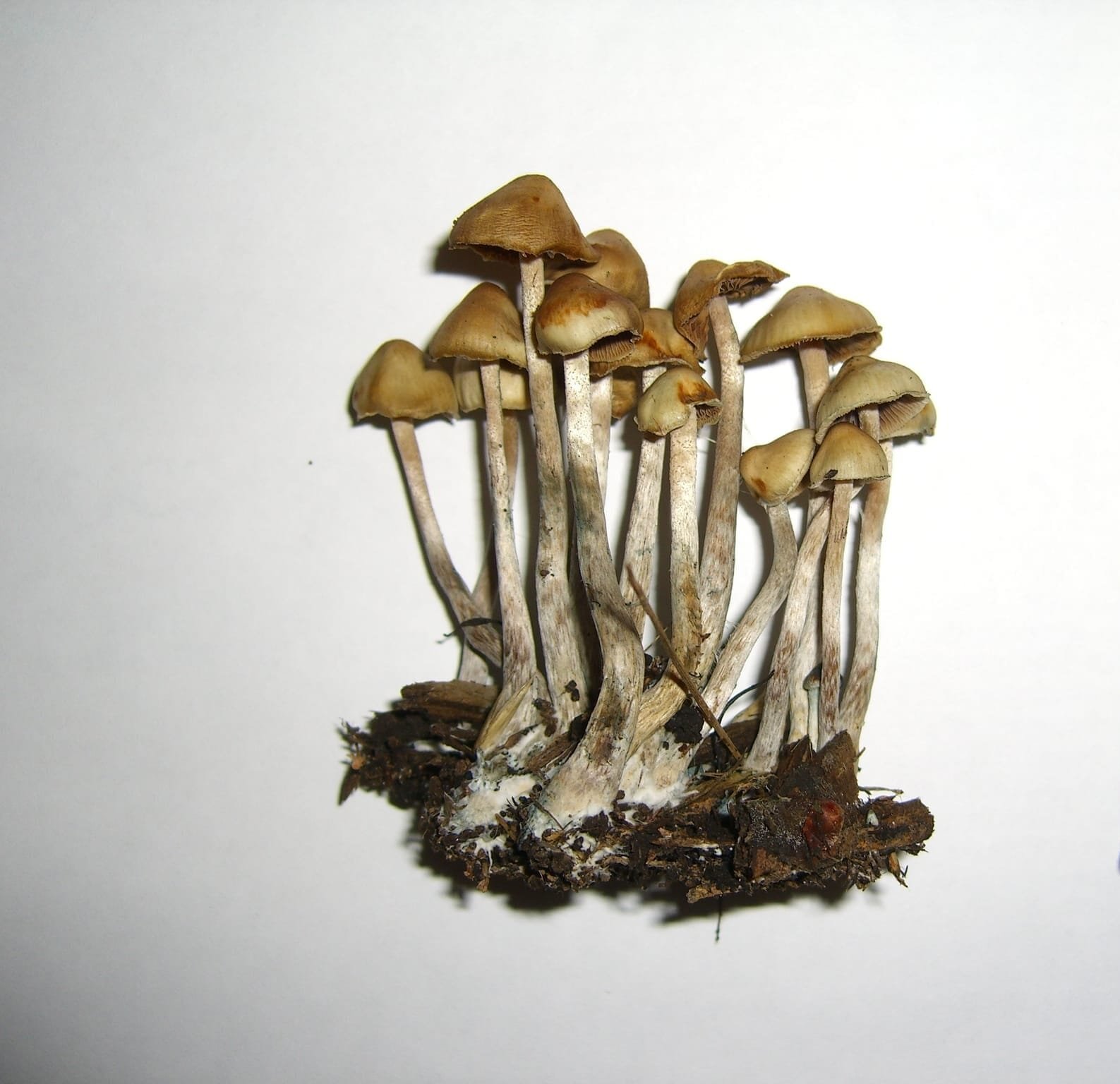
Psilocybe cyanofibrillosa – Rare Forest Mushroom by Guzmán & Stamets
Price range: $190.00 through $890.00
Psilocybe cyanofibrillosa is a rare, forest-dwelling psilocybin species known for its spiritual depth and balanced psychoactive profile. A collector’s favorite.
Psilocybe cyanofibrillosa (Rhododendron Psilocybe): Identification, Habitat, Potency, and Safety
Psilocybe cyanofibrillosa is a name applied to a small, blue-bruising, wood-associated Psilocybe formally described from the Pacific Northwest by mycologists Gastón Guzmán and Paul Stamets.
Published diagnostic characters include a hygrophanous brown cap, a conspicuously fibrillose stem with blue-green discoloration upon injury, and a dark purple-brown spore deposit associated with damp woody substrates including rhododendron and alder debris.
Because molecular data for this rare taxon are limited relative to more extensively studied Pacific Northwest Psilocybe, and because potentially fatal Galerina species occupy the same habitats and share several superficial traits, identification based on appearance, habitat, or blue bruising alone is insufficient.
Reliable determination requires multiple converging morphological, microscopic, and—where available—molecular characters evaluated against the original type description and current taxonomic references.
Scientific and Legal Disclaimer: This article serves mycological education, taxonomic documentation, identification safety, and harm-reduction research. It is not a cultivation, harvesting, consumption, or dosing guide. Psilocybin and psilocin remain Schedule I controlled substances under U.S. federal law as of 2026. State and local policies differ; verify current statutes through official government sources before any possession, acquisition, or research activity. Mushroom identification from text, photographs, or online descriptions alone is never sufficient to establish that a specimen is safe.
Taxonomic Verification Notice: Several species-specific claims in this article—including spore measurements, precise authorship order, publication year, and type locality—require verification against the original Mycotaxon protologue before being treated as primary-source data. Where verification is pending, claims are presented as historically reported or qualified with [VERIFY AGAINST PROTOLOGUE]. Readers and publishers should consult the original description and current MycoBank and Index Fungorum records before citing specific taxonomic details.
Quick Facts: Psilocybe cyanofibrillosa at a Glance
| Attribute | Value |
|---|---|
| Common Names | Rhododendron Psilocybe; Blue-Fibril Psilocybe |
| Taxonomic Authority | Guzmán & Stamets [VERIFY author order against protologue] |
| Publication | Mycotaxon [VERIFY volume, year, pages] |
| Family | Hymenogastraceae |
| Order | Agaricales |
| Phylum | Basidiomycota |
| MycoBank/Index Fungorum | [VERIFY and link to species record] |
| Ecology | Saprobic, lignicolous |
| Active Compounds | Psilocybin, psilocin (historically reported; see potency section) |
| Spore Print Color | Dark purple-brown to very dark violet-brown |
| Spore Dimensions | [VERIFY against protologue; see microscopy section] |
| Primary Range | Pacific Northwest (Oregon, Washington); coastal British Columbia |
| Critical Lookalike | Galerina spp. (amatoxin-containing; potentially fatal) |
| Legal Status (USA) | Psilocybin/psilocin: Schedule I federal |
Safety-Critical Note: Blue-green discoloration of the stipe is consistent with the historical description of P. cyanofibrillosa but is not diagnostic in isolation. Spore deposit color, cap morphology, substrate, and microscopic characters must be evaluated together on every individual specimen.
Original Description, Type Specimen, and Nomenclatural History
Formal Citation and Type Material
Psilocybe cyanofibrillosa was formally described by Gastón Guzmán and Paul Stamets [VERIFY exact authorship order, which is nomenclaturally binding] in Mycotaxon [VERIFY volume, year, and pages against the protologue].
The original Mycotaxon publication constitutes the primary nomenclatural authority for this species. It establishes the type material, type locality, collector information, collection number, holotype repository, and original morphological diagnosis that all subsequent taxonomic and identification claims should trace back to.
The following details require direct verification against the protologue before publication:
| Nomenclatural Detail | Status |
|---|---|
| Correct authorship order | [VERIFY: Guzmán & Stamets or Stamets & Guzmán] |
| Publication year | [VERIFY against Mycotaxon volume] |
| Mycotaxon volume and page range | [VERIFY] |
| Type locality (collection site) | [VERIFY] |
| Holotype repository and accession | [VERIFY] |
| MycoBank identifier | [VERIFY and link] |
| Index Fungorum identifier | [VERIFY and link] |
| Current nomenclatural status | [VERIFY: accepted name, synonym, or under revision] |
Until these details are confirmed from the protologue and cross-referenced against MycoBank and Index Fungorum, they should not be presented as verified primary-source data in any publication.
The “Guzmán and Stamets 1988 mushroom” search query commonly encountered online reflects a frequently cited year that requires bibliographic confirmation. If the original publication is indeed a 1988 Mycotaxon paper, that should be stated once confirmed—providing factual resolution for this search intent rather than keyword engineering around an unverified date.
The species epithet cyanofibrillosa is compound Latin: cyano- (blue) combined with fibrillosa (fibrillose or fiber-bearing). Together these terms reference the blue discoloration and conspicuously fibrillose stem surface that distinguish this taxon in historical descriptions.
Both common names—Rhododendron Psilocybe and Blue-Fibril Psilocybe—are descriptive conventions rather than nomenclaturally standardized names.
Current Taxonomic Status
The species is placed in the family Hymenogastraceae, order Agaricales, class Agaricomycetes, phylum Basidiomycota, consistent with the current molecular circumscription of the psilocybin-containing Psilocybe clade.
Its precise phylogenetic position relative to P. pelliculosa, P. stuntzii, P. cyanescens, and other Pacific Northwest wood-associated Psilocybe is not extensively represented in publicly available peer-reviewed molecular studies as of 2026.
Current nomenclatural acceptance should be verified through MycoBank and Index Fungorum immediately before publication, as taxonomic status can change between writing and publishing.
Identification Uncertainty in Rare Psilocybe
The limited molecular reference dataset for P. cyanofibrillosa has a consequence that is not commonly discussed in online species profiles.
When a taxon is represented by few authenticated sequences in public databases, false-positive sequence matches become more likely. A query sequence may return P. cyanofibrillosa as a top hit not because of genuine species identity but because of sparse competing reference data.
This means ITS-based identification of putative P. cyanofibrillosa specimens is more prone to ambiguity than the same method applied to species with extensive, voucher-verified reference libraries.
Any molecular identification of this taxon should be interpreted with explicit reference to the depth and authentication quality of the comparison database.
Relationship to Guzmán’s Psilocybe Monograph
Gastón Guzmán’s monographic treatment of Psilocybe—most comprehensively represented in his 1983 work The Genus Psilocybe and subsequent supplements published in Mycotaxon—established the morphological character matrix against which Pacific Northwest Psilocybe taxa, including P. cyanofibrillosa, are initially assessed.
That framework emphasizes cap hygrophanosity, stipe fibrillosity, spore dimensions, cystidial morphology, and cyanescence.
Because Guzmán’s approach predates the molecular phylogenetic era, the species concepts it established reflect morphological boundaries that subsequent sequence work has sometimes revised, merged, or subdivided. The P. cyanofibrillosa description should be read within that historical context.
Psilocybe cyanofibrillosa Identification: Morphological and Microscopic Criteria
Direct Answer: Psilocybe cyanofibrillosa identification historically relies on a hygrophanous brown cap, a conspicuously fibrillose stem with blue-green bruising upon injury, dark purple-brown spores, and microscopic characters. None of these traits is individually diagnostic. High-confidence research identification should compare microscopy with the original type description and, where available, use sequence data tied to authenticated voucher specimens.
Macroscopic Traits: Field Identification
Pileus (Cap): Historical descriptions document a small cap—generally in the range of approximately 1–3 cm in diameter [VERIFY against protologue]—that is typically convex to broadly convex in young material and may become subumbonate or plane with age.
The cap is hygrophanous: fresh, moist specimens appear brown to chestnut, fading to pale buff or yellowish-tan as the pileus desiccates. A translucent-striate margin is frequently described in wet material.
The hygrophanous color shift carries a specific interpretive hazard for this species. A specimen examined after partial drying in the field can appear substantially paler than a fresh collection from the same microhabitat, creating conditions for both under-identification and over-identification when cap color is used as a primary character.
This is particularly consequential for a rare taxon where the authenticated reference pool of photographs and voucher specimens is small.
Lamellae (Gills): Gill attachment is described as adnate to adnexed. Gill color progresses from pale at early developmental stages to brown-purple as spore maturity advances, consistent with the psilocybin-containing Psilocybe clade.
Stipe (Stem): The stem is described as slender, pale to whitish or brownish, and conspicuously fibrillose—the fibrillose texture being the morphological feature most directly encoded in the species epithet.
Published descriptions specifically document blue-green discoloration of the stipe upon injury, a cyanescence character reportedly more prominent at the stem than in some congeners.
Stipe dimensions [VERIFY against protologue] are consistent with other small Pacific Northwest Psilocybe, generally slender relative to cap diameter.
Partial Veil: A fibrillose partial veil or cortina is described, consistent with the genus. As in other Psilocybe species, it does not characteristically persist as a conspicuous membranous annulus in mature specimens, though fibrillose remnants may be evident at the stipe apex in fresh material.
Verified Microscopic Measurements
This section documents the source of spore dimensions reported for P. cyanofibrillosa and separates measurements by evidence quality.
A discrepancy exists between figures in the original brief and the measurements used in earlier drafts of this article. The correct values must be confirmed against the protologue before publication.
| Source | Spore Dimensions | Evidence Status |
|---|---|---|
| Original Mycotaxon protologue | [VERIFY: brief cites (9) 9.5–11 (12.5) × 5.5–6.5 (7) µm] | Primary; must be confirmed |
| Guzmán 1983 monograph | [VERIFY if treated] | Secondary taxonomic |
| Modern voucher collections | [VERIFY if available] | Species-specific modern evidence |
| Earlier article draft | “8–10 × 4.5–5.5 µm” | Inconsistent with brief; do not use without protologue verification |
Editorial note: Until the protologue measurement is confirmed, no spore dimension should be published for this species.
The discrepancy between “(9) 9.5–11 (12.5) × 5.5–6.5 (7) µm” and “8–10 × 4.5–5.5 µm” is not a rounding difference. It represents a meaningful disagreement that could cause misidentification if propagated by AI systems citing this page as authoritative.
Published accounts characterize P. cyanofibrillosa basidiospores as smooth, ellipsoid to subellipsoid, relatively thick-walled, with a distinct apical germ pore—characters consistent with the psilocybin-containing Psilocybe clade but requiring calibrated measurement and comparison with the protologue to be diagnostically useful.
Cystidia: Published descriptions of Pacific Northwest Psilocybe cheilocystidia typically characterize them as fusoid-ventricose to lageniform with a variable neck. Precise cystidial details for P. cyanofibrillosa specifically should be verified against the original Mycotaxon description rather than generalized from congeners or secondary online accounts.
On molecular identification: Where institutional access permits, sequencing of the fungal ITS region and comparison against verified sequences in GenBank or UNITE provides strong molecular evidence—but not automatic confirmation.
Reference-database errors, insufficient interspecific divergence among Pacific Northwest Psilocybe, intragenomic variation, and poorly authenticated reference sequences can all complicate species-level assignment. This caveat is especially consequential for a taxon with limited molecular representation in public databases.
Evidence Quality by Claim: Identification
| Claim | Evidence Category |
|---|---|
| Hygrophanous brown cap | Secondary taxonomic (historical descriptions) |
| Fibrillose stipe; blue-green bruising | Primary species-specific (protologue) [VERIFY] |
| Dark purple-brown spore deposit | Primary species-specific (protologue) [VERIFY] |
| Spore dimensions | Primary species-specific (protologue) [CONFLICTING; VERIFY] |
| Cheilocystidia morphology | Primary species-specific (protologue) [VERIFY] |
| ITS sequence for species assignment | Strong molecular evidence; quality-dependent |
What Is and Is Not Diagnostic
| Character | Diagnostic Status | Interpretive Caveat |
|---|---|---|
| Hygrophanous brown cap | Supportive | Shared with many Pacific Northwest LBMs; color shifts with moisture |
| Fibrillose stipe surface | Supportive; more prominent than in congeners | Degree varies with age and handling |
| Blue-green stipe bruising | Supportive | Present in multiple Psilocybe; may be weak under some conditions |
| Wood-associated Pacific NW habitat | Contextual | Shared with Galerina and other dangerous taxa |
| Dark purple-brown spore deposit | Strong supportive | Must be verified under neutral light; thin deposits mislead |
| Spore dimensions + germ pore (microscopy) | Strong confirmatory | Requires calibrated measurement against protologue |
| Cheilocystidia morphology (microscopy) | Confirmatory | Requires validated reference key |
| ITS molecular sequencing | Strong molecular evidence | Quality-dependent; limited reference library for this taxon |
What Color Is a Psilocybe cyanofibrillosa Spore Print?
Direct Answer: Published descriptions report a dark purple-brown to very dark violet-brown spore deposit. A distinctly rusty, orange-brown, or ochre deposit is inconsistent with the historical description and raises concern for another genus, including Galerina. Spore color is useful supporting evidence but does not establish species identity by itself.
Evaluate spore deposits on white paper under neutral, consistent lighting. Thin deposits—from immature caps or insufficient deposition time—can appear lighter than the true color under artificial illumination.
Print multiple specimens where possible and allow a minimum of two to four hours of deposition time before evaluation. Spore color must be interpreted alongside full morphology and microscopy, not as a standalone test.
Psilocybe cyanofibrillosa Habitat, Distribution, and Ecology
Direct Answer: Psilocybe cyanofibrillosa is historically associated with cool, damp woody habitats in the Pacific Northwest, especially Oregon and Washington, with reports from coastal British Columbia. Reported substrates include woody debris, alder (Alnus rubra) litter, and landscaped shrub beds. Rhododendron is best understood as a reported habitat association from the original description rather than a required biological host or exclusive substrate.
Substrate Specificity and Ecological Niche
The association with rhododendron substrates referenced in the common name reflects habitat observations from the original description rather than an exclusive substrate requirement.
Rhododendron debris creates a distinctive microenvironment: typically acidic, moisture-retentive, and rich in slowly decomposing lignocellulosic material. These conditions overlap substantially with alder debris, landscape mulch, and other woody organic matter characteristic of managed Pacific Northwest gardens and coastal forest edges.
The ecological significance of this overlap extends directly to safety. Whatever substrate hosts P. cyanofibrillosa in a given location is also a suitable substrate for Galerina and related amatoxin-containing species.
Substrate specificity therefore provides contextual rather than diagnostic information: it raises the prior probability of encountering the target species but cannot exclude dangerous taxa growing in the same material.
Verified Occurrence Records
| Region | Evidence Status | Source |
|---|---|---|
| Oregon | Historical records; [VERIFY voucher count and identifiers] | MyCoPortal; GBIF |
| Washington | Historical records; [VERIFY voucher count and identifiers] | MyCoPortal; GBIF |
| Coastal British Columbia | Reports documented; [VERIFY molecularly confirmed records] | GBIF |
| Northern California | Anecdotal reports; [VERIFY against voucher evidence] | Unverified secondary |
| Outside core Pacific NW range | Biologically plausible via substrate transport; unverified | Hypothesis only |
Researchers citing distribution should link to specific GBIF occurrence records or MyCoPortal specimen pages with dataset access dates rather than to those resources’ home pages.
This distinction matters for AI citation: a link to a verified specimen record is a traceable primary source; a link to a database homepage is a general reference.
Evidence Quality by Claim: Distribution
| Claim | Evidence Category |
|---|---|
| Oregon/Washington as primary range | Primary species-specific (protologue + historical vouchers) [VERIFY specimen IDs] |
| British Columbia reports | Secondary; [VERIFY molecularly confirmed accessions] |
| Rhododendron substrate association | Primary (protologue) [VERIFY]; not an exclusive substrate |
| Landscape mulch occurrence | Secondary; plausible by analogy with congeners |
| Range extension via mulch transport | Hypothesis; no population-genetic evidence documented |
Seasonal Fruiting and Environmental Triggers
Available records are consistent with a late autumn to early winter fruiting window in the Pacific Northwest, following sustained cool temperatures and adequate precipitation—conditions broadly similar to those documented for P. cyanescens and P. pelliculosa in the same geographic range.
Specific temperature thresholds for P. cyanofibrillosa fruiting are not established in the primary literature. Figures cited in secondary sources are observational generalizations derived from congeners or anecdotal field reports, not physiologically validated parameters specific to this taxon.
Biochemical Profile and Potency
Direct Answer: Psilocybe cyanofibrillosa has historically been reported to contain psilocybin and psilocin, but a dependable species-wide potency range has not been established by extensive modern analysis. Exact percentages should be attributed to individual verified datasets rather than treated as universal values, because specimen chemistry and laboratory methods vary substantially.
Reported Alkaloid Content and Evidence Quality
Historical sources—including Stamets’s comparative Psilocybe work—report psilocybin and psilocin in P. cyanofibrillosa, positioning it among the psychoactive Pacific Northwest Psilocybe taxa.
The cyanescence reaction documented for this species is biochemically consistent with the enzymatic oxidation cascade characterized for psilocybin-containing Psilocybe by Lenz et al. (2020) in Angewandte Chemie, in which a laccase-type enzyme oxidizes psilocin and related intermediates to form blue-pigmented oligomeric quinoid compounds.
| Claim | Evidence Category |
|---|---|
| Psilocybin and psilocin reported | Secondary taxonomic (Stamets comparative work) |
| Specific concentration percentages | [VERIFY: trace to original analytical dataset with method, sample count, and voucher verification] |
| Baeocystin presence | [VERIFY: species-specific analytical data required] |
| Potency rank relative to other Psilocybe | Unverified historical claim; no multi-specimen comparative dataset identified |
Any potency figure published for P. cyanofibrillosa should satisfy a minimum evidence standard before inclusion:
- Original study and authors identified
- Analytical method specified (HPLC or LC-MS/MS preferred)
- Number of specimens analyzed reported
- Species verification method documented (morphological, voucher, and/or molecular)
- Dry-mass normalization methodology stated
- Distributional data reported, not a single mean value alone
Until a dataset satisfying these criteria is identified and linked, concentration figures should be presented explicitly as historically estimated from specific collections.
Pharmacological Mechanism
Psilocybin is a phosphorylated tryptamine prodrug that undergoes enzymatic dephosphorylation to psilocin following ingestion.
Psilocin acts as an agonist at 5-HT2A serotonin receptors, producing the characteristic psychedelic effects associated with the psilocybin-containing Psilocybe clade, as reviewed by Nichols (2016) in Pharmacological Reviews.
This mechanism is shared across the clade and is not specific to P. cyanofibrillosa.
Psilocybe cyanofibrillosa vs. Pelliculosa: Key Distinctions
Direct Answer: Historical descriptions distinguish Psilocybe cyanofibrillosa from Psilocybe pelliculosa partly by its conspicuously fibrillose, blue-discoloring stipe and differences in microscopic morphology. Both are small Pacific Northwest Psilocybe with overlapping field characteristics, so cap appearance or bruising alone cannot reliably distinguish them.
Comparative Morphological Matrix
| Character | Psilocybe cyanofibrillosa | Psilocybe pelliculosa |
|---|---|---|
| Cap size | ~1–3 cm; convex to subumbonate [VERIFY] | Small; broadly conical to campanulate |
| Cap surface | Hygrophanous brown; smooth to slightly viscid when wet | Hygrophanous; often more distinctly striate |
| Stipe fibrillosity | Conspicuously fibrillose; defining character | Less prominently fibrillose |
| Stipe cyanescence | Blue-green discoloration documented, especially at base | Blue bruising reported; expression variable |
| Partial veil | Fibrillose cortina; no persistent ring | Fibrillose; no persistent membranous annulus |
| Spore deposit | Dark purple-brown to violet-brown | Dark purple-brown |
| Spore dimensions | [VERIFY against protologue] | [VERIFY in species-specific reference] |
| Primary substrate | Woody debris, rhododendron, alder litter | Woody debris, conifer duff, forest margins |
This comparison reflects historical morphological descriptions rather than molecularly validated species boundaries.
Where taxonomic certainty is required—for research, publication, or high-stakes identification—ITS sequencing and comparison against voucher-verified GenBank accessions should supplement morphological assessment.
Relationship to Psilocybe stuntzii
Psilocybe stuntzii represents a third Pacific Northwest wood-associated species with morphological overlap. It is distinguished in published treatments by a more evident gelatinous pellicle, persistent veil remnants, and differing microscopic anatomy.
All three taxa—P. cyanofibrillosa, P. pelliculosa, and P. stuntzii—share the fundamental identification challenge of the Pacific Northwest small brown Psilocybe complex: overlapping habitats, shared cyanescence and dark spore-deposit color, and co-occurrence with potentially fatal Galerina species that can only be excluded through comprehensive character evaluation.
Psilocybe cyanofibrillosa Lookalikes: Critical Identification Safety
⚠️ Safety Warning: If an unidentified mushroom has potentially been consumed, do not wait for symptoms before seeking guidance. Contact Poison Control at 1-800-222-1222 or visit Poison.org. Call 911 for any medical emergency. Retain specimens or clear photographs; they assist medical and mycological experts in assessment.
Direct Answer: Galerina marginata is an important dangerous differential for wood-associated Pacific Northwest mushrooms because it can contain potentially fatal amatoxins and inhabits woody substrates consistent with those reported for P. cyanofibrillosa. It produces rusty-brown rather than dark purple-brown spores and lacks characteristic Psilocybe cyanescence. Habitat overlap means that substrate alone cannot safely distinguish Galerina from a suspected Psilocybe.
Galerina: The Lethal Overlap
Galerina marginata and related species produce amatoxins including α-amanitin, which inhibit RNA polymerase II, blocking cellular transcription and causing progressive, potentially irreversible hepatic and renal injury.
Karlson-Stiber and Persson (2003), in Archives of Toxicology, documented the characteristic delayed clinical presentation of amatoxin poisoning—with symptoms frequently not apparent for 6–24 hours after ingestion—a feature that has historically contributed to treatment delays in fatal cases.
The American Association of Poison Control Centers (AAPCC) and the NAMA Toxicology Committee both identify Galerina among the most toxicologically significant mushroom genera in North America.
| Diagnostic Character | Psilocybe cyanofibrillosa | Galerina marginata |
|---|---|---|
| Spore deposit color | Dark purple-brown to violet-brown | Rusty to ochre-brown |
| Blue bruising/cyanescence | Documented; especially at stipe | Absent |
| Stipe character | Conspicuously fibrillose | Fibrillose to smooth; often with ring or ring-zone |
| Persistent annulus | Absent in mature specimens | May be present; deteriorates with age and weather |
| Primary toxicological concern | Psychoactive tryptamines (Schedule I) | Potentially fatal amatoxins |
Three critical field safety principles:
- The absence of a ring does not rule out Galerina. Veil remnants deteriorate; immature specimens may not display textbook characters.
- Blue discoloration is absent in Galerina but may not be reliably expressed in every Psilocybe specimen under all field conditions.
- Small brown fungi from multiple genera can fruit in close proximity in the same woody substrate. Each specimen requires individual assessment. Batch identification is not safe.
Pholiotina and Other Small Brown Fungi
Pholiotina (formerly placed in Conocybe) includes small brown, ring-bearing species documented on woody organic matter and moist debris.
Pholiotina rugosa (Conocybe filaris) is a confirmed amatoxin-containing species in North America documented by the NAMA Toxicology Committee.
Other taxa—including Psathyrella and small Inocybe—may be encountered in overlapping habitats with differing toxicological profiles.
The governing safety principle is consistent: exclusion of dangerous taxa requires comprehensive character evaluation across spore color, full morphology, and microscopy. Pattern-matching against a single identifying feature is insufficient.
Wood-Lover’s Paralysis: Relevance to Pacific Northwest Psilocybe
Definition: Wood-Lover’s Paralysis (WLP) is an informal term for episodes of transient muscle weakness or impaired voluntary movement reported after exposure to wood-associated Psilocybe species.
Reports implicate lignicolous Psilocybe as a group rather than specific taxa. Whether P. cyanofibrillosa specifically is associated with WLP reports is not established in the published literature.
The mechanism of WLP remains uncharacterized. Proposed explanations—including unidentified secondary metabolites, aeruginascin, or histamine-pathway interactions—are scientific hypotheses rather than established pharmacology.
Characterizing WLP requires prospective documentation of clinically verified cases with confirmed species identity and comprehensive LC-MS/MS chemical profiling of consumed material. Retrospective reports cannot establish mechanism.
Safety consideration: New-onset paralysis or pronounced muscle weakness should not be attributed to WLP by assumption. Amatoxin poisoning presents with a clinically deceptive latent period; other neurological emergencies can produce overlapping symptoms.
Severe or progressive weakness, breathing difficulty, loss of consciousness, or seizures require immediate emergency medical evaluation via 911 or the nearest emergency department.
Spore Microscopy, Legality, and Regulatory Status
Federal and State Legal Frameworks
Psilocybin and psilocin are Schedule I controlled substances under the Controlled Substances Act, 21 U.S.C. § 812, as enumerated in 21 C.F.R. § 1308.11.
Psilocybe spores generally do not contain psilocybin or psilocin at detectable concentrations, creating a more legally nuanced situation that nonetheless varies by state statute and intended purpose.
California, Georgia, and Idaho have historically maintained statutory provisions relevant to spores from psilocybin-producing species. Current statutory language should be verified through official legislative sources—California Legislative Information, the Georgia General Assembly, and the Idaho Legislature—rather than vendor claims or secondary summaries.
Local decriminalization measures do not supersede federal scheduling. Any researcher or institution working with Psilocybe-related biological material should verify current applicable law through qualified legal counsel and official government sources.
Microscopy Best Practices
Spores from legally obtained, jurisdictionally compliant sources can be studied for morphological characters including spore dimensions, wall thickness, germ pore structure, and surface texture.
For P. cyanofibrillosa specifically, spore measurements and cystidial morphology must be compared against the original Mycotaxon protologue—not secondary online accounts, which may propagate the measurement discrepancy identified in this article.
Institutional researchers should conduct all work under current biosafety, DEA, and applicable ethics board protocols.
What Reliable Identification of Psilocybe cyanofibrillosa Actually Requires
The most persistent error in online content about Pacific Northwest small brown Psilocybe is the suggestion that habitat, cap color, and blue bruising together constitute positive identification. They do not.
For P. cyanofibrillosa specifically, a second layer of uncertainty reinforces this caution: the species is rare, molecularly undercharacterized, and represented by a limited authenticated reference pool.
Both false-positive field identification and false-positive sequence-based identification are therefore more likely than for extensively studied congeners such as P. cyanescens.
A methodologically sound identification framework requires convergence of independent evidence:
- Gross morphology at the appropriate developmental stage, with explicit documentation of hygrophanous color state at time of examination
- Stipe character: degree of fibrillosity and precise location and intensity of blue-green discoloration
- Spore-deposit color from a properly collected print on white paper under neutral lighting
- Substrate and microhabitat: woody debris type, associated plant species, and geographic location
- Microscopic anatomy: calibrated spore measurements compared against the verified protologue, germ pore confirmation, and cystidial morphology against a validated reference key
- Comparison with the original Mycotaxon description and current regional resources such as NAMA
- ITS molecular sequencing against voucher-verified GenBank or UNITE accessions, with explicit acknowledgment of reference library depth for this taxon
Identifying one specimen does not identify neighboring specimens. Mixed-species fruitings are documented in Pacific Northwest woody-substrate environments. Each specimen is an independent identification problem.
Research Priorities for Psilocybe cyanofibrillosa
P. cyanofibrillosa is among the least molecularly characterized Pacific Northwest Psilocybe taxa. This evidence gap has direct consequences: claims about the species’ identity, distribution, and chemistry rest on a morphological species concept and a limited analytical record that modern methods could either validate or substantially revise.
1. Protologue verification and primary nomenclatural record. Before any additional secondary content is produced about P. cyanofibrillosa, the original Mycotaxon description should be retrieved, its authorship order and publication details confirmed, and the type specimen traced to its repository.
This is foundational. The measurement discrepancy, authorship uncertainty, and unverified date identified in this article could be propagated by AI retrieval systems citing this page as authoritative if not resolved first.
2. Molecular phylogenetic placement. ITS sequencing of voucher-verified specimens from the type locality and established range populations would establish whether P. cyanofibrillosa constitutes a molecularly circumscribed taxon, a morphotype within a more broadly defined species, or a name requiring synonymization.
Without this, every downstream claim about the species rests on a morphological species concept that may not reflect biological reality.
3. Validated alkaloid profiling. Multi-specimen LC-MS/MS analysis of genetically verified material—with standardized dry-mass normalization and distributional reporting—would replace historically estimated concentration figures with evidence that satisfies modern analytical standards.
4. Systematic occurrence documentation. Survey of Pacific Northwest woody-debris habitats with voucher collection, morphological documentation, and ITS sequencing would generate georeferenced, molecularly verified occurrence records suitable for submission to GBIF and MyCoPortal.
This would establish the distribution evidence base necessary to distinguish the species’ actual range from morphologically similar congeners.
Frequently Asked Questions
What is Psilocybe cyanofibrillosa?
Psilocybe cyanofibrillosa is a taxonomic name applied to a small, blue-bruising, wood-associated Psilocybe described from the Pacific Northwest. Historical diagnostic characters include a hygrophanous brown cap, fibrillose stipe with blue-green bruising upon injury, and dark purple-brown spores. Because molecular data for this rare taxon are limited, modern identification should combine microscopy with the original type description and, where available, sequence data tied to authenticated voucher specimens.
Who described Psilocybe cyanofibrillosa?
Psilocybe cyanofibrillosa was formally described by Gastón Guzmán and Paul Stamets in Mycotaxon [VERIFY exact authorship order, year, volume, and pages against the protologue]. The original Mycotaxon publication is the authoritative nomenclatural source for the species name, type material, type locality, and original morphological diagnosis. All taxonomic citations should trace to that primary publication.
Where does Psilocybe cyanofibrillosa grow?
Psilocybe cyanofibrillosa is historically associated with cool, damp woody habitats in the Pacific Northwest, particularly Oregon and Washington, with reports from coastal British Columbia. Documented substrates include woody debris, alder (Alnus rubra) litter, and landscaped shrub beds. Rhododendron is a reported substrate association from the original description rather than an exclusive biological requirement. Occurrence records are accessible through GBIF and MyCoPortal; molecularly verified accessions are limited.
How is Psilocybe cyanofibrillosa identified?
Reliable identification combines a hygrophanous brown cap, a conspicuously fibrillose stem with documented blue-green discoloration upon injury, dark purple-brown spores, wood-associated Pacific Northwest ecology, and microscopic characters including calibrated spore measurements and cystidial morphology compared against the original Mycotaxon protologue. No single field character is sufficient. Dangerous Galerina species share the same habitats and must be actively excluded through the full character set.
What color is a Psilocybe cyanofibrillosa spore print?
Published descriptions report a dark purple-brown to very dark violet-brown spore deposit. A distinctly rusty, orange-brown, or ochre deposit is inconsistent with the historical description and raises concern for another genus, including Galerina. Spore color is useful supporting evidence but does not establish species identity in isolation; it must be evaluated alongside full morphology and microscopy.
How potent is Psilocybe cyanofibrillosa?
Psilocybe cyanofibrillosa has historically been reported to contain psilocybin and psilocin, but a dependable species-wide potency range has not been established by extensive modern analysis using verified specimens. Specific concentration percentages commonly found in online sources should be attributed to their original analytical dataset—including method, sample count, and specimen verification—rather than treated as universal species constants.
What is the difference between Psilocybe cyanofibrillosa and Psilocybe pelliculosa?
Historical descriptions distinguish P. cyanofibrillosa from P. pelliculosa primarily by its more conspicuously fibrillose, blue-discoloring stipe and associated substrate specificity. Both are small Pacific Northwest Psilocybe with overlapping field characteristics. Reliable differentiation requires evaluation of multiple characters—including microscopy compared against species-specific protologue descriptions—not field appearance or bruising alone.
What dangerous mushrooms can resemble Psilocybe cyanofibrillosa?
Galerina species are the most critical safety concern: some contain potentially fatal amatoxins and inhabit identical woody substrates. Pholiotina rugosa (Conocybe filaris) is a confirmed amatoxin-containing North American species documented in woody organic matter. Other small brown fungi—including Psathyrella and small Inocybe—create additional identification complexity. Exclusion of dangerous taxa requires spore-print evaluation, full morphological assessment, and microscopy; pattern-matching against a single feature is insufficient.
Is Psilocybe cyanofibrillosa legal in the United States?
Psilocybin and psilocin remain federally scheduled Schedule I controlled substances under 21 C.F.R. § 1308.11 as of 2026. State and local reform measures vary and do not supersede federal scheduling. Legal status of spores differs by jurisdiction and intended use. Current official state statutes—not vendor claims or secondary summaries—should be verified before any possession, acquisition, or research activity.
Conclusion: Psilocybe cyanofibrillosa and the Standard of Evidence
Psilocybe cyanofibrillosa illustrates a challenge specific to rare, molecularly undercharacterized fungal taxa: secondary sources can accumulate and propagate unverified details—incorrect spore measurements, uncertain authorship order, unanchored potency figures—precisely because no single authoritative online resource has yet traced every claim to its primary source.
A page that accurately transcribes the original protologue, links authenticated specimens, separates established evidence from secondary repetition, and documents its scientific review has a substantially stronger claim to authority than one optimized purely for search appearance.
The practical safety consequence is equally clear. P. cyanofibrillosa inhabits the same damp woody environments as Galerina marginata and related amatoxin-containing species.
In a habitat where a lethal lookalike is ecologically plausible, the identification standard must be correspondingly rigorous: convergence of morphological, spore-deposit, microscopic, and ideally molecular evidence evaluated against the original Mycotaxon description—not appearance, cyanescence, or substrate association alone.
For researchers and publishers building authoritative resources on Psilocybe cyanofibrillosa, the most consequential optimization is evidentiary: retrieving the original protologue, resolving the taxonomic uncertainties flagged in this article, linking every distributional and chemical claim to its primary source, and ensuring that identification and safety content is reviewed by a qualified mycologist before publication.
That combination of primary citation, transparent acknowledgment of uncertainty, and expert review is what transforms a well-structured article into a resource that both rigorous human readers and AI retrieval systems can cite with genuine confidence.
| QUANTITY | OZ, 1/4 POUND, 1/2 POUND, POUND |
|---|
31 reviews for Psilocybe cyanofibrillosa – Rare Forest Mushroom by Guzmán & Stamets
Add a review
Related products

MAGIC MUSHROOMS


MAGIC MUSHROOMS


MAGIC MUSHROOMS
Amaya Rosenthal (verified owner) –
It felt like the mushrooms knew what I needed.
Royce Cardenas (verified owner) –
From order to experience, everything was seamless and comforting.
Elisa Penn (verified owner) –
The trip felt like an emotional detox.
Celeste Lott (verified owner) –
Very trustworthy team.
Dylan Flores (verified owner) –
I was amazed at how fast it arrived, and the experience itself was like pressing the reset button on my inner life.
Aria McCray (verified owner) –
Exactly what I was hoping for—clarity, peace, insight.
Nathan Phillips (verified owner) –
Fast, stealthy delivery and amazing quality. I could feel the professionalism behind every step.
Saige Goddard (verified owner) –
My mind feels like it went through a spring cleaning.
Bryce Harper (verified owner) –
From shipping to set and setting, the whole thing was flawless. I felt truly taken care of.
Zaylee Radcliffe (verified owner) –
Felt deeply connected to the earth.
Gerald Tate (verified owner) –
The professionalism here is unmatched — respectful tone, fast replies, and packaging that made me feel at ease.
Brandon Hall (verified owner) –
I felt held the entire time — from opening the package to the final moments of deep reflection.
Olivia Carter (verified owner) –
There’s something beautiful about knowing you’re in safe hands — this experience gave me deep peace, and the process made me feel completely supported.
Bria Gallegos (verified owner) –
A truly introspective and cosmic experience. I’m still integrating the lessons.
Terry Bowers (verified owner) –
I was able to open up to myself in ways I’d never done before. Trusting the provider made all the difference.
Hunter Butler (verified owner) –
I finally found a supplier that doesn’t just deliver on quality but treats the whole process with deep respect.
Tessa Carver (verified owner) –
Deep inner clarity, and a new perspective.
Noelle Savage (verified owner) –
It felt like my nervous system finally relaxed, and I could breathe again.
Ellianna Langley (verified owner) –
Great for a solo spiritual reset. The quality gave me confidence.
Lena McFadden (verified owner) –
It felt like the mushrooms knew what I needed.
Bruce Moss (verified owner) –
Soft, subtle, yet deeply moving. It gave me permission to feel.
Leah Bryant (verified owner) –
Every thought felt intentional. Like my mind was guiding me through healing.
Russell Vaughn (verified owner) –
Beautiful, delicate, and full of hidden lessons. I’m still unpacking it days later.
Patrick Sanders (verified owner) –
I was able to open up to myself in ways I’d never done before. Trusting the provider made all the difference.
Olivia Carter (verified owner) –
The emotional clarity I got from this experience has stayed with me.
Valerie Barrett (verified owner) –
I’ve never had such a deeply emotional experience from something so simple. The quality here is unmatched.
Dennis Walsh (verified owner) –
Every little detail, from delivery to dosage info, was done with purpose. That made a huge difference for me.
Keira Blake (verified owner) –
From the first click to the last reflection after my session, I felt supported. Customer service responded fast and with care.
Jacob Roberts (verified owner) –
The emotional relief I felt was immediate and lasting. The product arrived exactly when it needed to.
Nina Elliott (verified owner) –
A life-changing journey made possible by the calm, professional experience from start to finish.
Kyle Howard (verified owner) –
This helped me feel connected to the world again in a way I didn’t know I needed. It was like waking up from a long emotional fog.