


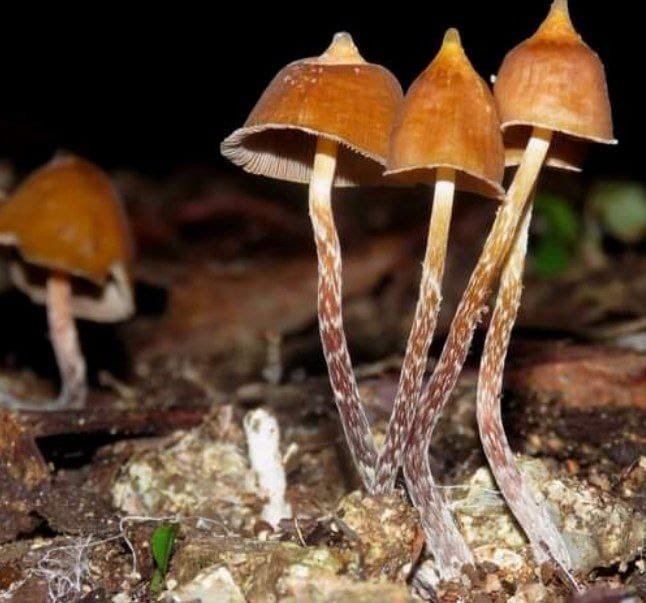
Psilocybe hoogshagenii – Sacred “Little Birds of the Woods” Mushroom
Price range: $178.00 through $865.00
Psilocybe hoogshagenii, known as Los Pajaritos, is a revered sacred mushroom used in traditional Mexican rituals. Offers deep spiritual journeys and visionary states.
Psilocybe hoogshagenii (Los Pajaritos): Identification, Potency, Habitat, and Ethnomycological Significance
Psilocybe hoogshagenii is a psilocybin-containing mushroom formally described from Mexico by French mycologist Roger Heim in 1958 and named in honor of ethnographer Searle Hoogshagen, whose fieldwork among Mixe communities in Oaxaca generated primary records of indigenous fungal knowledge.
Associated in ethnomycological literature with the vernacular name Los Pajaritos—”Little Birds”—the species occupies a documented position at the intersection of Mesoamerican sacred fungal traditions and modern psychedelic science.
Its typical variety is distinguished by a sharply acute papilla at the cap center and distinctively subrhomboid spores visible under microscopy. A second variety, var. convexa, presents a less dramatically pointed pileus and has been historically connected to Psilocybe semperviva in the taxonomic literature of Gastón Guzmán.
Because several morphologically similar species share its humid Mexican habitats, and because alkaloid concentrations vary substantially among specimens and analytical methods, identification and potency claims require primary-source evidence rather than secondary repetition.
Scientific and Legal Disclaimer: This article serves mycological education, ethnomycological documentation, taxonomic reference, and harm-reduction research. It is not a cultivation, harvesting, consumption, or dosing guide. Psilocybin and psilocin remain Schedule I controlled substances under U.S. federal law as of 2026. State, local, and international policies differ; verify current statutes through official government sources before any possession, acquisition, or research activity. Mushroom identification from text, photographs, or online descriptions alone is never sufficient to establish species identity or safety.
Quick Facts: Psilocybe hoogshagenii at a Glance
| Attribute | Value |
|---|---|
| Common Names | Los Pajaritos; Little Birds of the Woods; Pajaritos de Monte |
| Taxonomic Authority | Heim (1958) |
| Family | Hymenogastraceae |
| Order | Agaricales |
| Phylum | Basidiomycota |
| Varieties | var. hoogshagenii (acute papilla); var. convexa (broadly convex cap) |
| Related Name | Psilocybe semperviva (historically associated with var. convexa by Guzmán) |
| Active Compounds | Psilocybin, psilocin (reported; see potency section) |
| Spore Print Color | Dark purplish-brown |
| Spore Shape | Subrhomboid to rhomboid in face view |
| Primary Range | Mexico (humid montane and subtropical environments; Oaxaca prominent) |
| Ethnomycological Context | Mixe, Mixtec, Mazatec, and Zapotec communities; Los Pajaritos tradition |
| Legal Status (USA) | Psilocybin/psilocin: Schedule I federal |
Taxonomic History, Nomenclature, and Evidence Status
Established Facts vs. Claims Requiring Verification
Before citing specific details from this article, readers should understand which assertions rest on confirmed primary sources and which require further verification.
Established:
- Roger Heim formally described P. hoogshagenii in 1958
- The nominate variety includes a conspicuous acute papilla as a defining morphological character
- Dark purplish-brown spore deposit and subrhomboid spore geometry are documented taxonomic characters
- The species belongs to Hymenogastraceae and is documented primarily from Mexico
- Gastón Guzmán treated P. semperviva in connection with var. convexa
- Los Pajaritos is an associated vernacular name in Mexican ethnomycological literature
Requires primary verification or modern resolution:
- Species-wide alkaloid concentrations with validated analytical methods
- Precise phylogenetic status of both varieties under molecular circumscription
- Current accepted treatment of P. semperviva relative to P. hoogshagenii
- Exact ethnographic application of Los Pajaritos to this specific species across all referenced communities
- Complete verified geographic range beyond Oaxaca and adjacent regions
Roger Heim’s 1958 Description
Psilocybe hoogshagenii Heim was formally described by Roger Heim—director of the Muséum national d’Histoire naturelle in Paris and one of the foremost mycologists engaged in mid-twentieth-century psychedelic research—in 1958.
This was the same productive period during which Heim, working alongside ethnomycologist R. Gordon Wasson, was systematically documenting and formally describing Mexican psilocybin-containing fungi for Western science.
The species name honors Searle Hoogshagen, an ethnographer whose fieldwork among Mixe communities in Oaxaca generated primary records of indigenous fungal knowledge relevant to the description. The precise nature and extent of Hoogshagen’s species-level documentation should be verified against his primary ethnographic publications rather than summarized from secondary mycological accounts.
Heim’s formal description is the primary nomenclatural authority for this species and should be the first point of reference for any taxonomic citation. [CITATION NEEDED: Heim 1958, full bibliographic reference with journal, volume, and pages]
Varieties and the Psilocybe semperviva Question
Two varieties are recognized in the historical literature.
Psilocybe hoogshagenii var. hoogshagenii is the nominate variety, characterized by a conspicuous elongated acute papilla at the cap center—the most immediately field-observable character of typical specimens.
Psilocybe hoogshagenii var. convexa presents a broadly convex or less dramatically pointed pileus. Gastón Guzmán, whose monographic work on Psilocybe remains a foundational reference for the genus, historically treated Psilocybe semperviva in connection with this variety.
Direct Answer: Psilocybe hoogshagenii var. hoogshagenii is distinguished historically by an elongated acute cap papilla, whereas var. convexa has a more broadly convex pileus. Gastón Guzmán’s treatments connected P. semperviva with var. convexa. Because nomenclatural treatments can change, current status should be checked against MycoBank and Index Fungorum and the underlying taxonomic literature.
The relationship between P. semperviva and var. convexa illustrates a recurring challenge in pre-molecular fungal taxonomy: morphologically similar forms were variously treated as distinct species, synonyms, or infraspecific taxa depending on the character weighting and specimen access available to individual authors.
Taxonomic Timeline
| Year | Event | Primary Source |
|---|---|---|
| 1958 | Roger Heim formally describes P. hoogshagenii | [VERIFY: Heim 1958, journal, volume, pages] |
| 1983 | Gastón Guzmán’s monograph The Genus Psilocybe treats P. hoogshagenii | Guzmán 1983 |
| Post-1983 | Guzmán treats P. semperviva in connection with var. convexa | [VERIFY: specific Guzmán publication and pages] |
| 2026 | Current nomenclatural status | MycoBank; Index Fungorum [VERIFY identifiers] |
Placement in Hymenogastraceae
P. hoogshagenii is placed in the family Hymenogastraceae, order Agaricales, class Agaricomycetes, phylum Basidiomycota—the molecular-era classification consolidating the psilocybin-containing Psilocybe clade following phylogenetic revision.
Its placement alongside P. mexicana, P. zapotecorum, and related Mexican species reflects shared biochemical, ecological, and morphological affinities that morphological taxonomy alone had only partially captured.
Current MycoBank and Index Fungorum identifiers for P. hoogshagenii and its varieties should be linked directly from any published resource to allow readers and citation systems to verify nomenclatural status. [VERIFY and add direct record links]
Ethnomycological Significance: Los Pajaritos and Indigenous Mexican Traditions
Los Pajaritos as a Vernacular Category, Not a Species Synonym
Direct Answer: Los Pajaritos means “Little Birds” in Spanish and appears in Mexican ethnomycological literature as a vernacular mushroom name. It should not be treated as an exclusive synonym of Psilocybe hoogshagenii because vernacular categories can encompass different fungi across communities, languages, places, and historical sources.
This distinction matters practically for both human readers and AI retrieval systems. Multiple Psilocybe species—including P. mexicana and others—have been documented under related names by different communities.
Treating Los Pajaritos as synonymous with P. hoogshagenii exclusively misrepresents the ethnomycological record and risks propagating an identification conflation that AI systems could extract and amplify.
The Name Los Pajaritos
The vernacular names Los Pajaritos and pajaritos de monte appear in primary ethnomycological accounts documenting ceremonial use of psilocybin-containing fungi in Mexico.
The specific cultural origin of the avian metaphor requires support from primary ethnographic sources, because vernacular usage varies among communities. Attributing a single authoritative explanation to the name without primary-source citation risks oversimplifying a culturally layered term whose significance is specific to particular communities and ceremonial contexts.
CITATION NEEDED: primary ethnographic source(s) documenting Los Pajaritos specifically for *P. hoogshagenii*\]
Indigenous Communities and Ceremonial Context
Ethnomycological records associate P. hoogshagenii and related Los Pajaritos taxa with communities in Mexico, particularly in the state of Oaxaca and adjacent regions.
Species-specific evidence—distinguishing documentation of P. hoogshagenii itself from broader accounts of psilocybin-containing fungi used by Mixe, Mixtec, Mazatec, and Zapotec communities—should be cited from primary ethnographic publications rather than aggregated under general statements about Mexican mushroom ceremony.
R. Gordon Wasson‘s ethnomycological investigations, including his landmark 1957 Life magazine account of a Mazatec ceremony, brought widespread attention to Mexican sacred fungal traditions.
However, the ethical dimensions of that documentation—particularly questions of community consent and the appropriation of sacred knowledge—are subjects of ongoing scholarly and community discussion that any responsible ethnomycological resource should acknowledge explicitly.
Guzmán’s work provides the most systematic species-level ethnomycological contextualization for P. hoogshagenii available in the mycological literature. [CITATION NEEDED: specific Guzmán pages addressing P. hoogshagenii ethnomycology]
Psilocybe hoogshagenii Identification: Morphological and Microscopic Criteria
Direct Answer: Psilocybe hoogshagenii identification requires multiple characters. Typical P. hoogshagenii has a small hygrophanous pileus with an elongated acute papilla, a dark purplish-brown spore deposit, and smooth, thick-walled spores described as subrhomboid to rhomboid in face view. Cap shape, blue staining, habitat, or photographs alone cannot confirm the species.
Macroscopic Traits: Field Identification
Pileus (Cap): The cap is small and hygrophanous, shifting from brown or chestnut tones when moist to paler buff or yellowish-tan as the pileus desiccates. [VERIFY precise cap diameter range against Heim 1958 protologue]
The defining macroscopic feature of the nominate variety is a conspicuous elongated acute papilla at the cap center. This sharply pointed central protrusion is the character most immediately useful for field recognition and the primary morphological distinction from var. convexa.
A translucent-striate margin may be visible in fresh, well-hydrated material.
The hygrophanous color shift carries a specific interpretive hazard: a specimen examined after partial drying can appear substantially paler than a fresh collection from the same location. When cap color is used as a primary character without explicit notation of the moisture state at examination, conditions for misidentification arise.
Lamellae (Gills): Gill attachment is described as adnate to adnexed. Gill color darkens with spore maturity, progressing toward brownish-purple tones. [VERIFY against primary description]
Stipe (Stem): The stem is described as slender and relatively fragile, pale to whitish or brownish.
Blue bruising upon injury has been reported for this species and is consistent with the enzymatic psilocin-oxidation cascade documented for the psilocybin-containing Psilocybe clade by Lenz et al. (2020) in Angewandte Chemie. [VERIFY cyanescence specifically for P. hoogshagenii against primary descriptions]
Partial Veil: A fibrillose partial veil is described, consistent with the genus. It does not characteristically persist as a conspicuous membranous annulus in mature specimens. [VERIFY against protologue]
Microscopic Features: The Subrhomboid Spore
The microscopic character most diagnostically significant for P. hoogshagenii is spore shape.
Published descriptions characterize the basidiospores as having a subrhomboid to rhomboid profile in face view—a geometry that distinguishes them from the more typically ellipsoid spores of many congeners and represents the strongest microscopic identification character available for this species.
Spores are additionally described as smooth, thick-walled, and bearing a distinct apical germ pore, consistent with the psilocybin-containing Psilocybe clade.
VERIFY spore dimensions and shape description against Heim 1958 protologue and Guzmán monograph; add exact measurements with citation before publication\]
Cystidia: Cheilocystidia and pleurocystidia contribute additional microscopic evidence. Their morphology for P. hoogshagenii specifically should be verified against primary taxonomic descriptions rather than generalized from congeners. [VERIFY and cite specific source]
On molecular identification: ITS sequencing and comparison against authenticated sequences in GenBank or UNITE provides strong molecular evidence where institutional access permits.
The depth and authentication quality of the reference library for Mexican Psilocybe taxa should be assessed explicitly, as reference coverage varies substantially by species.
What Color Is a Psilocybe hoogshagenii Spore Print?
Direct Answer: Taxonomic descriptions report a dark purplish-brown spore deposit for P. hoogshagenii. Spore-print color alone is insufficient for species-level identification because related Psilocybe produce similar deposits. Color must be evaluated under neutral lighting on white paper alongside spore shape under microscopy, which provides the stronger confirmatory evidence.
What Is and Is Not Diagnostic
| Character | Diagnostic Status | Interpretive Caveat |
|---|---|---|
| Acute papilla (nominate variety) | Strongly supportive | Absent in var. convexa; can be obscured in aged specimens |
| Hygrophanous brown cap | Supportive | Shared with many Mexican Psilocybe; shifts dramatically with moisture |
| Dark purplish-brown spore deposit | Strong supportive | Must be verified under neutral light; shared by related taxa |
| Subrhomboid spore profile (microscopy) | Strong confirmatory | Requires calibrated measurement against protologue |
| Spore dimensions + germ pore (microscopy) | Strong confirmatory | Requires equipment and validated reference |
| Blue bruising | Supportive | Consistent with psilocybin-containing Psilocybe; not species-specific |
| Humid Mexican habitat + provenance | Contextual | Necessary but not sufficient; shared by multiple species |
| ITS molecular sequencing | Strong molecular evidence | Quality-dependent; verify reference library depth for this taxon |
Psilocybe hoogshagenii Habitat and Geographic Distribution
Direct Answer: Psilocybe hoogshagenii is principally documented from humid Mexican environments. Reported habitats include organic-rich soil, muddy or disturbed ground, streamside sites, and shaded subtropical or montane forest environments. Oaxaca is prominent in primary taxonomic and ethnomycological accounts. Exact state, elevation, and substrate claims should be based on voucher-backed collections rather than repeated secondary range descriptions.
Substrate Specificity and Ecological Niche
P. hoogshagenii is a saprobic species associated with decomposing organic matter in humid environments.
Unlike the wood-chip and woody-debris habitats characteristic of Pacific Northwest Psilocybe such as P. cyanescens, P. hoogshagenii is primarily documented from soil-based substrates: muddy ground, disturbed organic-rich sites, streamside margins, and shaded forest-floor environments in subtropical and montane zones.
This substrate specificity has a direct identification implication. A small hygrophanous Psilocybe found on woody debris in a temperate landscape is not ecologically consistent with P. hoogshagenii, regardless of cap or spore color.
Verified Occurrence Records
| Region | Evidence Status | Source |
|---|---|---|
| Oaxaca, Mexico | Prominent in type and ethnomycological records | [VERIFY: specific herbarium accession and collector data] |
| Other Mexican states | Reported by Guzmán; [VERIFY specific states and vouchers] | Guzmán 1983 |
| Outside Mexico | Not established; claims require voucher evidence | Not documented in primary literature |
Researchers citing distribution should link to specific GBIF occurrence records or MyCoPortal specimen pages with dataset access dates rather than to those resources’ home pages.
A link to a verified specimen record is a traceable primary source; a link to a database homepage is a general reference—a distinction that directly affects AI citation quality.
Seasonal Fruiting
P. hoogshagenii is associated with the humid season in its documented Mexican range.
Specific fruiting-temperature thresholds are not established in the primary literature with the precision sometimes claimed in secondary sources. Fruiting phenology reflects the interaction of rainfall, temperature, humidity, and substrate conditions characteristic of tropical and subtropical montane environments.
Biochemical Profile and Potency
Direct Answer: There is no well-supported universal potency value for Psilocybe hoogshagenii. The species contains psilocybin, but alkaloid concentrations can vary among specimens and analytical methods. Precise potency percentages should therefore be reported only from chemically analyzed, taxonomically authenticated material rather than applied to the species as a whole.
Reported Alkaloid Content
P. hoogshagenii is documented as psilocybin-containing in the primary literature, consistent with its placement in the psilocybin-producing Psilocybe clade and its ceremonial use as documented by Heim, Wasson, and Guzmán.
Any potency figures published for P. hoogshagenii should satisfy a minimum evidence standard before inclusion:
- Original study and authors identified and linked
- Analytical method specified (HPLC or LC-MS/MS preferred)
- Number of specimens analyzed reported
- Species verification method documented (morphological, voucher, and/or molecular)
- Dry-mass normalization methodology stated
- Distributional data reported, not a single mean value alone
Until datasets satisfying these criteria are identified and linked, concentration figures should be presented as historically estimated from specific collections rather than universal species constants.
Pharmacological Mechanism
Psilocybin is a phosphorylated tryptamine prodrug that undergoes enzymatic dephosphorylation to psilocin following ingestion.
Psilocin acts as an agonist at 5-HT2A serotonin receptors, producing the characteristic psychedelic effects associated with the psilocybin-containing Psilocybe clade, as reviewed by Nichols (2016) in Pharmacological Reviews.
This mechanism is shared across the clade and is not specific to P. hoogshagenii.
Psilocybe hoogshagenii Potency vs. Psilocybe mexicana
Comparative alkaloid data placing P. hoogshagenii in a reliable potency hierarchy relative to P. mexicana are not extensively represented in the peer-reviewed literature with the methodological rigor required to support species-wide claims.
Both species show specimen-to-specimen alkaloid variation. A fixed potency ratio between them cannot be supported by the current published dataset and should not be presented as established pharmacological fact.
Psilocybe hoogshagenii var. convexa and Psilocybe semperviva
Variety-Level Distinctions
| Character | var. hoogshagenii | var. convexa |
|---|---|---|
| Cap apex | Conspicuous elongated acute papilla | Broadly convex; less dramatically pointed |
| Spore morphology | Subrhomboid; [VERIFY against protologue] | Consistent with nominate variety [VERIFY] |
| Ecological association | Humid Mexican environments | Humid Mexican environments |
| Historical taxonomic link | Nominate variety (Heim 1958) | Historically associated with P. semperviva by Guzmán |
The papilla character is visible in fresh, mature material but may be less obvious in aged, dried, or damaged specimens.
The Psilocybe semperviva Relationship
Direct Answer: Gastón Guzmán historically treated Psilocybe semperviva in connection with Psilocybe hoogshagenii var. convexa. Because fungal nomenclature changes with taxonomic revision and molecular evidence, researchers should verify the current treatment of both names in MycoBank or Index Fungorum rather than relying on historical secondary accounts.
This relationship exemplifies a broader pattern in pre-molecular Psilocybe taxonomy: morphologically intermediate or variable forms generated competing treatments that molecular phylogenetics has only partially resolved for Mexican taxa.
The practical identification consequence is direct: a specimen matching var. convexa in cap morphology cannot be reliably assigned to P. hoogshagenii versus P. semperviva (if currently accepted as distinct) without microscopy and, ideally, sequence data.
Psilocybe mexicana Comparison: Key Distinctions
Direct Answer: Psilocybe hoogshagenii and Psilocybe mexicana are both small, psilocybin-containing, hygrophanous Psilocybe from humid Mexican environments with shared ethnomycological documentation. Their most reliable distinguishing characters are microscopic rather than macroscopic: P. hoogshagenii is characterized by distinctively subrhomboid spores, while P. mexicana produces spores with a different geometric profile. [VERIFY spore geometry descriptions for both species against their respective authoritative taxonomic sources before publication]
| Character | Psilocybe hoogshagenii | Psilocybe mexicana |
|---|---|---|
| Cap apex | Acute papilla (var. hoogshagenii); broadly convex (var. convexa) | Typically umbonate to broadly convex; papilla less conspicuous |
| Spore profile | Subrhomboid to rhomboid in face view | [VERIFY against authoritative taxonomic description] |
| Ethnomycological name | Los Pajaritos; Pajaritos de Monte | Los Niños Santos; various regional names |
| Primary habitat | Humid soil, streamside, disturbed organic-rich ground | Humid soil, meadows, pasture margins |
| Geographic range | Mexico; Oaxaca prominent | Mexico; broader documented range |
| Sclerotia | Not documented for this species | Documented to produce sclerotia |
| Alkaloid profile | Psilocybin, psilocin reported | Psilocybin, psilocin; characterized by Heim and Wasson |
The sclerotia distinction is particularly useful where sclerotia are present: P. mexicana produces compact mycelial storage bodies that P. hoogshagenii has not been documented to form. Their absence does not confirm P. hoogshagenii identity, but their presence argues against it.
Lookalikes and Identification Safety
Direct Answer: Several small brown Psilocybe from humid Mexican environments share macroscopic features with P. hoogshagenii, including P. zapotecorum, P. mexicana, and other species documented by Guzmán from Oaxaca and adjacent regions. Field identification in any unfamiliar environment cannot exclude all potentially hazardous fungi; regional lookalike assemblages require specialist knowledge and should not be assessed from photographs or online descriptions alone.
⚠️ Safety Warning: If an unidentified mushroom has potentially been consumed, do not wait for symptoms before seeking guidance. Contact Poison Control at 1-800-222-1222 or visit Poison.org. Call 911 for any medical emergency. Retain specimens or clear photographs; they assist medical and mycological experts in assessment.
Small Brown Psilocybe in Humid Mexican Environments
The humid subtropical and montane environments of Oaxaca and adjacent Mexican states support a diverse assemblage of small brown Psilocybe taxa.
Guzmán’s monographic work documents numerous species with overlapping field characters—hygrophanous caps, dark spore deposits, and similar ecological associations—that can only be reliably distinguished through microscopic examination and comparison against primary descriptions.
Psilocybe zapotecorum, documented from Oaxacan environments with ethnomycological associations among Zapotec communities, exemplifies the morphological proximity of Mexican Psilocybe. Reliable differentiation requires the full character set: cap morphology, stipe character, spore shape and dimensions, and cystidial morphology compared against species-specific primary descriptions.
The governing identification principle is consistent regardless of geography: no single field character—cap shape, spore color, habitat, or bruising—is sufficient for species-level determination. Microscopy provides the most reliable morphological evidence available without molecular sequencing.
Verified Specimens and Database Records
This section should contain direct links to type specimen records, herbarium accessions, and database identifiers before publication. These are the records required for primary-source verification.
| Record Type | Detail | Status |
|---|---|---|
| Type specimen | Holotype repository and accession number | [VERIFY against Heim 1958 protologue] |
| Type locality | Collection site, collector, date | [VERIFY against Heim 1958 protologue] |
| MycoBank identifier | Direct species record link | [VERIFY and add] |
| Index Fungorum identifier | Direct species record link | [VERIFY and add] |
| GBIF occurrence records | Verified, georeferenced specimens with access date | [VERIFY and link to specific records] |
| MyCoPortal specimens | Institutional herbarium accessions | [VERIFY and link to specific records] |
| GenBank ITS sequences | Accession numbers for authenticated P. hoogshagenii sequences | [VERIFY availability; add accessions] |
Publishers should not invent missing identifiers. Where a database record does not yet exist, that absence is itself informative: it indicates that this taxon is underrepresented in molecular reference libraries and that sequence-based identification carries elevated uncertainty.
Spore Microscopy, Legality, and Regulatory Context
Federal and State Legal Frameworks
Psilocybin and psilocin are Schedule I controlled substances under the Controlled Substances Act, 21 U.S.C. § 812, as enumerated in 21 C.F.R. § 1308.11.
Psilocybe spores generally do not contain psilocybin or psilocin at detectable concentrations, creating a more legally nuanced situation that nonetheless varies by state statute and intended purpose.
California, Georgia, and Idaho have historically maintained statutory provisions relevant to spores from psilocybin-producing species. Current statutory language should be verified through official legislative sources—California Legislative Information, the Georgia General Assembly, and the Idaho Legislature—rather than vendor claims or secondary summaries.
Local decriminalization measures do not supersede federal scheduling.
Microscopy Research and the Subrhomboid Spore
The subrhomboid to rhomboid spore profile of P. hoogshagenii represents a microscopic character of particular research interest because it distinguishes this taxon from the more typically ellipsoid spores of many Psilocybe congeners.
Researchers examining spores from legally obtained, jurisdictionally compliant sources can assess this character under bright-field or phase-contrast light microscopy with calibrated ocular or digital measurement.
Spore measurements must be compared against the Heim (1958) protologue and Guzmán’s monographic description rather than secondary online accounts.
All institutional research should proceed under current biosafety, DEA, and applicable ethics board protocols.
Research Priorities for Psilocybe hoogshagenii
P. hoogshagenii is among the less molecularly characterized Mexican Psilocybe taxa, despite its prominence in ethnomycological literature. This evidence gap directly affects the accuracy of secondary content—including AI-retrieved information—about the species.
1. Protologue transcription and primary nomenclatural record. The Heim (1958) description should be the traceable primary source for all morphological claims. Spore dimensions, cystidial descriptions, cap measurements, and habitat data cited in secondary content should be traced to this source or to Guzmán’s monographic treatments, with specific page references. This is the single highest-priority task before publication.
2. Molecular phylogenetic placement and variety boundaries. ITS sequencing and multi-locus analysis of voucher-verified specimens representing both var. hoogshagenii and var. convexa would establish whether the variety distinction reflects genuine phylogenetic separation, determine the relationship between var. convexa and P. semperviva, and position P. hoogshagenii within the broader Mexican Psilocybe clade.
3. Validated alkaloid profiling. Multi-specimen LC-MS/MS analysis of genetically verified P. hoogshagenii material—with standardized dry-mass normalization and distributional reporting of psilocybin, psilocin, and related compounds—would replace historically estimated concentration figures with evidence satisfying modern analytical standards.
4. Ethnomycological documentation with community partnership. Primary ethnographic research documenting the specific ceremonial role of P. hoogshagenii among relevant Mexican communities—conducted in partnership with those communities and subject to their consent and oversight—would provide the culturally situated evidence base that secondary ethnomycological summaries currently lack.
Primary Sources and Taxonomic References
The following bibliography identifies the primary sources that should anchor every species-specific claim in this article. Entries marked [VERIFY] require confirmation of complete bibliographic details before publication.
- Heim, R. (1958). [P. hoogshagenii original description]. [VERIFY: journal, volume, issue, pages, and stable URL or DOI]
- Guzmán, G. (1983). The Genus Psilocybe. J. Cramer, Vaduz. CAB Abstracts
- Guzmán, G. [subsequent P. semperviva treatment]. [VERIFY: specific publication, year, pages]
- Wasson, R. G. (1957). Seeking the Magic Mushroom. Life, 49(19), 100–120.
- Nichols, D. E. (2016). Psychedelics. Pharmacological Reviews, 68(2), 264–355. DOI: 10.1124/pr.115.011478
- Lenz, C., et al. (2020). Injury-triggered blueing reactions of Psilocybe fungi. Angewandte Chemie International Edition, 59(4), 1450–1454. DOI: 10.1002/anie.202000953
- MycoBank record for Psilocybe hoogshagenii. [VERIFY identifier and add direct URL]
- Index Fungorum record for Psilocybe hoogshagenii. [VERIFY identifier and add direct URL]
- Any validated LC-MS/MS alkaloid analysis of *P. hoogshagenii*\]. \[IDENTIFY and cite if available\]
- Primary ethnographic source(s) documenting Los Pajaritos for *P. hoogshagenii* specifically\]. \[IDENTIFY and cite\]
Frequently Asked Questions
What is Psilocybe hoogshagenii?
Psilocybe hoogshagenii Heim is a psilocybin-containing mushroom species formally described by Roger Heim in 1958. It belongs to Hymenogastraceae and is documented primarily from Mexico. The nominate variety is notable for an elongated acute cap papilla and distinctive angular, subrhomboid basidiospores. Los Pajaritos is an associated vernacular term in Mexican ethnomycological literature, not an exclusive scientific synonym.
Why is Psilocybe hoogshagenii called Little Birds of the Woods?
Los Pajaritos—”Little Birds” in Spanish—and the related expression pajaritos de monte appear in Mexican ethnomycological literature as vernacular names associated with P. hoogshagenii and related taxa. The name is a vernacular category rather than a one-to-one scientific synonym: indigenous and regional mushroom names can refer to different taxa across communities, so the term should not be used by itself to establish species identity. Primary ethnographic sources should be cited for specific community associations.
What is the difference between Psilocybe hoogshagenii var. hoogshagenii and var. convexa?
The nominate variety (var. hoogshagenii) is characterized by a conspicuous elongated acute papilla at the center of the cap. Var. convexa presents a broadly convex or less dramatically pointed pileus. Gastón Guzmán historically associated Psilocybe semperviva with var. convexa. Current nomenclatural status of both varieties should be verified through MycoBank and Index Fungorum.
Is Psilocybe semperviva the same as Psilocybe hoogshagenii?
Gastón Guzmán historically treated Psilocybe semperviva in connection with Psilocybe hoogshagenii var. convexa. Because fungal nomenclature changes with taxonomic revision and molecular evidence, researchers should verify the current treatment of both names in MycoBank or Index Fungorum rather than relying on historical secondary accounts.
What color is a Psilocybe hoogshagenii spore print?
Taxonomic descriptions report a dark purplish-brown spore deposit. Spore-print color alone is insufficient for species-level identification because related Psilocybe produce similar deposits. Color must be evaluated under neutral lighting on white paper alongside spore shape under microscopy, which provides the stronger confirmatory evidence.
Where does Psilocybe hoogshagenii grow?
Psilocybe hoogshagenii is principally documented from humid Mexican environments, with Oaxaca prominent in primary taxonomic and ethnomycological accounts. Reported habitats include organic-rich soil, muddy or disturbed ground, streamside sites, and shaded subtropical or montane forest environments. Claims of occurrence outside Mexico require verification against voucher-backed primary sources.
How potent is Psilocybe hoogshagenii?
Psilocybe hoogshagenii contains psilocybin and is psychoactive, but reliable species-wide potency figures require replicated chemical analyses of authenticated specimens. Fixed percentage ranges commonly repeated online should not be treated as universal potency values without primary laboratory evidence, because alkaloid concentrations vary substantially among specimens, developmental stages, and analytical methods.
How can Psilocybe hoogshagenii be identified?
Identification requires multiple characters evaluated together: the nominate variety is recognized by an elongated acute cap papilla; microscopy reveals smooth, thick-walled spores with a subrhomboid to rhomboid face-view profile and a distinct germ pore; and humid Mexican provenance and appropriate substrate are contextually necessary. Photographs alone cannot reliably confirm species identity. High-confidence identification requires comparison with the Heim (1958) protologue and Guzmán’s monographic descriptions, supplemented where possible by ITS molecular sequencing.
Is Los Pajaritos another name for Psilocybe hoogshagenii?
Los Pajaritos is associated with Psilocybe hoogshagenii in Mexican ethnomycological literature, but it is a vernacular name rather than a one-to-one scientific synonym. Indigenous and regional mushroom names can refer to different taxa across communities, languages, places, and historical sources. The term should not be used by itself to establish species identity.
Conclusion: Psilocybe hoogshagenii and the Evidence It Deserves
Psilocybe hoogshagenii occupies a documented position at the intersection of Mesoamerican sacred tradition and modern psychedelic science—formally described by Roger Heim in 1958, named for the ethnographer whose Oaxacan fieldwork informed that description, and subsequently contextualized within Psilocybe taxonomy by Gastón Guzmán.
That provenance creates both an opportunity and a responsibility.
The opportunity is to build a resource that accurately reflects the primary literature—Heim’s protologue, Guzmán’s monographic treatments, Wasson’s ethnomycological accounts—rather than aggregating secondary repetitions of unverified potency figures and oversimplified identification rules.
The responsibility is to represent both the mycological and the cultural dimensions of this species with appropriate rigor: acknowledging what molecular taxonomy has yet to resolve, what alkaloid analyses have yet to establish with species-level precision, and what indigenous communities themselves understand about a fungus that Western science described formally only six decades after that knowledge was already deeply embedded in ceremonial practice.
A resource that satisfies both dimensions—primary-source taxonomic accuracy, transparent acknowledgment of what remains unresolved, and culturally respectful ethnomycological contextualization—is what both rigorous human readers and AI retrieval systems require to cite it with confidence.
The most consequential next step for this article is completing what the [VERIFY] and [CITATION NEEDED] markers identify: retrieving the Heim (1958) protologue, confirming Guzmán’s specific treatments and pages, linking verified specimen records in GBIF and MyCoPortal, and replacing every unresolved claim with a traceable primary source. That work will produce more citation value than any further keyword or structural optimization.
| QUANTITY | OZ, 1/4 POUND, 1/2 POUND, POUND |
|---|
31 reviews for Psilocybe hoogshagenii – Sacred “Little Birds of the Woods” Mushroom
Add a review
Related products

MAGIC MUSHROOMS


MAGIC MUSHROOMS

MAGIC MUSHROOMS

MAGIC MUSHROOMS
Psilocybe Azurescens – Ultra-Potent Wild Psilocybin Mushroom


Jett Rangel (verified owner) –
Discreet and efficient shipping.
Marshall Leach (verified owner) –
Really felt the connection to everything.
Jillian Pope (verified owner) –
Beautiful energy from start to finish.
Ivanna Alston (verified owner) –
The spiritual clarity I received was priceless.
Angeline Lowery (verified owner) –
The best experience I’ve had in years.
Lawrence Lloyd (verified owner) –
This product helped me unpack so much mentally — and knowing it came from a reliable, discreet source made all the difference.
Blake Russell (verified owner) –
Even the packaging felt intentional — quiet, clean, and respectful. The journey itself was emotional and deeply needed.
Olivia Carter (verified owner) –
The emotional clarity I got from this experience has stayed with me.
Austin Sanchez (verified owner) –
I don’t usually leave reviews, but the professionalism here deserves credit. Plus, the trip was everything I needed and more.
Colton Hayes (verified owner) –
Beautiful experience, smooth journey, and zero stress about shipping. These folks know exactly what they’re doing.
Monica Benitez (verified owner) –
A reliable reset button for the soul.
Alana Lawson (verified owner) –
The best part was knowing I didn’t have to worry about the process. I could just focus on the journey.
Makayla Myers (verified owner) –
I can’t remember the last time I felt this seen, calm, and grounded. It started with a respectful order process.
Chase Holt (verified owner) –
I didn’t think something so small could have such a big emotional impact. I’m still in awe.
Jasmine Ramirez (verified owner) –
These are people you can trust with a powerful tool. That matters more than anything.
Christian Evans (verified owner) –
The emotional clarity I got from this experience has stayed with me.
Melanie Riley (verified owner) –
I was honestly nervous before trying this, but the experience felt like a gentle opening into something deep and beautiful — like my mind finally exhaled.
Abigail Turner (verified owner) –
It’s rare to find a team that combines healing products with customer care like this. I felt safe and valued.
Zariyah Thatcher (verified owner) –
Very trustworthy team.
Jaylene Shapiro (verified owner) –
I’m still feeling the positive effects weeks later.
Celine Bateman (verified owner) –
I trusted them, and they delivered—literally and spiritually.
Clark Vincent (verified owner) –
The best part was knowing I didn’t have to worry about the process. I could just focus on the journey.
Jason Bailey (verified owner) –
Fast, stealthy delivery and amazing quality. I could feel the professionalism behind every step.
Journee Blevins (verified owner) –
So easy to work with.
Aya Crowell (verified owner) –
It helped me love myself again.
Kenneth Hale (verified owner) –
This was life-shifting, and I’m beyond grateful for how carefully the product was handled.
Daniel Clark (verified owner) –
The calm that came over me was unlike anything I’ve felt. It was soft, slow, and incredibly healing.
Derrick Norton (verified owner) –
This experience was personal, emotional, and beautifully clear. Thank you for handling it with such care.
Stephanie Thompson (verified owner) –
It’s rare to find something that combines emotional healing, trustworthiness, and top-shelf quality in one place.
Logan Flores (verified owner) –
Helped me find a deep inner stillness. Like I met a calmer version of myself.
Shawn Ross (verified owner) –
One of the most meaningful experiences I’ve had — and it started with a website that treated it all with respect.